
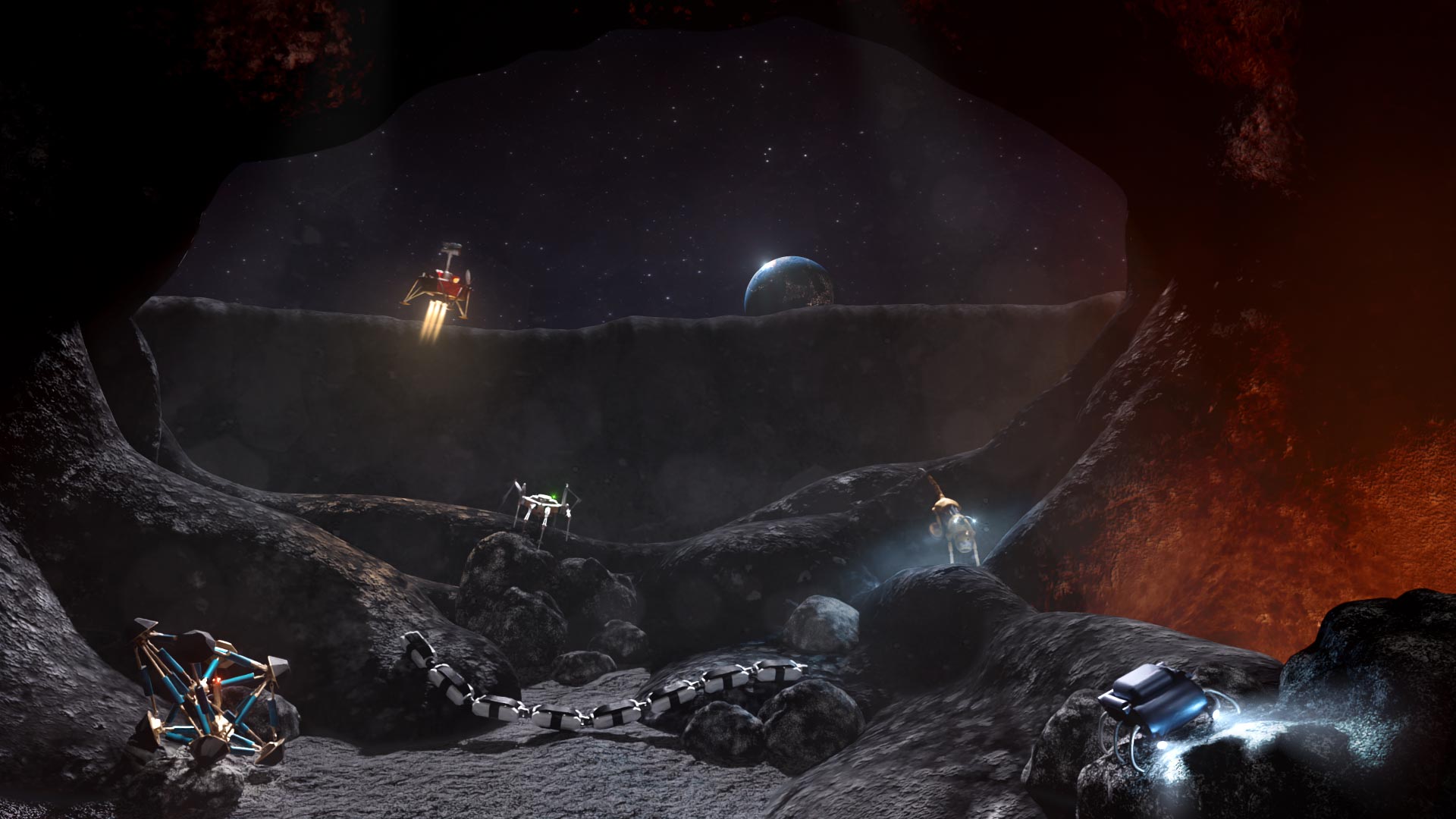
NASA’s BIG Idea Challenge invites students to create next-gen robots capable of navigating extreme lunar and Martian terrain. These mobility innovations could help Artemis missions reach previously inaccessible areas.
In 2022, university students’ robotics designs may hop, slither, crawl, balloon, tumble, levitate, or leap to victory, displaying alternative rover motion techniques during NASA’s annual Breakthrough, Innovative and Game-Changing (BIG) Idea Challenge.
Traditional wheeled rovers cannot reach many of the unexplored areas of the Moon and Mars. Student teams participating in the BIG Idea Challenge, a university-level competition sponsored by NASA and managed by the National Institute of Aerospace (NIA), will develop innovative and cost-effective robots that go beyond wheeled rovers capable of exploring other worlds. The challenge is aligned with the agency’s Artemis program goals of using innovative technologies to explore more of the lunar surface than ever before and using what we learn on the Moon to send humans to Mars.
The BIG Idea Challenge, now in its seventh year, invites university students to tackle some of the most critical needs facing space exploration and the mission capabilities that could make new discoveries possible. The challenge provides undergraduate and graduate students working with faculty advisors the opportunity to design, develop, and demonstrate their technology in a project-based program over the course of a year and a half.
Adaptive locomotive modality, or the ability to move in different ways, is integral to extreme terrain exploration on the Moon and Mars. Exploring areas that are currently inaccessible will open new opportunities for science and in-situ resource utilization (ISRU) operations. Lessons learned exploring more of the Moon will lower the costs, improve safety, and increase the performance of deep space exploration, enabling more robust Mars missions. Mobility innovations will allow NASA to respond more rapidly to evolving mission needs.
“To fully explore the Moon and Mars, NASA will need more than traditional wheeled rovers,” said Niki Werkheiser, director of technology maturation within the agency’s Space Technology Mission Directorate (STMD). “We’re looking to these university students for cutting-edge alternative ideas that will enable us to explore extreme terrestrial terrain on the Moon and later on Mars.”
Teams are invited to submit proposals for robots with new mobility solutions in operating scenarios that require access to extreme terrain categories, including, but not limited to:
- Fluffy/high-porosity regolith expected at the lunar poles
- Steep, rugged slopes (state of the art for a wheeled rover is about 30 degrees)
- Uneven terrain with possible ice content at the bottom of deep-shadowed craters
- Subterranean features, such as caves, lava tubes, and pits
Written proposal and video submission are due January 18, 2022. Teams must provide a specific mission scenario where the proposed solution might be needed, for example, the placement of navigation beacons in lava tubes on the Moon or Mars. NASA is interested in new mobility ideas that are part of an integrated robotic platform, with prototypes incorporating at least a minimal level of sensing, autonomy, and other necessary elements needed for a relevant test.
Teams of at least five and no more than 25 must be comprised of students and faculty at U.S.-based colleges and universities affiliated with their state’s Space Grant Consortium. Non-Space Grant affiliated colleges and universities may partner with a Space Grant-affiliated institution. This NASA-funded challenge provides development awards of up to $180,000 to up to eight selected teams to bring concept designs to life and share the results of their research and testing at the culminating forum in November 2022.
Unique to this year’s challenge is that selected finalist teams will be required to perform and provide results for robust proof-of-concept testing. Teams are encouraged to be creative and design their own accurate and realistically simulated testing scenarios that prove readiness to support a possible near-term lunar mission.
“This is an exciting time in space exploration,” said Mike Kincaid, associate administrator of NASA’s Office of STEM Engagement. “It’s so cool to host hands-on challenges that prepare college students for future aerospace careers. The 2022 BIG Idea Challenge theme incorporates an extra element of creativity that will undoubtedly result in fascinating ideas for NASA’s pursuit of alternative rover technologies.”
The 2022 BIG Idea Challenge is sponsored by NASA through a collaboration between STMD’s Game Changing Development program and the Office of STEM Engagement’s Space Grant project.
For full competition details, visit:
Never miss a breakthrough: Join the SciTechDaily newsletter.
Follow us on Google and Google News.