
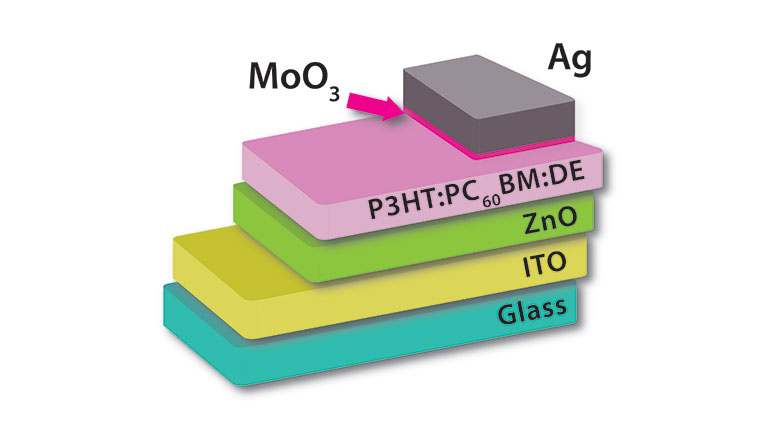
Researchers at Yale University demonstrate the use of fossilized diatoms (diatomaceous earth) to boost solar technology.
Diatoms, a kind of algae that reproduces prodigiously, have been called “the jewels of the sea” for their ability to manipulate light. Now, researchers hope to harness that property to boost solar technology.
In the lab of Andre Taylor, associate professor of chemical & environmental engineering, fossilized diatoms are being used to solve a design problem that has long plagued the development of organic solar cells. The results of their work are published in Organic Electronics.
The abundant diatoms are found in all kinds of water and even in the bark of trees, and possess a skeleton made of nanostructured silica or glass. “It’s really amazing that these things exist in nature,” said Lyndsey McMillon-Brown, a Ph.D. student in Taylor’s lab and lead author of the study. “They help trap and scatter light for the algae to photosynthesize, so we’re able to use something directly from nature and put it in a solar cell.”
These small creatures could prove to be particularly valuable for the design of solar technologies known as organic photovoltaics – a lower-cost option to conventional solar technologies. One challenge of designing these devices, though, is that they require very thin active layers (100 to 300 nanometers), which limits their efficiency in converting light to electricity. Ways to correct this include embedding nanostructures that trap and scatter light to enhance the absorption levels. These approaches, though, are too costly for large-scale production.
That’s where diatoms can help. They’ve been optimized for light absorption through billions of years of adaptive evolution. The most common type of phytoplankton found in nature, they’re cheap and can be found almost anywhere. The research team, which includes collaborators from NASA, Princeton University and Lincoln University, dispersed diatoms throughout the active layer of the solar cell. By doing so, they reduced the amount of the material needed for the active layer but maintained the same levels of electrical output.
“We were able to see what the right concentration was and how much of this material we needed to put into our solar cells to get enhancement,” McMillon-Brown said. “It’s really beneficial because the active layer materials we use are expensive and very rare.”
Although the diatoms were initially too large for the active layer, they were able to fix that with a simple grinding process. “It didn’t interrupt our existing processing steps, so it doesn’t add any complexities or challenges, and can definitely be an easy addition to existing commercialized organic solar cells,” McMillon-Brown said.
McMillon-Brown and Taylor said even better results are likely with some adjustments.
“We can use different species of diatoms and tailor it to the right size, and we can also use some of the better donor-acceptor polymers for a higher performance,” Taylor said.
McMillon-Brown said the diatoms seemed like a natural fit for her research as soon as she learned about them.
“My work is on biomimicry, so I’m always looking at existing patterns and structures in nature,” she said. “We’re always on the hunt for new patterns in nature because we believe that nature solves all our engineering problems – we just have to find the solutions.”
Reference: “Light-trapping in polymer solar cells by processing with nanostructured diatomaceous earth” by Lyndsey McMillon-Brown, Marina Mariano, YunHui L. Lin, Jinyang Li, Sara M. Hashmi, Andrey Semichaevsky, Barry P. Rand and André D. Taylor, 28 September 2017, Organic Electronics.
DOI: 10.1016/j.orgel.2017.09.009
Never miss a breakthrough: Join the SciTechDaily newsletter.
Follow us on Google and Google News.