
Close Menu
    Facebook X (Twitter) Instagram
    SciTechDaily
    • Biology
    • Chemistry
    • Earth
    • Health
    • Physics
    • Science
    • Space
    • Technology
    Facebook X (Twitter) Pinterest YouTube RSS
    SciTechDaily
    Home»Biology»Fossils Reveal the Jaw-Dropping Origins of Human Mobility
    Biology

    Fossils Reveal the Jaw-Dropping Origins of Human Mobility

    By PLOSFebruary 25, 20252 Comments3 Mins Read
    Facebook Twitter Pinterest Telegram LinkedIn WhatsApp Email Reddit
    Share
    Facebook Twitter LinkedIn Pinterest Telegram Email Reddit
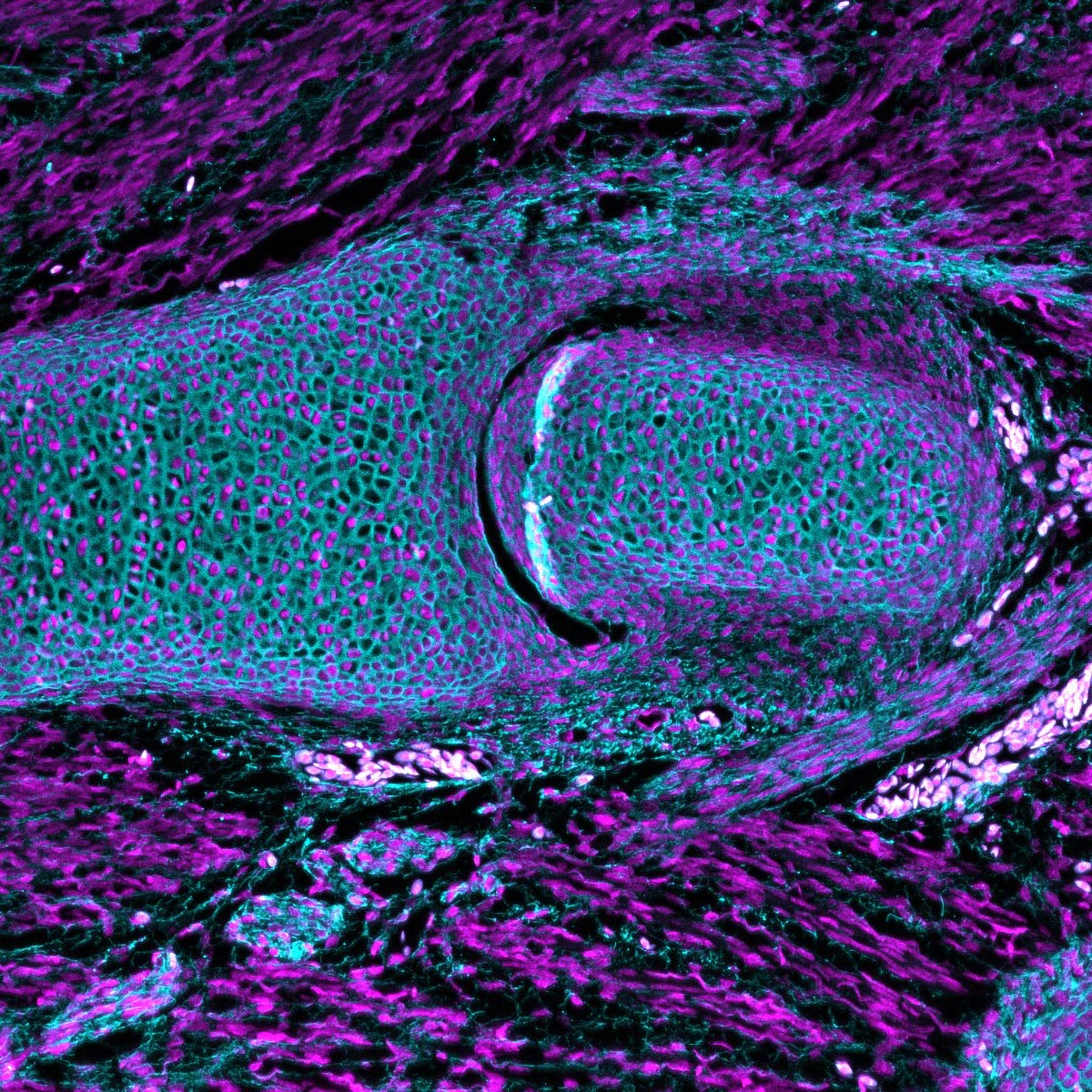
    Ollagen-2 and Nucleus Little Skate Embryo
    Immunostaining depicts collagen-2 (cyan) and nucleus (magenta) at the articulation in the little skate embryo’s pelvic joint. Credit: Neelima Sharma, University of Chicago (CC-BY 4.0)

    The ability of our skeletons to move with both flexibility and stability can be traced back to ancient jawed fish.

    Scientists studied modern cartilaginous fish, such as sharks and skates, and compared them to their jawless counterparts, like lampreys. They discovered that synovial joints — lubricated, cavitated structures found in most vertebrates — first appeared in jawed fish ancestors. Fossil evidence further supports this timeline, with the earliest known synovial joint identified in an ancient fish called Bothriolepis.

    The Ancient Origins of Our Flexible Joints

    The flexible yet sturdy design of our joints can be traced back to our earliest jawed fish ancestors, according to a study published today (February 25th) in the open-access journal PLOS Biology by Neelima Sharma of the University of Chicago and colleagues.

    Synovial joints, found in most vertebrates, allow for smooth movement and increased stability by enabling bones or cartilage to glide past each other within a lubricated cavity. These joints exist in both land vertebrates and bony fish, suggesting they originated in their common ancestors. However, the exact point in vertebrate evolution when synovial joints first appeared has remained uncertain.

    Tracing Joint Evolution in Early Vertebrates

    To explore this, Sharma and her team studied joint anatomy and development in two early vertebrate lineages: one species of jawless fish, the sea lamprey, and two species of cartilaginous fish, the bamboo shark and little skate. Their analysis found that cartilaginous fish had cavitated joints — fluid-filled spaces that enhance mobility — while lampreys did not. The researchers also discovered that cartilaginous fish share key proteins and developmental processes with synovial joints in other vertebrates. Using CT scans, they identified a similar cavitated joint in the fossilized fish Bothriolepis, the oldest known example of a synovial joint.

    Fossil Evidence Confirms Ancient Joint Origins

    Altogether, these results show that synovial joints are shared across jawed fish, but apparently absent in jawless fish, indicating that these joints first evolved in the ancestors of jawed vertebrates. This study provides critical information for research into the origins of the skeletal architecture of vertebrates, including ourselves. The authors suggest that future steps might include analysis of joint morphology in other fossil fish lineages and further comparisons between joints of jawed and jawless vertebrates to uncover more details about early joint evolution.

    The Evolutionary Impact of Mobile Joints

    The authors add, “The origin of mobile joints in our fish ancestors enabled them to move about and feed in new ways. This study shows that the developmental processes that are responsible for these joints arose deep within the fish evolutionary tree.”

    Reference: “Synovial joints were present in the common ancestor of jawed fish but lacking in jawless fish” by Neelima Sharma, Yara Haridy and Neil Shubin, 25 February 2025, PLOS Biology.
    DOI: 10.1371/journal.pbio.3002990

    Never miss a breakthrough: Join the SciTechDaily newsletter.
    Follow us on Google and Google News.

    Bones Evolution Evolutionary Biology Fish PLOS Vertebrates
    Share. Facebook Twitter Pinterest LinkedIn Email Reddit

    Related Articles

    A Surprising Genetic Discovery About How Vertebrates Emerged

    Fossil From 310 Million Years Ago Rewrites the Story of Fish Evolution

    Instant Sex Swap: How a Female Fish Becomes a Male Boss in Minutes

    Oldest Saber-Toothed Creature Found, Rewriting the Story of Mammal Evolution

    Hatching a Plan: How Fish Embryos Pick Their Own Birthday

    New Study: These Bizarre Blood-Sucking Fish Have a “Jaw-Dropping” Evolutionary Origin

    Human Y-Chromosome Has Enough Genes to Stay for Millions of Years

    Invasive Species of Asian Mussels Turns Parasites into Hosts

    Study Measures Mammalian Growth, Taking 24 Million Years to Go from Mouse to Elephant

    2 Comments

    1. Joe Black on February 27, 2025 8:35 am

      Everything is in service of the worm

      Reply
    2. Robert Burns on February 27, 2025 9:29 am

      This is much like researching one’s family tree 6, 7 generations or more out. It is scientific pursuit but far from scientific conclusion.

      Reply
    Leave A Reply Cancel Reply

    • Facebook
    • Twitter
    • Pinterest
    • YouTube

    Don't Miss a Discovery

    Subscribe for the Latest in Science & Tech!

    Trending News

    Sitting Up Straight Could Actually Help You Make Better Decisions

    Never-Before-Seen Vortices Are Swirling Across the Sun

    This Common Amino Acid May Help the Body Fight Cancer and Viruses

    Low-Protein “Longevity Diet” Linked to Fat Loss, Muscle Preservation, and Healthy Aging

    How Prehistoric Poop Changed Earth’s Ecosystems Forever

    This Fossil Upends a Decades-Old Debate About Snake Evolution

    A Blood Test Years Before Cancer May Reveal a Hidden Warning Sign

    Starlink Satellites Reveal a Hidden Atmosphere 300 Miles Above Earth

    Follow SciTechDaily
    • Facebook
    • Twitter
    • YouTube
    • Pinterest
    • Newsletter
    • RSS
    SciTech News
    • Biology News
    • Chemistry News
    • Earth News
    • Health News
    • Physics News
    • Science News
    • Space News
    • Technology News
    Recent Posts
    • A Simple Feeding Change Makes Zoo Lions Behave More Like They Do in the Wild
    • Scientists Discover a Hidden World of Fungi 1,640 Feet Beneath Michigan
    • Where Were All the Tiny Dinosaurs? Scientists May Finally Have an Answer
    • Astronomers Caught a Star Exploding Almost the Instant It Began
    • Empty Space May Not Be Empty After All: Magnetar Reveals a Bizarre Quantum Effect
    Copyright © 1998 - 2026 SciTechDaily. All Rights Reserved.
    • Science News
    • About
    • Contact
    • Editorial Board
    • Privacy Policy
    • Terms of Use

    Type above and press Enter to search. Press Esc to cancel.