
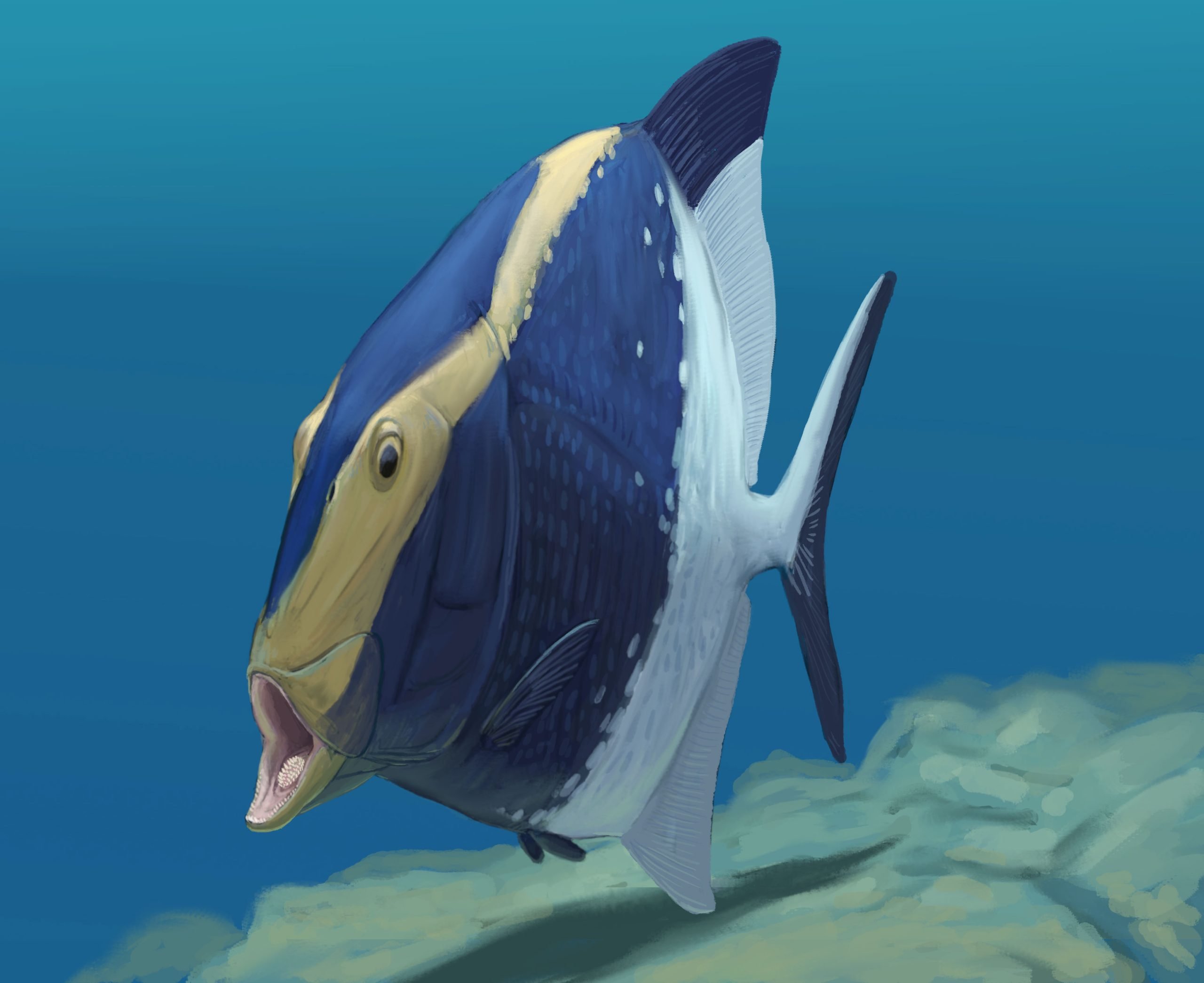
A University of Michigan researcher has discovered an early innovation in the way fish eat.
A scientist from the University of Michigan has helped uncover the earliest evidence of a tongue-like biting structure in an ancient fish. This adaptation, first appearing around 310 million years ago, marked the moment when fish began using their gill bones to change the way they captured and processed food.
The species, known as Platysomus, lived during the early Pennsylvanian period, a time when ray-finned fish were experimenting with new survival strategies, including different methods of feeding. Like many familiar species alive today (goldfish, salmon, cod, and tuna), Platysomus belonged to the ray-finned lineage.
Paleontologist Matt Friedman of the University of Michigan was part of the research team that made the discovery. They found that Platysomus possessed a plate of teeth anchored by jointed bones that also supported its gills. This plate, positioned on the floor of the mouth like a tongue, pressed directly against another plate of teeth above it. The fish used this arrangement to crush and grind its food. Evidence shows that Platysomus was the first known species to develop this specialized feeding structure, now called a tongue bite.
“One of the most powerful things we have for understanding evolution is adaptation. We can see that different kinds of creatures can adjust to similar kinds of demands in different ways,” said Friedman, director and curator of the U-M Museum of Paleontology.
“But in this case, this is cool because it’s showing us a convergent adaptation. This extinct group of fishes discovered this trick, and actually, it turns out that many different groups of fishes figured out this trick at later times. After multiple times, that tells us a little bit about what the constraints on evolutionary change might be, or if there are pathways that are easier to evolve along than others.”
Tracing Evolutionary Patterns
A general question in evolutionary biology is how evolutionary outcomes occur in different groups of animals, Friedman says. Tracking how different groups of fish evolved a similar tool (tooth plates) to tackle similar problems (eating hard stuff) can help researchers understand if these groups travel similar evolutionary pathways.
That, in turn, allows biologists to find common patterns in the origins of these structures. The research, published in the journal Biology Letters, was supported by the U.S. National Science Foundation.
The name “platysomus” means flat-bodied, and as well as being flat, the fish had a deep body. Their shape presents challenges for finding fossils that allow researchers to look at internal structures: When fish die and become entombed in mud, they tend to lie on their sides, providing a clear side view of the fish, its body shape, and some of its external structures, but compression during fossilization obscures structures inside the fish.
“They’re deep-bodied animals. They look a little like an angel fish,” Friedman said. “But not only were they flat in life, they’re typically squished even more flat as fossils. So although whole fossil fish skeletons are common, it’s often hard to extract details of the internal skeleton. Fossils probably preserve those parts, but they’re deadly flat.”
Hunting for Clues in Fish Heads
As a consequence, Friedman has spent a large part of his career scouring museum collections for uncrushed, three-dimensionally preserved fish heads that contain just this kind of internal information.
“Fish heads are a good target because they’re really complicated. They have a lot of parts, and where you have a lot of parts, you have a lot of different connections,” Friedman said. “Those connections can take different forms, and that’s the basis of the variation that we might use to try and reconstruct evolutionary history.”
Friedman and colleagues were CT scanning three-dimensional fish fossils in a UK museum when they spotted the peculiar internal gill skeletons in a uniquely uncrushed Platysomus head. They were surprised to see a series of well-developed tooth plates inside the mouth of the animal. This led them to scrutinize flattened Platysomus fossils, where painstaking digital dissections also revealed the trademark features of a tongue bite.
The fish living today that have biting plates most similar to Platysomus are bonefish, a game fish living in warm tropical and subtropical waters that mostly eat hard-shelled prey like crabs.
Friedman says the finding also points to the importance of museum collections. The key fossil that formed the basis of his study was likely collected more than 120 years ago, and had probably received little attention since then.
“There’s a popular perception that as a paleontologist, to do anything new or find anything exciting, you need to go to the field and dig up a fossil,” Friedman said. “That’s important, of course. But people have already collected a lot of fossils, and as we develop new techniques, we find ways to coax new bits of data out of materials that are already in museums.”
Reference: “Tongue-bite apparatus highlights functional innovation in a 310-million-year-old ray-finned fish” by Sam Giles, Matthew Kolmann and Matt Friedman, 31 August 2025, Biology Letters.
DOI: 10.1098/rsbl.2025.0270
Funding: U.S. National Science Foundation
Never miss a breakthrough: Join the SciTechDaily newsletter.
Follow us on Google and Google News.
1 Comment
Not a bony fish, but a late-surviving discoidal placoderm after phylogenetic analyis. Details here: https://pterosaurheresies.wordpress.com/2025/09/04/tongue-bite-apparatus-found-in-discoidal-placoderm-platysomus/