
Scientists Worldwide Can Use Ion-Based Testbed at Sandia National Laboratories
A new Department of Energy open-access quantum computing testbed is ready for the public. Scientists from Indiana University recently became the first team to begin using Sandia National Laboratories’ Quantum Scientific Computing Open User Testbed, or QSCOUT.
Quantum computers are poised to become major technological drivers over the coming decades. But to get there, scientists need to experiment with quantum machines that relatively few universities or companies have. Now, scientists can use Sandia’s QSCOUT for research that might not be possible at their home institutions, without the cost or restrictions of using a commercial testbed.
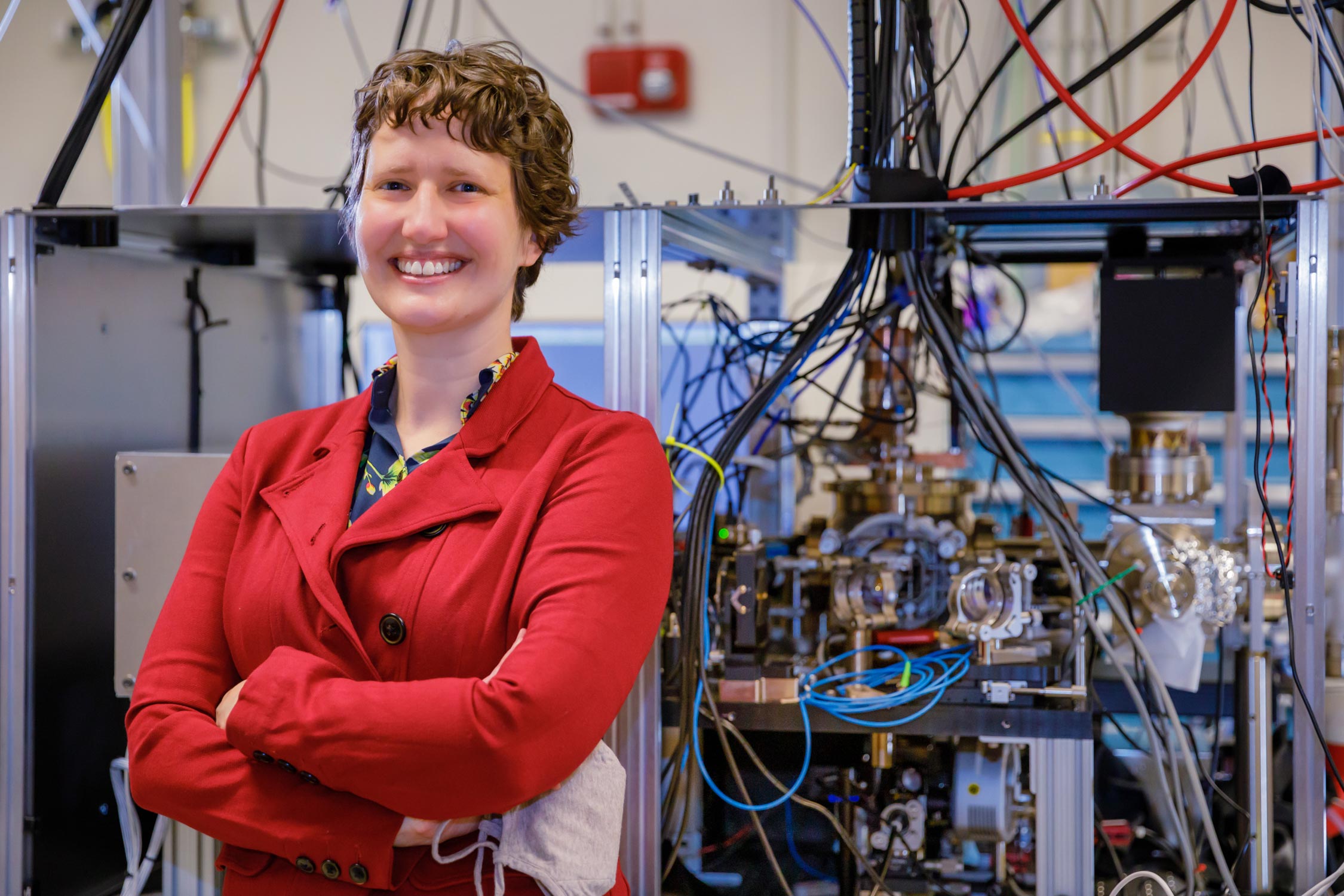
“QSCOUT serves a need in the quantum community by giving users the controls to study the machine itself, which aren’t yet available in commercial quantum computing systems. It also saves theorists and scientists from the trouble of building their own machines. We hope to gain new insights into quantum performance and architecture as well as solve problems that require quantum computation,” said Sandia physicist and QSCOUT lead Susan Clark.
She said the new testbed is a rare machine in three ways: first, as a free, open-access testbed; second, as one made with trapped ion technology; and third, as a platform that gives users an uncommon amount of control over their research.
Last month, Sandia began running the testbed’s first user experiment for scientists from Indiana University. Researchers from IBM, Oak Ridge National Laboratory, the University of New Mexico and the University of California, Berkeley, have also been selected to begin experiments soon. Their projects range from testing benchmarking techniques to developing algorithms that could someday solve problems in chemistry too complex for normal computers.
Researchers interested in using the Quantum Scientific Computing Open User Testbed are invited to sign up for notifications by emailing [email protected]. Sandia expects to select the next round of projects in the spring, subject to change.
Sandia Soliciting Proposals
Now, Sandia is getting ready for more research proposals. Anyone can submit a proposal to use QSCOUT, and computing time is free thanks to funding from the DOE Office of Science, Advanced Scientific Computing Research program. The next group of projects is expected to be selected in the spring.
On top of providing an exceptional research opportunity, QSCOUT has a rare design for a testbed. Most commercial testbeds use technology called superconducting circuits. Such machines need to be kept at ultralow temperatures, making them expensive to build and operate. But Sandia’s testbed uses what is called an ion trap instead. This means Sandia’s testbed can run at warmer temperatures. Trapped ions also yield clearer signals than circuits and hold on to information longer, enabling scientists to perform different types of experiments and compare the two platforms.
Trapped ions are held inside QSCOUT in a so-called “trap on a chip,” a flat, bow tie-shaped device, about 2 cm (0.8 inches) long, overlaid on a semiconductor chip. Three electrically charged atoms of the element ytterbium are suspended in place by radio waves and an electric field above a hairline channel that runs down the center of the device. Lasers encode information in each ion as a qubit, comparable to a bit in a conventional computer, to perform calculations.
Sandia plans to expand the system from three to 32 qubits over the next three years so scientists can perform more sophisticated tests.
QSCOUT resides at Sandia’s Microsystems Engineering, Science, and Applications complex, which also produces microelectronics for the nation’s nuclear stockpile.
Never miss a breakthrough: Join the SciTechDaily newsletter.
Follow us on Google and Google News.
4 Comments
…WOW!!!
… okay, now this part “Free Open-Access Quantum Computer” needs to sink in and I need to check with my … where and how do we actually apply but not get refused for not filling all of the questions that need to be circled,…
xABBAAA -Wow! Is exactly right. I suggest you quell a tad bit of excitement and circle what needs to be circled. Slow down and do it right the first time and you, too (maybe!) can be a part of this amazing new technology. What a gift. I am stoked to see this happening and hats off to IU for being incredibly generous to the scientific community. Bravo to all.
Keep the Chinese off.