
In the process of converting plants into fuel, the initial phase — decomposing the plant material — has consistently posed the greatest challenge. Recent research reveals that incorporating an easily renewable chemical during the pretreatment phase could, at last, render the production of advanced biofuels economically viable and carbon neutral.
For biofuels to compete with petroleum, biorefinery operations must be designed to better utilize lignin. Lignin is one of the main components of plant cell walls. It provides plants with greater structural integrity and resiliency from microbial attacks. However, these natural properties of lignin also make it difficult to extract and utilize from the plant matter, also known as biomass.
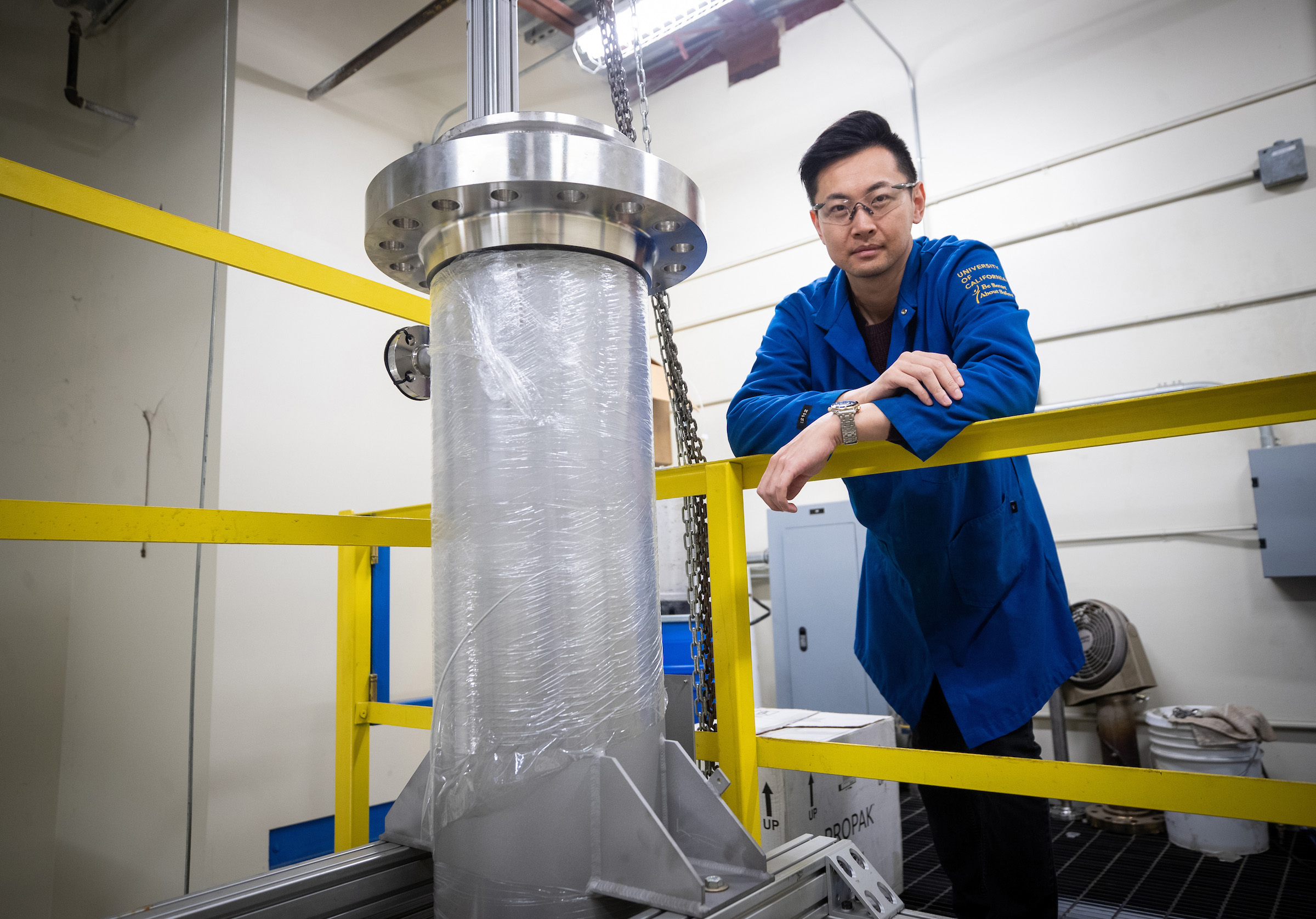
“Lignin utilization is the gateway to making what you want out of biomass in the most economical and environmentally friendly way possible,” said UC Riverside Associate Research Professor Charles Cai. “Designing a process that can better utilize both the lignin and sugars found in biomass is one of the most exciting technical challenges in this field.”
To overcome the lignin hurdle, Cai invented CELF, which stands for co-solvent enhanced lignocellulosic fractionation. It is an innovative biomass pretreatment technology.
“CELF uses tetrahydrofuran or THF to supplement water and dilute acid during biomass pretreatment. It improves overall efficiency and adds lignin extraction capabilities,” Cai said. “Best of all, THF itself can be made from biomass sugars.”
Economic and Environmental Advantages of CELF
A landmark Energy & Environmental Science paper details the degree to which a CELF biorefinery offers economic and environmental benefits over both petroleum-based fuels and earlier biofuel production methods.
The paper is a collaboration between Cai’s research team at UCR, the Center for Bioenergy Innovation managed by Oak Ridge National Laboratories, and the National Renewable Energy Laboratory, with funding provided by the U.S. Department of Energy’s Office of Science. In it, the researchers consider two main variables: what kind of biomass is most ideal and what to do with the lignin once it’s been extracted.
First-generation biofuel operations use food crops like corn, soy, and sugarcane as raw materials, or feedstocks. Because these feedstocks divert land and water away from food production, using them for biofuels is not ideal.
Second-generation operations use non-edible plant biomass as feedstocks. An example of biomass feedstocks includes wood residues from milling operations, sugarcane bagasse, or corn stover, all of which are abundant low-cost byproducts of forestry and agricultural operations.
According to the Department of Energy, up to a billion tons per year of biomass could be made available for the manufacture of biofuels and bioproducts in the US alone, capable of displacing 30% of our petroleum consumption while also creating new domestic jobs.
Selecting Optimal Feedstocks and Achieving Economic Benefits
Because a CELF biorefinery can more fully utilize plant matter than earlier second-generation methods, the researchers found that a heavier, denser feedstock like hardwood poplar is preferable over less carbon-dense corn stover for yielding greater economic and environmental benefits.
Using poplar in a CELF biorefinery, the researchers demonstrate that sustainable aviation fuel could be made at a break-even price as low as $3.15 per gallon of gasoline-equivalent. The current average cost for a gallon of jet fuel in the U.S. is $5.96.
The U.S. government issues credits for biofuel production in the form of renewable identification number credits, a subsidy meant to bolster domestic biofuel production. The tier of these credits issued for second-generation biofuels, the D3 tier, is typically traded at $1 per gallon or higher. At this price per credit, the paper demonstrates that one can expect a rate of return of over 20% from the operation.
“Spending a little more for a more carbon-rich feedstock like poplar still yields more economic benefits than a cheaper feedstock like corn stover, because you can make more fuel and chemicals from it,” Cai said.
The paper also illustrates how lignin utilization can positively contribute to overall biorefinery economics while keeping the carbon footprint as low as possible. In older biorefinery models, where biomass is cooked in water and acid, the lignin is mostly unusable for more than its heating value.
“The older models would elect to burn the lignin to supplement heat and energy for these biorefineries because they could mostly only leverage the sugars in the biomass – a costly proposition that leaves a lot of value off the table,” said Cai.
In addition to better lignin utilization, the CELF biorefinery model also proposes to produce renewable chemicals. These chemicals could be used as building blocks for bioplastics and food and drink flavoring compounds. These chemicals take up some of the carbon in the plant biomass that would not get released back into the atmosphere as CO2.
“Adding THF helps reduce the energy cost of pretreatment and helps isolate lignin, so you wouldn’t have to burn it anymore. On top of that, we can make renewable chemicals that help us achieve a near-zero global warming potential,” Cai said. “I think this moves the needle from Gen 2 biofuels to Gen 2+.”
In light of the team’s recent successes, the Department of Energy’s Bioenergy Technology Office has awarded the researchers a $2 million grant to build a small-scale CELF pilot plant at UCR. Cai hopes that demonstrating the pilot plant will lead to larger-scale investment in the technology, as harnessing energy from fossil fuels adds to global warming and hurts the planet.
“I began this work more than a decade ago because I wanted to make an impact. I wanted to find a viable alternative to fossil fuels and my colleagues and I have done that,” Cai said. “Using CELF, we have shown it is possible to create cost-effective fuels from biomass and lignin and help curb our contribution of carbon emissions into the atmosphere.”
Reference: “Economics and global warming potential of a commercial-scale delignifying biorefinery based on co-solvent enhanced lignocellulosic fractionation to produce alcohols, sustainable aviation fuels, and co-products from biomass” by Bruno Colling Klein, Brent Scheidemantle, Rebecca J. Hanes, Andrew W. Bartling, Nicholas J. Grundl, Robin J. Clark, Mary J. Biddy, Ling Tao, Cong T. Trinh, Adam M. Guss, Charles E. Wyman, Arthur J. Ragauskas, Erin G. Webb, Brian H. Davison and Charles M. Cai, 13 December 2023, Energy & Environmental Science.
DOI: 10.1039/D3EE02532B
Never miss a breakthrough: Join the SciTechDaily newsletter.
Follow us on Google and Google News.
2 Comments
the jet fuel price stated in this article seems to be wrong
Might have been correct at the time of writing of the article. Now it’s USD 2.54.
https://www.iata.org/en/publications/economics/fuel-monitor/
However, an international tax agreement could put a basement price of say USD 6 on fossil fuels per gallon. This would generate revenues of about 5 billion USD for the U.S. The same should be done for shipping.