

New study reveals Megalodon’s elongated body form, challenging earlier views of its size and shape.
A new scientific study shows that the prehistoric gigantic shark, Megalodon or megatooth shark, which lived roughly 15-3.6 million years ago nearly worldwide, was a more slender shark than previous studies have suggested.
Formally called Otodus megalodon, it is typically portrayed as a super-sized, monstrous shark in novels and sci-fi films, including “The Meg.” Previous studies suggest the shark likely reached lengths of at least 50 to 65 feet (15 to 20 meters). However, O. megalodon is largely known only from its teeth and vertebrae in the fossil record. Thus, the modern great white shark (Carcharodon carcharias) has traditionally been used as a model for the body form of O. megalodon in previous studies.
Insights From Fossils
The new study published in the journal “Palaeontologia Electronica,” however, illuminates that O. megalodon had a body form that was more elongated than the modern great white shark. “The remarkably simple evidence that O. megalodon had a more slender body than the great white shark was hidden in plain sight,” said Kenshu Shimada, DePaul University paleobiology professor, a co-leader and the senior author of the new study.
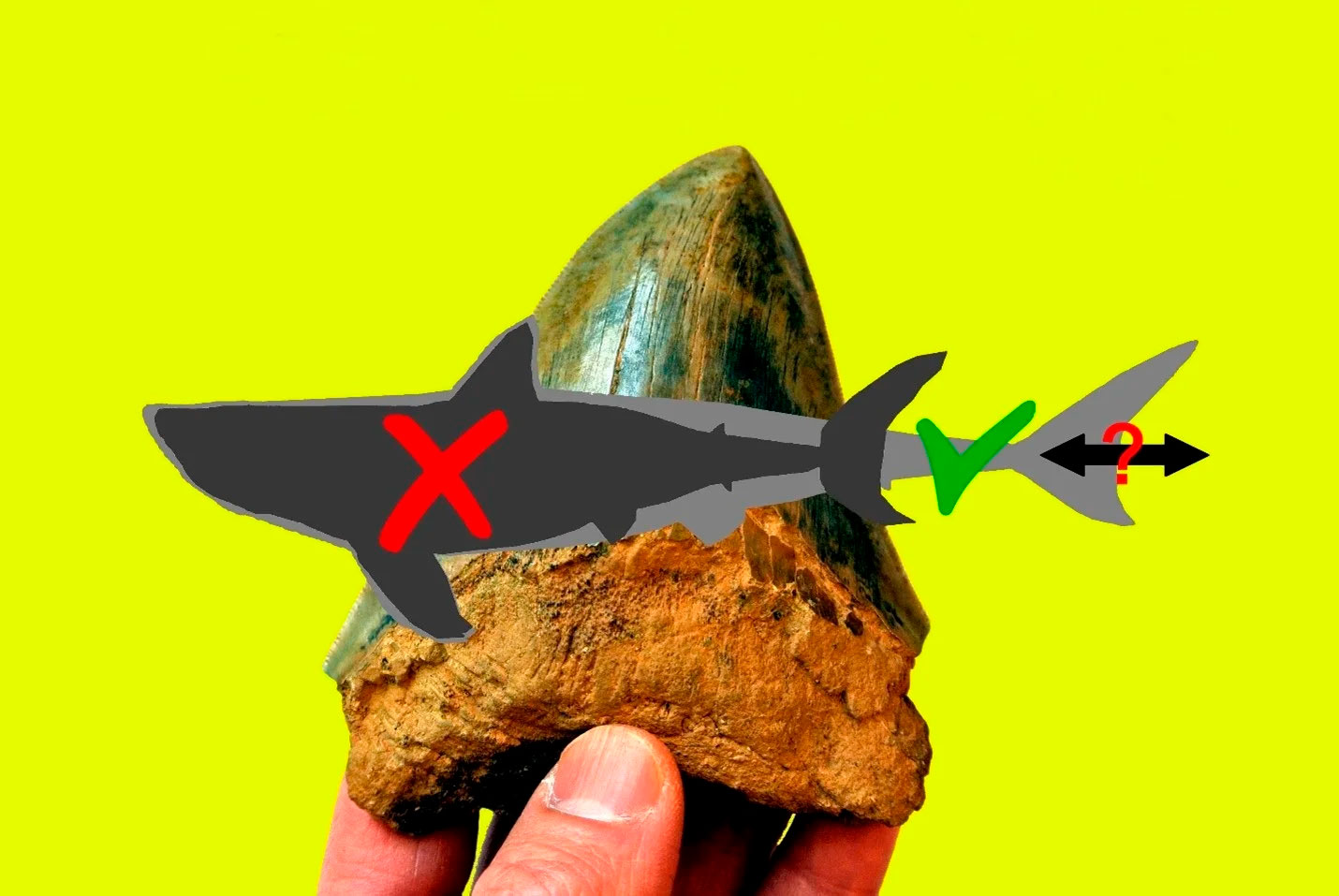
A previously described, incomplete set of fossil vertebrae from an O. megalodon individual was reported to be 11.1 m in total combined vertebral length. However, the exact same fossil individual was estimated to be only 9.2 m in total length, including the head, in yet another previous study extrapolated from the quantitative relationship between the diameters of the largest vertebrae and body lengths measured from multiple modern great white sharks. “It was a ‘eureka-moment’ when our research team realized the discrepancy between the two previously published lengths for the same Megalodon specimen,” added Shimada.
A Breakthrough in Shark Paleobiology
“The new study strongly suggests that the body form of O. megalodon was not merely a larger version of the modern great white shark,” noted the other co-leader Phillip Sternes, who studied with Shimada and earned his master’s degree from DePaul. Sternes, the first author of the study, is now a Ph.D. candidate at the University of California, Riverside.
“Even though it remains uncertain exactly how long the body of O. megalodon was elongated relative to the great white shark, this new finding marks a major scientific breakthrough in the quest to decipher what Megalodon looked like,” described Sternes.
The research team of the new study consists of 26 shark experts including Sternes and Shimada, representing 29 academic institutions around the globe, including the U.K., Austria, Italy, Japan, Mexico, Brazil, France, and Australia, as well as the U.S. The international team also includes Jake Wood, who was also one of Shimada’s master’s students.
“Moving forward, any meaningful discussion about the body form of O. megalodon would require the discovery of at least one complete, or nearly complete, skeleton of the species in the fossil record,” noted Wood.
“Despite the major scientific advancement in our new study, the fact that we still don’t know exactly how O. megalodon looked keeps our imagination going,” Shimada said. “The continued mystery like this makes paleontology, the study of prehistoric life, a fascinating and exciting scientific field.”
Reference: “White shark comparison reveals a slender body for the extinct megatooth shark, Otodus megalodon (Lamniformes: Otodontidae)” by Phillip C. Sternes, Patrick L. Jambura, Julia Türtscher, Jürgen Kriwet, Mikael Siversson, Iris Feichtinger, Gavin J.P. Naylor, Adam P. Summers, John G. Maisey, Taketeru Tomita, Joshua K. Moyer, Timothy E. Higham, João Paulo C.B. da Silva, Hugo Bornatowski, Douglas J. Long, Victor J. Perez, Alberto Collareta, Charlie Underwood, David J. Ward, Romain Vullo, Gerardo González-Barba, Harry M. Maisch IV, Michael L. Griffiths, Martin A. Becker, Jake J. Wood and Kenshu Shimada, January 2024, Palaeontologia Electronica.
DOI: 10.26879/1345
This work was partially supported by a U.S. National Science Foundation grant (Award Number 1830858) and DePaul University’s University Research Council Competitive Research Grant awarded to Kenshu Shimada.
Never miss a breakthrough: Join the SciTechDaily newsletter.
Follow us on Google and Google News.