
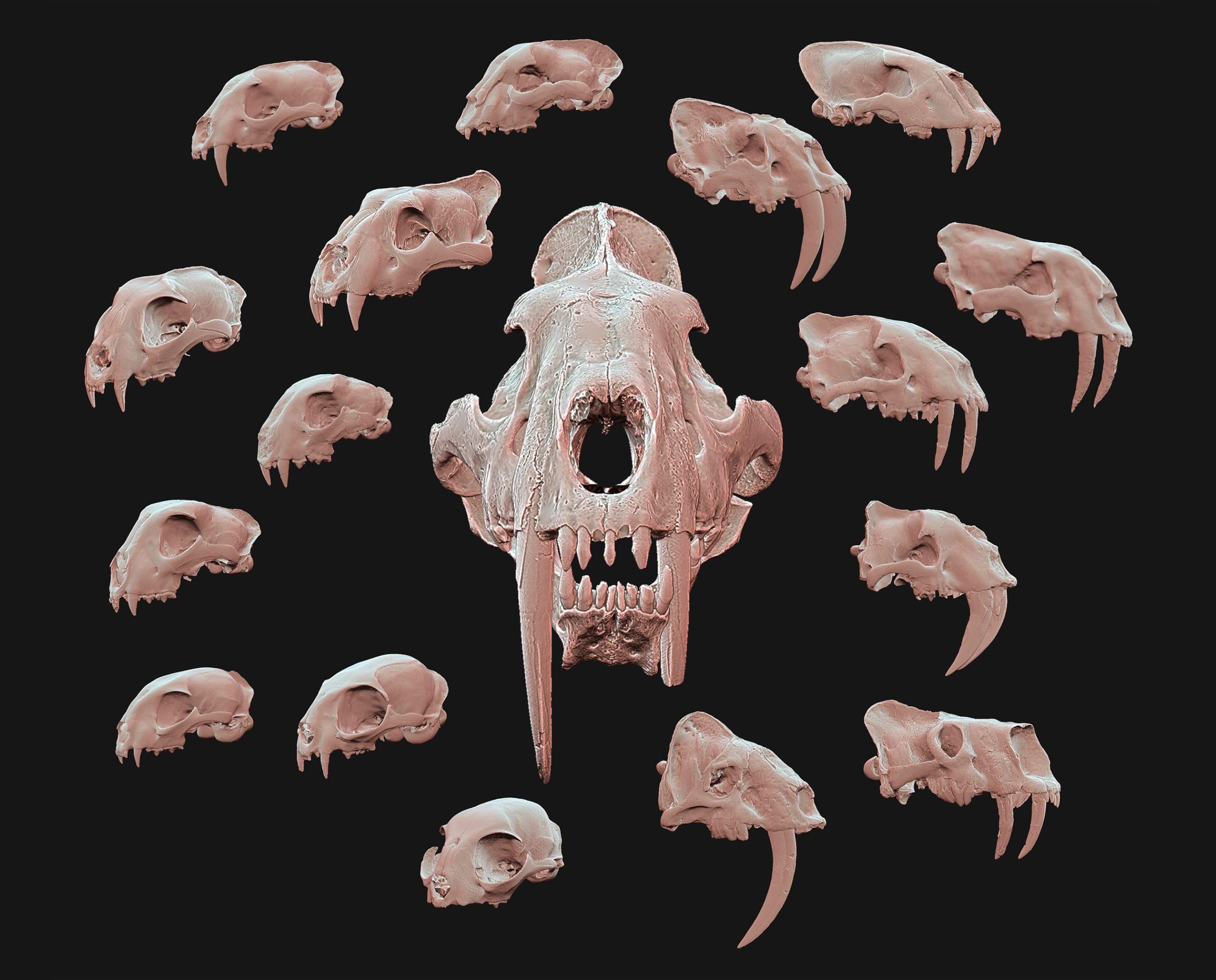
How did sabre-toothed tigers acquire their long upper canine teeth?
In a groundbreaking study, an international team of scientists explored the evolutionary development of sabre teeth, revealing a complex continuum of cranial forms and accelerated evolutionary rates in sabre-toothed species. This study provides insights into the decline of these predators and broader evolutionary trends, enhancing our understanding of Earth’s past and the mechanisms of evolutionary convergence.
Groundbreaking Study on Sabre Teeth Evolution
Sabre teeth, those iconic elongated upper canine teeth, have long fascinated both scientists and the general public, notably because they have appeared several times in the fossil record, including two particularly well-known lineages of sabre-toothed tigers: the felids (the family of our domestic cats, lions, tigers, etc.) and the nimravids (a completely extinct family). However, the process by which these lineages acquired their elongated upper canines remains rather unclear.
Detailed Analysis of Fossil and Modern Species
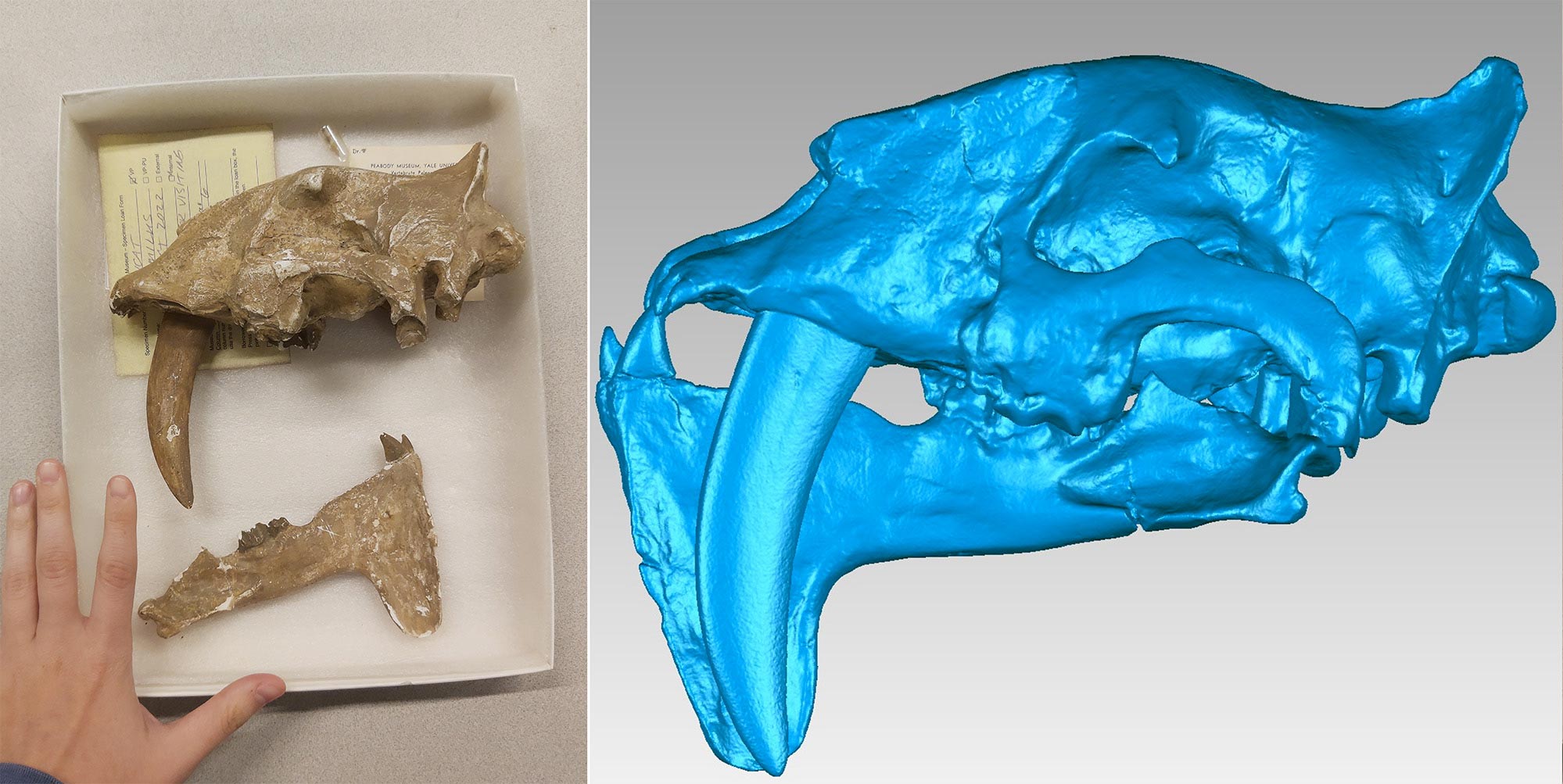
Narimane Chatar, lead author of the study, who completed her doctorate at the EDDy Lab at the University of Liège and is now a post-doctoral fellow at UC Berkeley in the United States, has led an ambitious study to uncover the secrets of sabre tooth evolution. Using state-of-the-art 3D scanners and analytical methods, the team meticulously collected and analyzed data from a diverse set of current and extinct species.
“We quantified the shape of 99 mandibles and 91 skulls, from different eras and continents, giving us a better understanding of the evolution of these animals,” explains Dr. Chatar. “Unlocking the secrets of sabre tooth evolution not only enriches our understanding of the Earth’s past, but also documents the mechanisms leading to evolutionary convergence,” says Professor Valentin Fischer, Director of the EDDyLab at ULiège.
Surprising Findings in Sabre Tooth Evolution
The study revealed some surprising results. The first is that rather than contrasting two distinct cranial morphologies in species with elongated upper canines and those with short teeth, there is instead a continuum of form linking the smallest present-day cats and their extinct sabre-toothed counterparts.
“From a morphological point of view, the skull of a present-day small cat is just as strange and modified as that of a large sabre-toothed felid,” says Dr. Margot Michaud, a researcher at the University of French Guyana in Cayenne. These are therefore the two extremes of a continuum of forms that feline predators have seen evolve over geological time.
“Our study suggests that what we often think of as examples of evolutionary patterns in textbooks are actually simplified for educational purposes. However, when we immerse ourselves in statistical analyses, we discover much more complex scenarios in these cases, as suggested by the results of our convergence tests,” explains Davide Tamagnini, post-doctoral researcher at the University of Rome La Sapienza.
The second surprise concerns the path taken by evolution to produce sabre-toothed species. In fact, the team’s work has revealed that sabre-toothed species show faster rates of morphological evolution at the start of their evolutionary history than species with shorter canines.
“Among other fascinating discoveries, we have shown that craniomandibular integration in sabre-toothed species is reduced, facilitating greater adaptability and diversification in the jaw and cranial morphology,” points out Margot Michaud.
Thus, rapid morphological diversification and a fairly plastic skull have been identified as two key components that facilitated the emergence of elongated upper canines in both felids and nimravids. “As a result, there appears to be a common recipe for evolving into sabre-toothed feline-like predators,” says Dr. Chatar.
Evolutionary Trends and Implications
Finally, the team’s research highlighted the decline of sabre-toothed forms as well as the broader trends of feline-like predators over the course of their evolutionary history. Despite the relatively recent extinction of sabre-toothed forms ‘only’ a few thousand years ago, feline predators have in fact been in decline since the Miocene epoch (between -23 and -5 million years ago).
“Some of these feline predators, particularly the sabre-toothed species, rapidly occupied fairly specialized niches, which made them more susceptible to extinction,” explains Dr. Tamagnini.
This phenomenon, known as ‘ratchet’ or macroevolutionary ratchet, has been proposed as a potential driver for the decline of certain groups, where evolution favors the loss of early generalized forms, leading to the emergence of more specialized, but also more vulnerable, forms later in the history of the lineage.
“Predators have their own evolutionary pathways and risks of extinction. Studying how ancient predators prospered and declined provides us with information about the possible futures of our ecosystems,” concludes Professor Fischer.
Reference: “Evolutionary patterns of cat-like carnivorans unveil drivers of the sabertooth morphology” by Narimane Chatar, Margot Michaud, Davide Tamagnini and Valentin Fischer, 16 May 2024, Current Biology.
DOI: 10.1016/j.cub.2024.04.055
Never miss a breakthrough: Join the SciTechDaily newsletter.
Follow us on Google and Google News.