

Perseverance is on a thrilling hunt across Mars’ Jezero Crater rim, exploring mysterious light and dark rock layers at Witch Hazel Hill.
After analyzing fine-grained light rocks at Main River, the team set their sights on coarser, dark-toned rocks — rich with intriguing spherules that could reveal secrets of ancient Martian processes. From tantalizing but tricky sites like Puncheon Rock and Wreck Apple, to surprising findings at Port Anson, the rover’s journey is packed with discoveries. Now, fresh data from a promising abrasion at Hare Bay could finally unlock new insights into Mars’ rocky past.
Exploring Witch Hazel Hill’s Layered Mysteries
Perseverance has been actively exploring the lower slopes of “Witch Hazel Hill,” a rocky outcrop exposed along the rim of Jezero Crater. This outcrop features alternating light and dark layers, and the team has been working to understand their composition and the relationship between them.
A few weeks ago, we sampled one of the light-toned layers at a site called “Main River” and found it was made up of very small clasts—fragments of rocks or minerals. Since then, we’ve discovered that the darker layers generally consist of larger clasts compared to the lighter ones. This insight has led us to search for a place where we could collect a sample of the coarser-grained material. Some of these coarser rocks also contain spherules, which are of particular interest because they offer important clues about the processes that formed these layered deposits.
Chasing Clues in Dark Layers
Perseverance first investigated a dark layer at “Puncheon Rock” by performing an abrasion. We then examined another dark layer at “Wreck Apple,” near “Sally’s Cove,” but were unable to find a surface suitable for abrasion. While the team continued searching for better locations to study these coarse-grained rocks and spherules, Perseverance drove south toward a promising new site: “Port Anson.”
Port Anson’s Surprising Discoveries
Port Anson was intriguing because, from orbit, it showed a clear contact between the light layers of Witch Hazel Hill and a distinct unit below it. And, although the rocks below the Port Anson contact do show interesting compositional differences with those of Witch Hazel Hill, they weren’t the coarse-grained rocks we were looking for. We still performed an abrasion there, at Strong Island, before driving back up north for another attempt at investigating the coarser-grained rocks.
Hopes High at Hare Bay
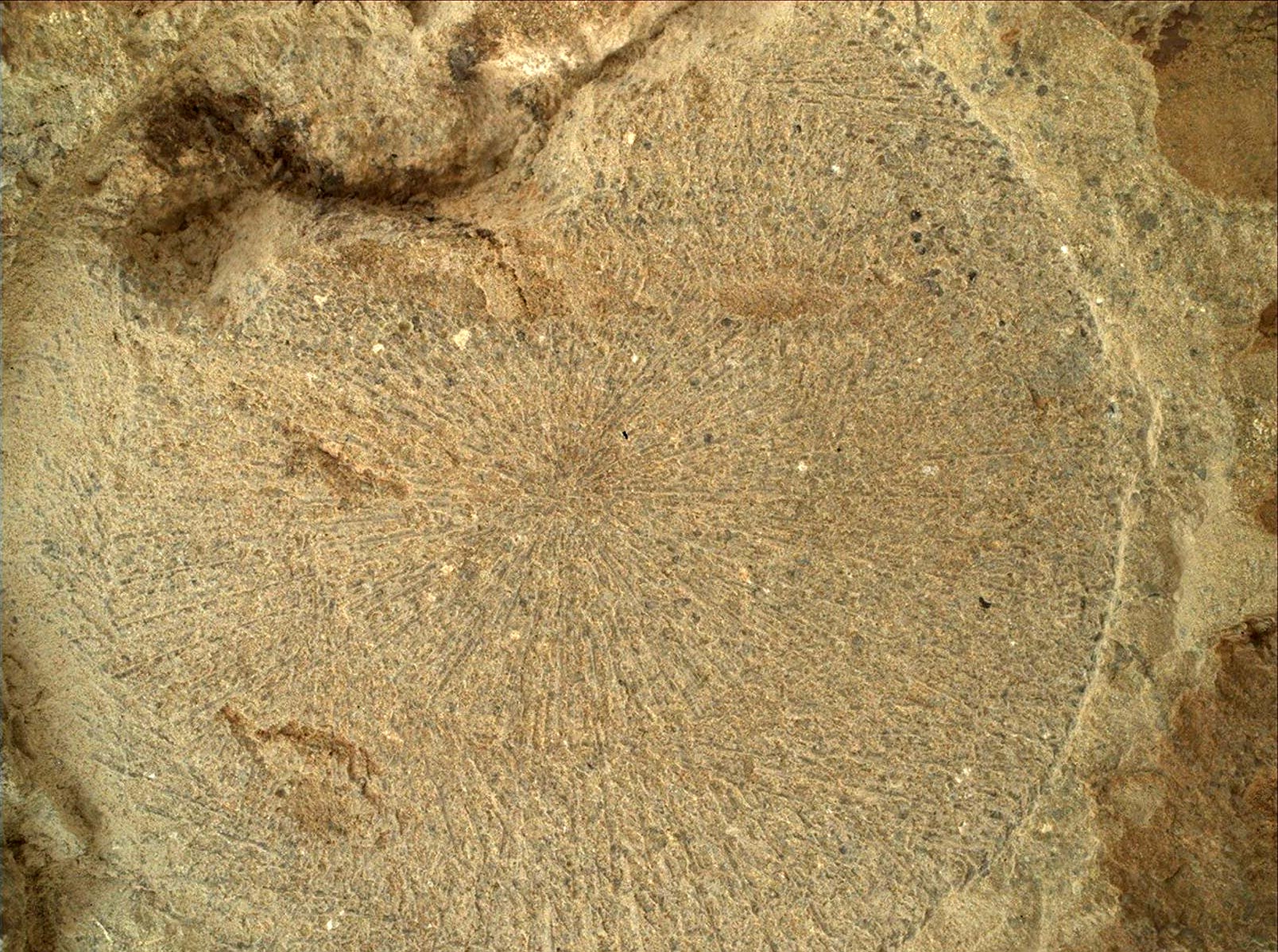
We aimed for “Pine Pond,” which neighbors “Dennis Pond,” to abrade at “Hare Bay.” With the data just coming down over the weekend, the team will be hard at work to figure out if we captured the coarse grains and spherules, and if it is representative of rocks we have seen before or not. The image below is a close-up of this most recent abrasion patch at Hare Bay — what do you think? Stay tuned to find out!
Written by Eleanor Moreland, Ph.D. Student Collaborator at Rice University
Never miss a breakthrough: Join the SciTechDaily newsletter.
Follow us on Google and Google News.