

Perseverance just stumbled upon one of Mars’ weirdest rocks yet—a formation covered in dark, spherical shapes with mysterious textures that have scientists buzzing.
While similar Martian spheres have been seen before, this one, dubbed “St. Pauls Bay,” stands out. Could it be remnants of volcanic activity, groundwater processes, or even a cosmic impact? Determining its origin could reshape our understanding of Mars’ geological past.
Discovery of a Bizarre Rock Formation
The Perseverance science team was recently intrigued by a highly unusual rock – one that appears to be made up of hundreds of tiny, millimeter-sized spheres. Now, the team is working to understand how these curious features formed.
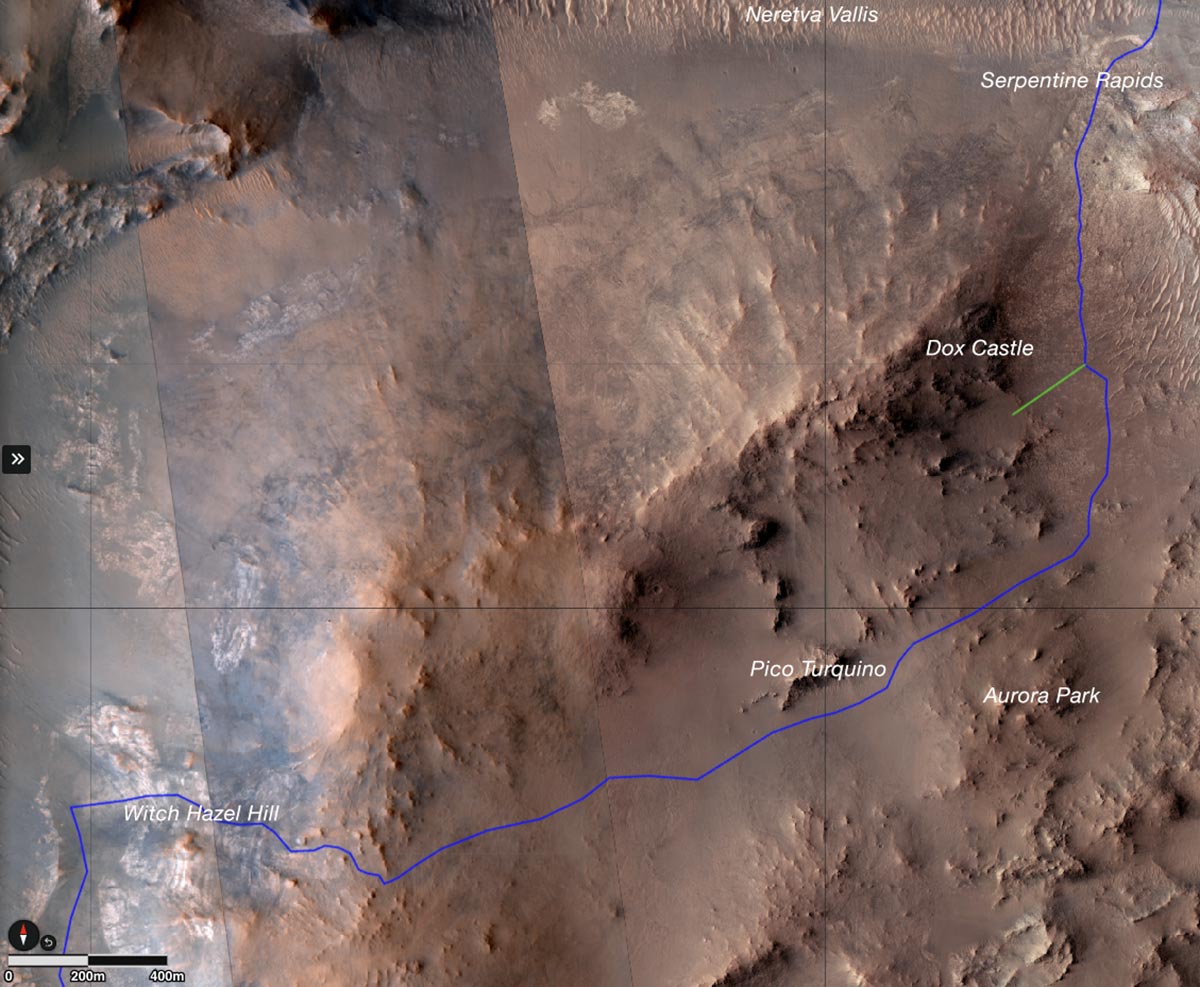
The discovery happened at Broom Point, a location on the lower slopes of Witch Hazel Hill, along the rim of Jezero Crater. Perseverance arrived there two weeks earlier to investigate a series of light- and dark-toned rock layers first spotted from orbit. Just last week, the rover successfully abraded and sampled one of the light-toned beds. It was from this sampling site that the rover noticed a nearby rock with a remarkably strange texture.
A Rock Unlike Any Other
That rock, now named “St. Pauls Bay,” is filled with dark gray, spherical features – some round, some more elongated or elliptical, and some with sharp, angular edges that may be fragments of broken spheres. A few even contain tiny pinholes. What kind of geologic process could create such a variety of unusual shapes?

Martian Spheres: A Longstanding Mystery
This isn’t the first time strange spheres have been spotted on Mars. In 2004, the Mars Exploration Rover Opportunity spotted so-called, “Martian Blueberries” at Meridiani Planum, and since then, the Curiosity rover has observed spherules in the rocks of Yellowknife Bay at Gale crater.
Just a few months ago, Perseverance itself also spied popcorn-like textures in sedimentary rocks exposed in the Jezero crater inlet channel, Neretva Vallis. In each of these cases, the spherules were interpreted as concretions, features that formed by interaction with groundwater circulating through pore spaces in the rock. Not all spherules form this way, however.
They also form on Earth by rapid cooling of molten rock droplets formed in a volcanic eruption, for instance, or by the condensation of rock vaporized by a meteorite impact.
The Clues Beneath the Surface
Each of these formation mechanisms would have vastly different implications for the evolution of these rocks, so the team is working hard to determine their context and origin. St. Pauls Bay, however, was float rock — a term used by geologists to describe something that is not in place.
The team is now working to link the spherule-rich texture observed at St. Pauls Bay to the wider stratigraphy at Witch Hazel Hill, and initial observations have provided tantalizing indications that it could be linked to one of the dark-toned layers identified by the team from orbit.
Placing these features in a geologic context will be critical for understanding their origin, and determining their significance for the geological history of the Jezero crater rim and beyond!
Written by Alex Jones, Ph.D. candidate at Imperial College London
Never miss a breakthrough: Join the SciTechDaily newsletter.
Follow us on Google and Google News.
17 Comments
We,ll never know unless someone goes n finds out for sure what’s up there on that dead planet ?
I’m certain the spherules were formed when Mars had an active magnetic field. I believe the author should have stated as much.
> I’m certain the spherules were formed when Mars had an active magnetic field.
Why?
Why should you expect the NASA press agency (by way of a UK PhD candidate) state your unknown whims instead of trying to put some information on the science to the public?
obviously it has something to do with the vacuum of mars’ atmosphere; they are small nodules of expansion due to a hot rock cooling in a vacuum. we wouldn’t see such things on earth
Mars has a thin atmosphere, it’s not a vacuum.
Not a space-vacuum.
It would technically count as a “medium vacuum” in lab-settings; 1 to 25 Torr
Obviously not. Mars has a thin atmosphere, it’s not a vacuum.
Those didn’t form on Mars. Meteor? The thin atmosphere wouldn’t make a meteor deteriorate like ones coming into earth.
They don’t need to have formed on Mars, but it is a more likely prior. And they have found similar concretions before.
Looks like a bit Martian made insulating construction material to me.
I’m surprised that a science oriented website would discuss a rock and not use input from a geologist or mineralogist or mineral collector. The description of the rock having “spherules” is comical as no one involved with rocks and minerals would describe it this way. Also, the rock appears to be similar to some forms of hematite/goethite commonly found on Earth. Rocks on earth commonly have this feature and I’ve never seen it described as spherules. Mammillary or botryoidal – yes, spherules – never.
And yet NASA’s source material uses that word. https://science.nasa.gov/blog/shocking-spherules/
It is an established term for the NASA rover missions.
“Martian spherules (also known as hematite spherules, blueberries, & Martian blueberries) are small spherules (roughly spherical pebbles) that are rich in an iron oxide (grey hematite, α-Fe2O3) and are found at Meridiani Planum (a large plain on Mars) in exceedingly large numbers. These spherules were discovered on the Martian day that NASA’s Mars Exploration Rover Opportunity landed at Meridiani Planum. (At NASA’s Mission Control building that was January 24, 2004.) They are grey but look bluish next to the ubiquitous rusty reds on Mars, and since the first spherules found in Eagle Crater were 3–6 mm in diameter, the Opportunity team quickly called them “blueberries”.” -“Martian spherules”, Wikipedia
Alex Jones Imperial College bio tells us he has field geology experience.
… has field geology experience and interested in using that to reconstruct the emplacement setting of rock units that Perseverance sees.
“Determining its origin could reshape our understanding of Mars’ geological past.” Really! Really! How about we take a chill pill. Iron Concretions are probably larger in size but are known to be volcanic in origin and except for their size, somewhat similar. It’s most likely a natural (for Mars) geological event. It seems that the smallest, slightest new thing we discover is going to change the meaning of life, the Universe and everything. Except we already know the answer is 42…
I don’t see anything that says the find can’t reshape understanding – any find have the potential to do that. But this was a neat find!