

On Mars, swirling columns of dust—known as dust devils—regularly roam the landscape, sometimes colliding in dramatic displays like one recently captured by NASA’s Perseverance rover. In a rare moment, the rover filmed a large dust devil overtaking a smaller one in the Jezero Crater.
These short-lived mini-tornadoes play a major role in Martian weather and are key indicators of atmospheric behavior. Despite being unpredictable, scientists are learning to better anticipate and study them, uncovering more about the Red Planet’s dynamic surface conditions.
Dust Devils Clash on Mars
A striking sequence from NASA’s Perseverance Mars rover shows one Martian dust devil overtaking and absorbing a smaller one. The video, made from images taken by the rover’s navigation camera, captures this rare interaction between two swirling columns of dust, features that are surprisingly common across the Red Planet.
The footage was part of an imaging experiment by the rover’s science team aimed at studying the dynamic behavior of Mars’ atmosphere. At the time, Perseverance was about 0.6 miles (1 kilometer) away from the action. The larger dust devil measured roughly 210 feet (65 meters) wide, while the smaller one trailing behind was about 16 feet (5 meters) wide. Two additional dust devils appear in the background, adding to the drama of the scene, which was recorded on January 25 at a site on the western rim of Jezero Crater known as “Witch Hazel Hill.”

Fiendish Vortices and Their Fate
“Convective vortices — aka dust devils — can be rather fiendish,” said Mark Lemmon, a Perseverance scientist at the Space Science Institute in Boulder, Colorado. “These mini-twisters wander the surface of Mars, picking up dust as they go and lowering the visibility in their immediate area. If two dust devils happen upon each other, they can either obliterate one another or merge, with the stronger one consuming the weaker.”
Dust devils are formed by rising and rotating columns of warm air. Air near the planet’s surface becomes heated by contact with the warmer ground and rises through the denser, cooler air above. As other air moves along the surface to take the place of the rising warmer air, it begins to rotate. When the incoming air rises into the column, it picks up speed like a spinning ice skater bringing their arms closer to their body. The air rushing in also picks up dust, and a dust devil is born.
While exploring the rim of Jezero Crater on Mars, NASA’s Perseverance rover captured new images of multiple dust devils in January 2025. These captivating phenomena have been documented for decades by the agency’s Red Planet robotic explorers. Credit: NASA/JPL-Caltech/LANL/CNES/CNRS/INTA-CSIC/Space Science Institute/ISAE-Supaero/University of Arizona
Why These Twisters Matter
“Dust devils play a significant role in Martian weather patterns,” said Katie Stack Morgan, project scientist for the Perseverance rover at NASA’s Jet Propulsion Laboratory in Southern California. “Dust devil study is important because these phenomena indicate atmospheric conditions, such as prevailing wind directions and speed, and are responsible for about half the dust in the Martian atmosphere.”
Since landing in 2021, Perseverance has imaged whirlwinds on many occasions, including one on September 27, 2021, where a swarm of dust devils danced across the floor of Jezero Crater and the rover used its SuperCam microphone to record the first sounds of a Martian dust devil.
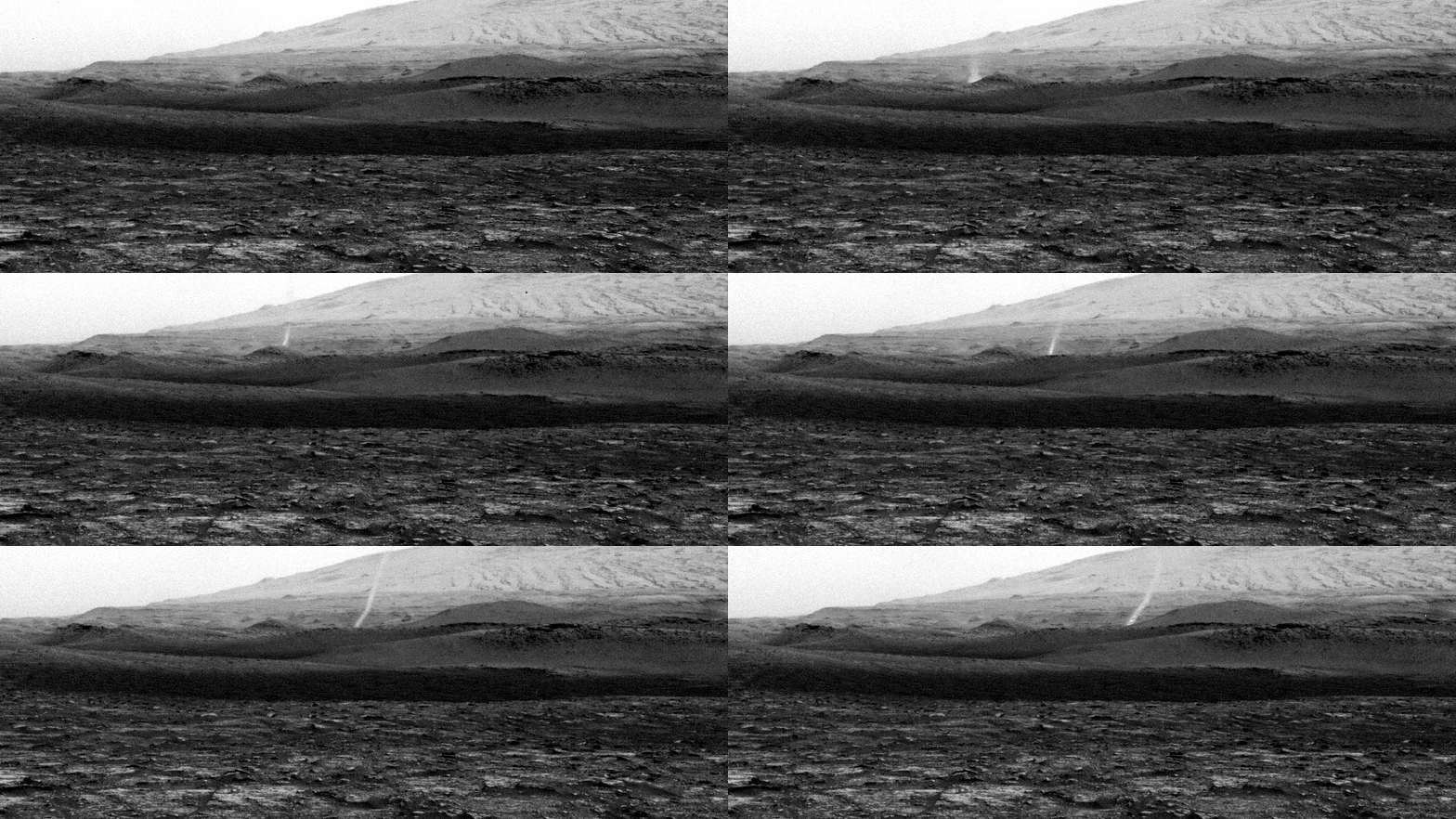
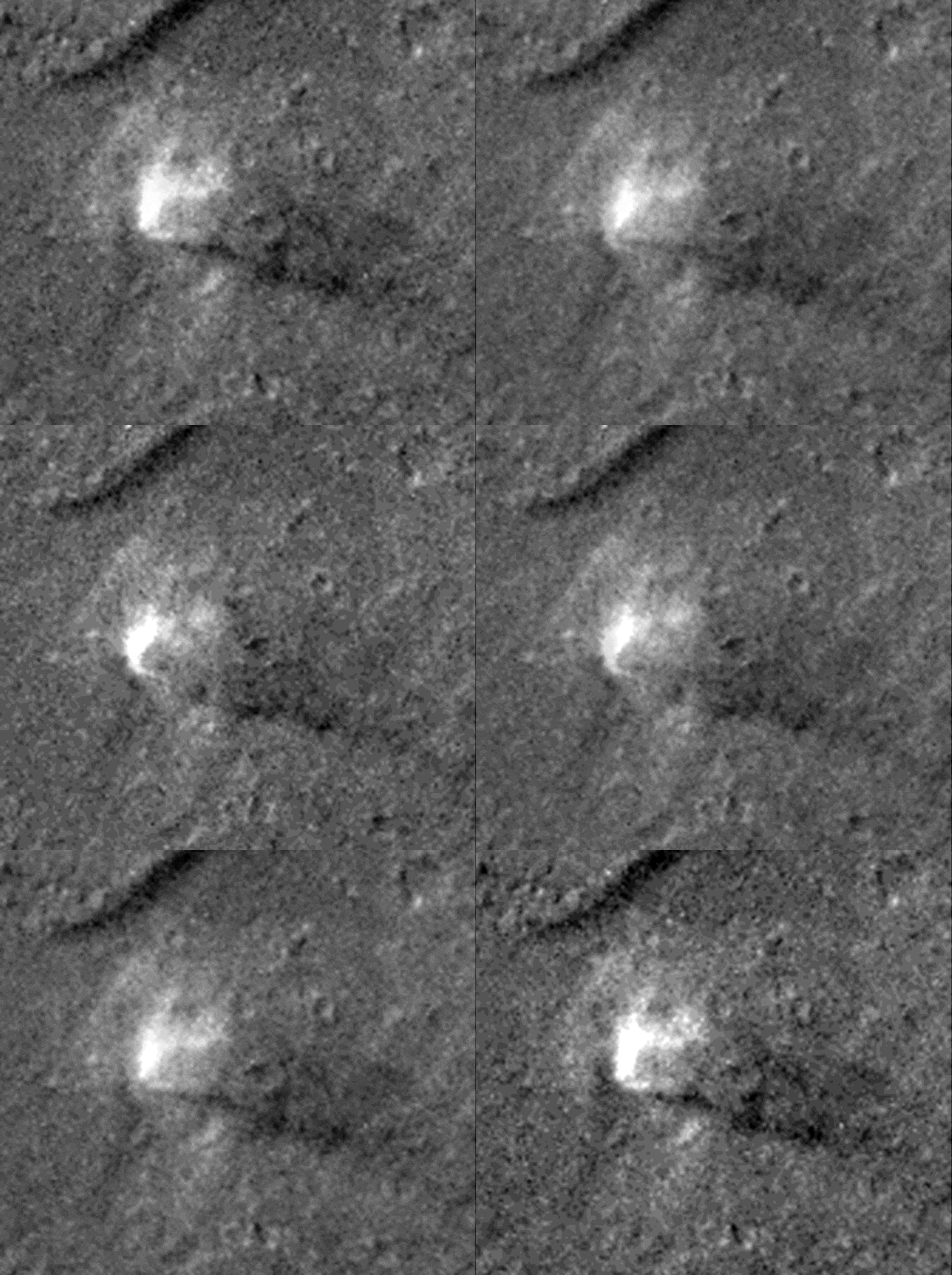
NASA’s Viking orbiters, in the 1970s, were the first spacecraft to photograph Martian dust devils. Two decades later, the agency’s Pathfinder mission was the first to image one from the surface and even detected a dust devil passing over the lander. Twin rovers Spirit and Opportunity managed to capture their fair share of dusty whirlwinds. Curiosity, which is exploring a location called Mount Sharp in Gale Crater on the opposite side of the Red Planet as Perseverance, sees them as well.
Capturing the Elusive Phenomena
Capturing a dust devil image or video with a spacecraft takes some luck. Scientists can’t predict when they’ll appear, so Perseverance routinely monitors in all directions for them. When scientists see them occur more frequently at a specific time of day or approach from a certain direction, they use that information to focus their monitoring to try to catch additional whirlwinds.
“If you feel bad for the little devil in our latest video, it may give you some solace to know the larger perpetrator most likely met its own end a few minutes later,” said Lemmon. “Dust devils on Mars only last about 10 minutes.”
More About Perseverance
Perseverance is NASA’s most advanced Mars rover, launched as part of the Mars 2020 mission under the agency’s broader Moon to Mars exploration strategy. A key goal of the rover is astrobiology—searching for signs of ancient microbial life on the Red Planet. To support this, Perseverance is the first mission to collect and cache samples of Martian rock and regolith, which could one day be returned to Earth through NASA and ESA’s Mars Sample Return Program for detailed scientific analysis.
Beyond the search for past life, the rover is studying Mars’ geology and climate history, gathering critical data to prepare for future human missions. Operated by NASA’s Jet Propulsion Laboratory (managed by Caltech), Perseverance is paving the way for the next era of Mars exploration.
Never miss a breakthrough: Join the SciTechDaily newsletter.
Follow us on Google and Google News.
21 Comments
Saw one of these completely engulf a gas station in Raton, NM last week. About 50 yards in diameter, 80 to 100mph winds thousands of feet high . A Dry EF-1 Dust Devil. Passed right in front of me. Lasted maybe 30 seconds. Clear skies.
Saw plenty of these mini twister in Iraq and Afghanistan, ironically. Usually as a larger massive dust storm or very light but consistent rain storm approached.
I love how they send these pictures of the Arizona or Utah desert and then call it Mars. That’s really cool…🙄
It’s Devon Island Canada. If you look at it on Google earth you can see all the NASA- mars equipment and people in NASA gear driving around scouting locations😂😂
Oh you guys kill me.
I can rarely get cell reception and they can send HD Video back from Mars? Cool
I think they are a little bit more advanced then your cell.
I think they are a little more advanced then your cell.
Why all the skepticism? Was the Covid pandemic a hoax too? There are still truths, here and there, in our world…
It is not an HD video. The clear images are artistic concepts (it says under the image). As for the real “video”, it is images stitched together. It has multiple cameras and gadgets that take great quality photos. You can view the photos it takes (and the other rovers) on the NASA website.
They can film on mars but can’t find a missing commercial airplane on earth.
It’s not a film video. It’s photos stitched together. Also, the first image (and some videos) are artistic concepts. Each image and video states if they are concepts or actual images beneath the photo. Read everything before making a false statement.
I just learned that mars has a lot of air..
It’s a mirror, look at the devil in the background, it’s on the exact same track as the one they are talking about…fake!
You know youre dumb when you lie dumb
Um, same path? It isn’t the same shape as the one they’re talking about so how is this a mirror? No clue what u mean by same path. How can u tell which way it’s moving?
I recall the awe, mystery, and discovery of the Mariner IV mission. Scientists and engineers have advanced their respective crafts impressively. It is a privilege to be able to experience the surface of Mars in such great detail.
I haven’t heard about Witch Hazel on the moon for 65 years.
In my SoCAL childhood, I had an older cousin point out the moon shadow shown at twilight was Witch Hazel watching us from her rocking chair deciding who she would haunt that night!
So now I know she’s even got a moon hill named after her…
Why isn’t the tictac sighting on mars included?
So y’all are saying the images are from Arizona .. dang I must be stupid.. I was all. “VthatA really we can see stuff on Mars that clearly. How did they do it ” I’m simple minded. Lol
The FIRST image is an artistic concept. People don’t read the captions… The other images are from the rover. Most images are blurry, but when closer up, the rover takes excellent images! The videos are made from compiled images, which allow for better clarity. You can look at all of the photos it takes online on the NASA website.