
Researchers successfully simulate a novel combination method for managing fusion plasma.
In their ongoing quest to develop a range of methods for managing plasma so it can be used to generate electricity in a process known as fusion, researchers at the U.S. Department of Energy’s (DOE) Princeton Plasma Physics Laboratory (PPPL) have shown how two old methods can be combined to provide greater flexibility.
While the two methods – known as electron cyclotron current drive (ECCD) and applying resonant magnetic perturbations (RMP) – have long been studied, this is the first time researchers have simulated how they can be used together to give enhanced plasma control.
“This is kind of a new idea,” said Qiming Hu, a staff research physicist at PPPL and lead author of a new paper published in the journal Nuclear Fusion about the work, which has also been demonstrated experimentally. “The full capabilities are still being figured out, but our paper does a great job of advancing our understanding of the potential benefits.”
Ultimately, scientists hope to use fusion to generate electricity. First, they will need to overcome several hurdles, including perfecting methods for minimizing bursts of particles from the plasma that are known as edge-localized modes (ELMs).
“Periodically, these bursts release a little bit of pressure because it’s too much. But these bursts can be dangerous,” said Hu, who works for PPPL at the DIII-D National Fusion Facility, a DOE user facility hosted by General Atomics. DIII-D is a tokamak, a device that uses magnetic fields to confine a fusion plasma in a donut shape. ELMs can end a fusion reaction and even damage the tokamak, so researchers have developed many ways to try to avoid them.
“The best way we’ve found to avoid them is by applying resonant magnetic perturbations, or RMPs, that generate additional magnetic fields,” said PPPL Principal Research Physicist Alessandro Bortolon, who was one of the co-authors of the paper.

Magnetic Fields Generate Islands, Microwaves Adjust Them
The magnetic fields initially applied by the tokamak wind around the torus-shaped plasma, both the long way – around the outer edge, and the short way – from the outer edge and through the center hole. The additional magnetic fields created by the RMPs travel through the plasma, weaving in and out like a sewer’s stitch. These fields produce oval or circular magnetic fields in the plasma called magnetic islands.
“Normally, islands in plasmas are really, really bad. If the islands are too big, then the plasma itself can disrupt.”
However, the researchers already knew experimentally that under certain conditions, the islands can be beneficial. The hard part is generating RMPs big enough to generate the islands. That’s where the ECCD, which is basically a microwave beam injection, comes in. The researchers found that adding ECCD to the plasma’s edge lowers the amount of current required to generate the RMPs necessary to make the islands.
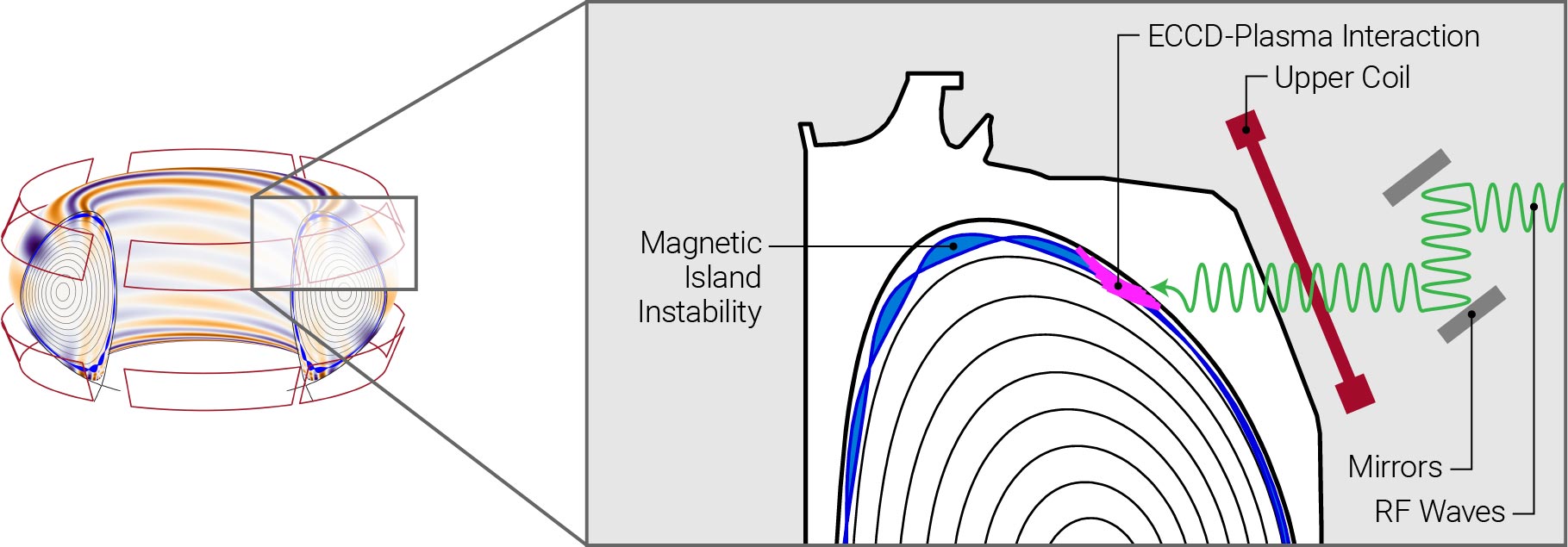
The microwave beam injection also allowed the researchers to perfect the size of the islands for maximum plasma edge stability. Metaphorically, the RMPs act like a simple light switch that turns the islands on, while the ECCD acts like an additional dimmer switch that lets the researchers adjust the islands to the ideal size for a manageable plasma.
“Our simulation refines our understanding of the interactions in play,” Hu said. “When the ECCD was added in the same direction as the current in the plasma, the width of the island decreased, and the pedestal pressure increased. Applying the ECCD in the opposite direction produced opposite results, with island width increasing and pedestal pressure dropping or facilitating island opening.”
ECCD at the Edge, Instead of the Core
The research is also notable because ECCD was added to the plasma’s edge instead of the core, where it is typically used.
“Usually, people think applying localized ECCD at the plasma edge is risky because the microwaves may damage in-vessel components,” said Hu. “We’ve shown that it’s doable, and we’ve demonstrated the flexibility of the approach. This might open new avenues for designing future devices.”
By lowering the amount of current required to generate the RMPs, this simulation work could ultimately lead to lowering the cost of fusion energy production in commercial-scale fusion devices of the future.
Reference: “Effects of edge-localized electron cyclotron current drive on edge-localized mode suppression by resonant magnetic perturbations in DIII-D” by Q.M. Hu, N.C. Logan, Q. Yu and A. Bortolon, 13 March 2024, Nuclear Fusion.
DOI: 10.1088/1741-4326/ad2ca8
This work was funded by the DOE under award numbers DE-AC02-09CH11466, DE-FC02-04ER54698, DE-SC0022270 and DE-AC52-07NA27344. Co-author Qingquan Yu was partially supported by the EUROfusion Enabling Research project (CfP-FSD-AWP24-ENR). His work has been carried out within the framework of the EUROfusion Consortium, funded by the European Union via the Euratom Research and Training Programme grant number 101052200.
Never miss a breakthrough: Join the SciTechDaily newsletter.
Follow us on Google and Google News.