
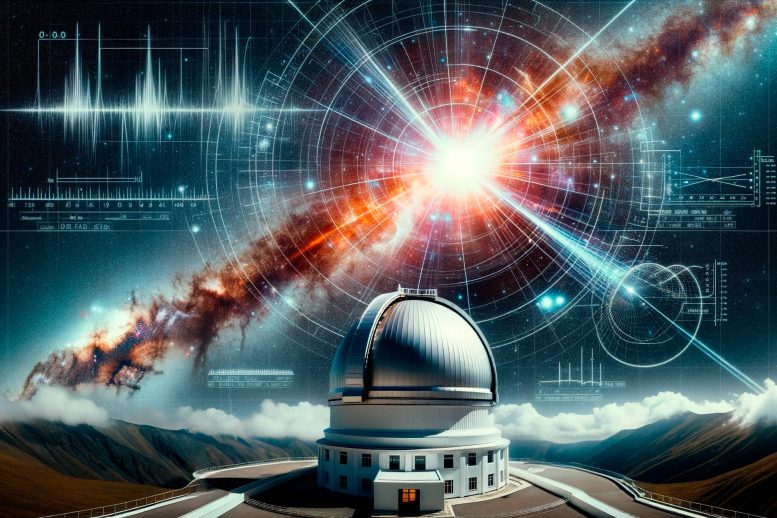
Astronomers have identified the oldest and most distant fast radio burst (FRB) yet, about eight billion years old, supporting theories on FRBs and their ability to reveal “missing” matter between galaxies. This discovery promises more insights into the Universe’s structure with future telescopic advancements.
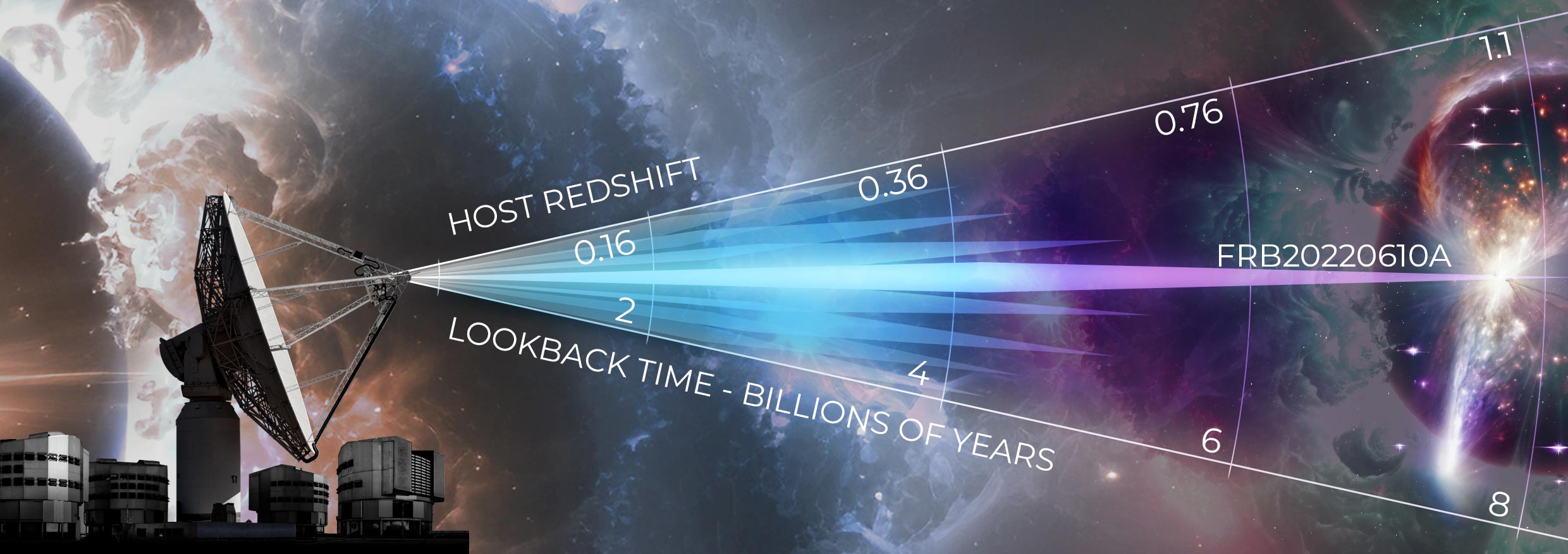
In a paper published in Science, a global team led by Macquarie University’s Dr. Stuart Ryder and Swinburne University of Technology’s Associate Professor Ryan Shannon, report on their discovery of the most ancient and distant fast radio burst located to date, about eight billion years old.
The discovery smashes the team’s previous record by 50 percent. It confirms that fast radio bursts (FRBs) can be used to measure the “missing” matter between galaxies.
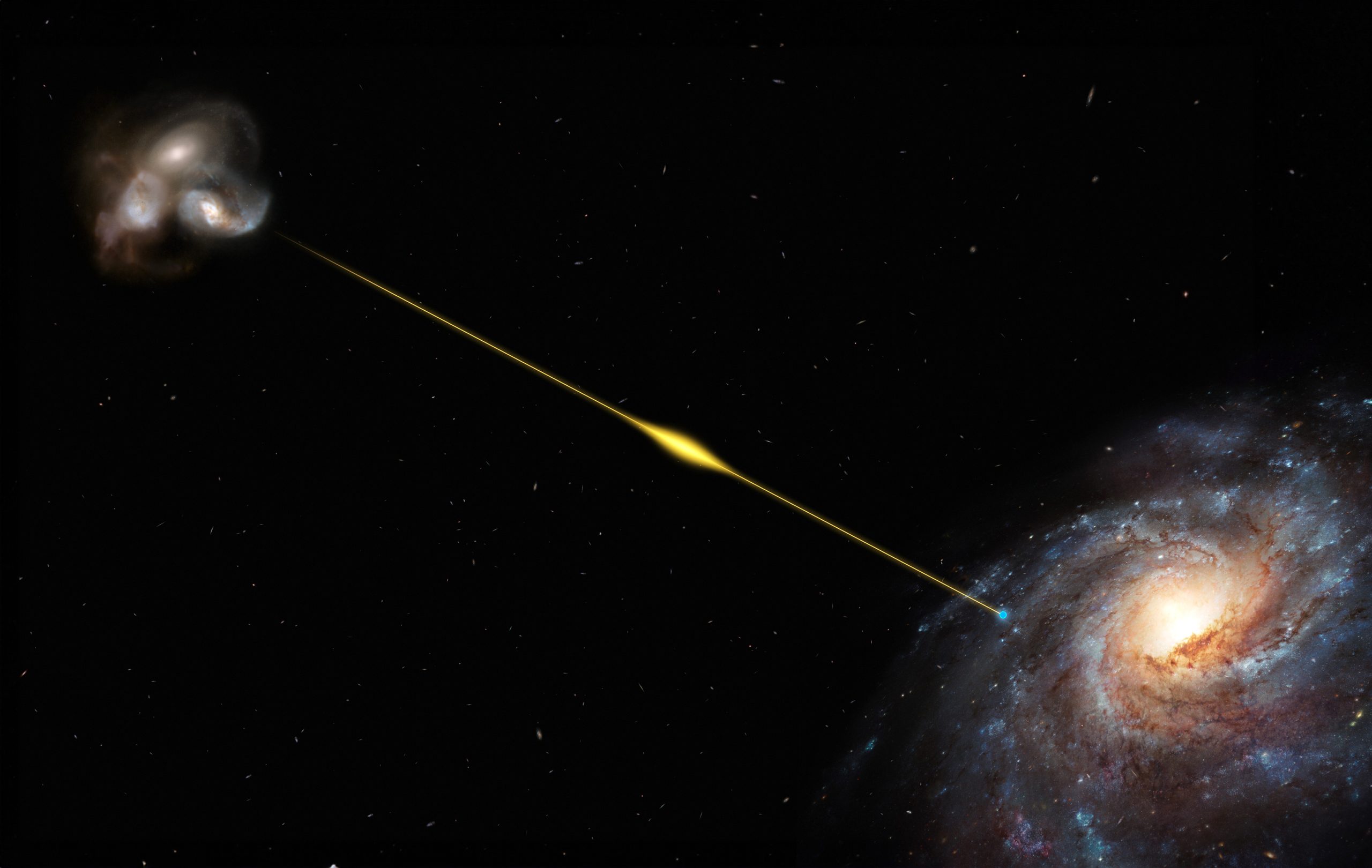
The source of the burst was shown to be a group of two or three galaxies that are merging, supporting current theories on the cause of fast radio bursts. The team also showed that eight billion years is about as far back as we can expect to see and pinpoint fast radio bursts with current telescopes.
Detection of the Burst and Its Significance
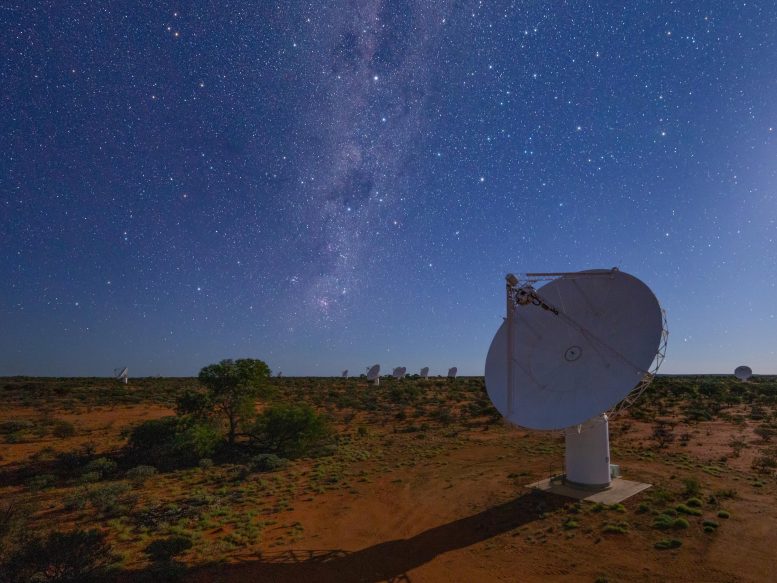
On June 10, 2022, CSIRO’s ASKAP radio telescope on Wajarri Yamaji Country was used to detect a fast radio burst, created in a cosmic event that released, in milliseconds, the equivalent of our Sun’s total emission over 30 years.
“Using ASKAP’s array of dishes, we were able to determine precisely where the burst came from,” says Dr. Ryder, the first author on the paper. “Then we used the European Southern Observatory (ESO) Very Large Telescope (VLT) in Chile to search for the source galaxy, finding it to be older and further away than any other FRB source found to date, and likely within a small group of merging galaxies.”
Named FRB 20220610A, the fast radio burst has reaffirmed the concept of weighing the Universe using data from FRBs. This was first demonstrated by the late Australian astronomer Jean-Pierre ‘J-P’ Macquart in a paper in Nature in 2020.
“J-P showed that the further away a fast radio burst is, the more diffuse gas it reveals between the galaxies,” says Dr. Ryder. “This is now known as the Macquart relation. Some recent fast radio bursts appeared to break this relationship. Our measurements confirm the Macquart relation holds out to beyond half the known Universe.”
Fast Radio Bursts and the Universe’s Structure
About 50 FRBs have been pinpointed to date – nearly half using ASKAP. The authors suggest we should be able to detect thousands of them across the sky, and at even greater distances.
“While we still don’t know what causes these massive bursts of energy, the paper confirms that fast radio bursts are common events in the cosmos and that we will be able to use them to detect matter between galaxies, and better understand the structure of the Universe,” says Associate Professor Shannon.
And we will soon have the tools to do so. ASKAP is currently the best radio telescope to detect and locate FRBs. The international SKA telescopes now under construction in Western Australia and South Africa will be even better at allowing astronomers to locate even older and more distant FRBs. The nearly 40-metre mirror of ESO’s Extremely Large Telescope, currently under construction in the high, dry Chilean desert will then be needed to study their source galaxies.
Collaborative Effort and Future Prospects
The project was a worldwide effort with researchers from ASTRON (Netherlands), Pontificia Universidad Católica de Valparaíso (Chile), Kavli Institute for the Physics and Mathematics of the Universe (Japan), SKA Observatory (UK), Northwestern University, UC Berkeley, and UC Santa Cruz (USA).
Australian participants were Macquarie University, Swinburne University of Technology, CSIRO, ICRAR/Curtin University, ASTRO 3D, and University of Sydney.
Current methods of estimating the mass of the Universe are giving conflicting answers and challenging the standard model of cosmology.
“If we count up the amount of normal matter in the Universe – the atoms that we are all made of – we find that more than half of what should be there today is missing,” says Associate Professor Shannon.
“We think that the missing matter is hiding in the space between galaxies, but it may just be so hot and diffuse that it’s impossible to see using normal techniques.
“Fast radio bursts sense this ionized material. Even in space that is nearly perfectly empty they can ‘see’ all the electrons, and that allows us to measure how much stuff is between the galaxies.”
Telescope Infrastructure and Future Endeavors
CSIRO’s ASKAP radio telescope is situated at Inyarrimanha Ilgari Bundara, the CSIRO Murchison Radio-astronomy Observatory in Western Australia, about 800 kilometres north of Perth.
Currently, 16 countries are partners in the SKA Observatory, which is building two radio telescopes. SKA-Low (the low frequency telescope) – at the same site as ASKAP – will comprise 131,072 two-metre-tall antennas, while SKA-Mid (the mid frequency telescope) in South Africa will comprise 197 dishes.
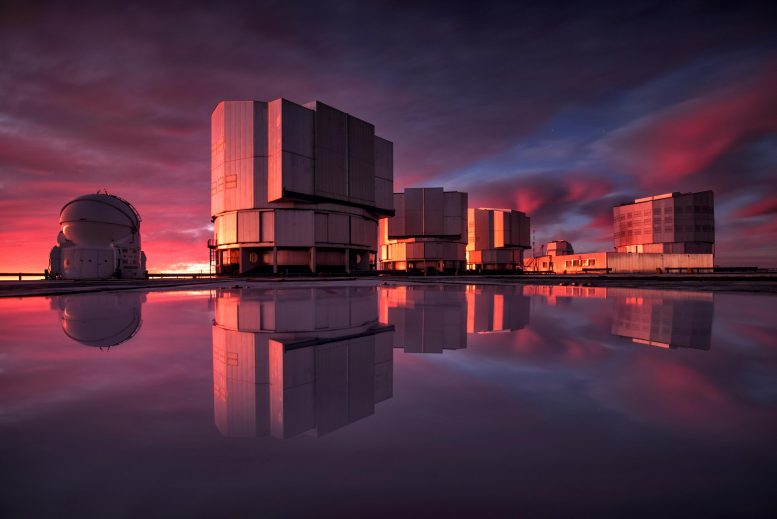
The Very Large Telescope (VLT) has four eight-meter mirrors and is operated by the European Southern Observatory (ESO), located on Cerro Paranal in the Atacama Desert of northern Chile. Australia is a strategic partner of ESO, giving Australian astronomers access to the VLT and the opportunity to contribute new technologies to it.
Australian astronomers are also hoping to gain access to ESO’s Extremely Large Telescope when it starts operation later this decade. The ELT will be able to deliver images 15 times sharper than the Hubble Space Telescope.
For more on this research, see Astronomers Detect Fast Radio Burst From 8 Billion Light-Years Away.
Reference: “A luminous fast radio burst that probes the Universe at redshift 1” by S. D. Ryder, K. W. Bannister, S. Bhandari, A. T. Deller, R. D. Ekers, M. Glowacki, A. C. Gordon, K. Gourdji, C. W. James, C. D. Kilpatrick, W. Lu, L. Marnoch, V. A. Moss, J. X. Prochaska, H. Qiu, E. M. Sadler, S. Simha, M. W. Sammons, D. R. Scott, N. Tejos and R. M. Shannon, 19 October 2023, Science.
DOI: 10.1126/science.adf2678
Never miss a breakthrough: Join the SciTechDaily newsletter.
Follow us on Google and Google News.