

A research team from HKUST has enhanced perovskite solar cell performance by discovering and eliminating surface concavities on the crystal grains of the films, paving the way for greater commercial viability of this promising technology.
A research team from the School of Engineering at the Hong Kong University of Science and Technology (HKUST) has discovered surface concavities on individual crystal grains, the fundamental building blocks of perovskite thin films. They revealed the significant impact of these concavities on the film’s properties and reliability. Based on this fundamental science discovery, the team pioneered a new way of making perovskite solar cells more efficient and stable via a chemo-elimination of these grain surface concavities.
Perovskite solar cells are a stellar solar-cell technology that has demonstrated potential to replace existing silicon solar cells in a wide range of application scenarios, for example, grid electricity, portable power, and space photovoltaics. They not only attain higher power conversion efficiencies (PCEs) than commercial silicon cells, but also offer advantages in terms of low material costs, sustainable manufacturing, and high versatility in transparency and colors. However, the long-term stability of perovskite devices under light, humidity, and thermomechanical conditions remains a hurdle in the commercialization of this promising solar technology.
Research Findings and Innovations
To address this issue, Prof. Zhou Yuanyuan, Associate Professor of the Department of Chemical and Biological Engineering at HKUST, and his research group have conducted fundamental-oriented research from a unique perspective of materials’ microstructure. They discovered a proliferation of surface concavities at the crystalline grains of the perovskite material. These concavities are shown to break the structural continuity at the perovskite film interface, serving as a hidden microstructure factor limiting the efficiency and stability of perovskite cells.
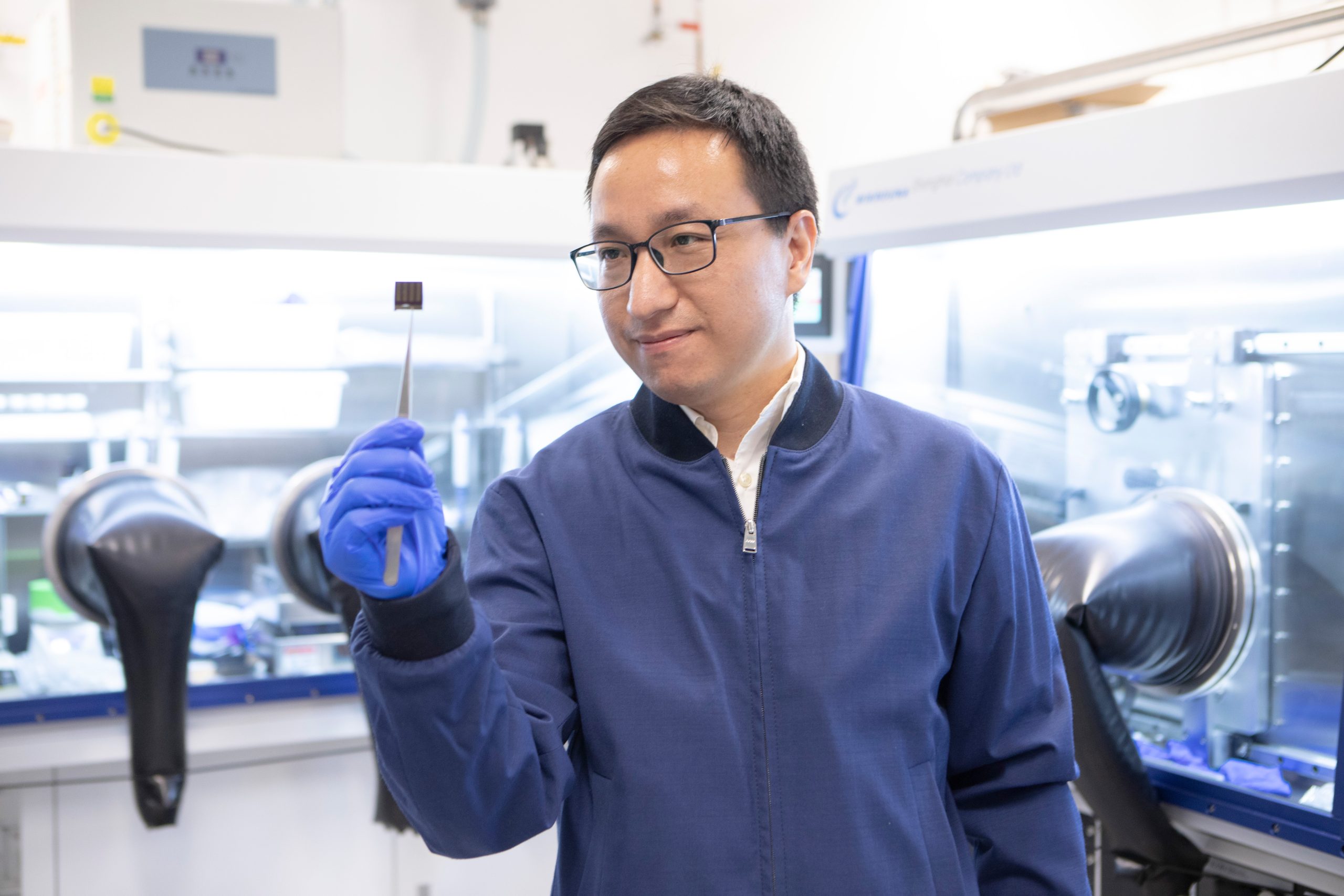
Then, the team took an innovative step to remove the grain surface concavities by using a surfactant molecule, tridecafluorohexane-1-sulfonic acid potassium, to manipulate the strain evolution and ion diffusion during the formation of perovskite films. Accordingly, their final perovskite cells demonstrated obvious improvements in efficiency retention under standardized thermal cycling, damp heat, and maximum-power-point tracking tests.
“Structure and geometry of individual crystalline grains are the origin of the performance of perovskite semiconductors and solar cells. By unveiling the grain surface concavities, understanding their effects, and leveraging chemical engineering to tailor their geometry, we are pioneering a new way of making perovskite solar cells with efficiency and stability toward their limits,” said Prof. Zhou, the corresponding author of this work.
“We were very intrigued by the surface concavities of perovskite grains when we were using atomic force microscopy to examine the structural details of perovskite films. These concavities are usually buried underneath the film bottom and can easily be overlooked,” he added.
“Microstructure is of vital importance for perovskite solar cells and other optoelectronic devices, and can be more complex than conventional materials owing to the hybrid organic-inorganic characteristics of perovskite materials. Under Prof. Zhou’s guidance, we are able to develop various novel characterization and data science approaches to gain insights into perovskite microstructure,” said Zhang Yalan, a PhD student in Prof. Zhou’s research group and a co-author of this work.
Reference: “Elimination of grain surface concavities for improved perovskite thin-film interfaces” by Tong Xiao, Mingwei Hao, Tianwei Duan, Yanyan Li, Yalan Zhang, Peijun Guo and Yuanyuan Zhou, 15 July 2024, Nature Energy.
DOI: 10.1038/s41560-024-01567-x
Never miss a breakthrough: Join the SciTechDaily newsletter.
Follow us on Google and Google News.
3 Comments
This secret discovery by the Chinise scientists may undergo as a fine one for economý on silicon crystal found in natural state on the earth geo-surface.
So, they don’t know what they’re actually making. And then they go “Whoa, how did THAT get in there?” I thought only the nitwits at “Tesla” had that kind of approach.
Protecting a centralized (controlled grid system) with smart technology… is like closing the barn door after the horse is out … Will always be susceptible to hacking and manipulation … mini grids are the only solution…Poly Grids …