
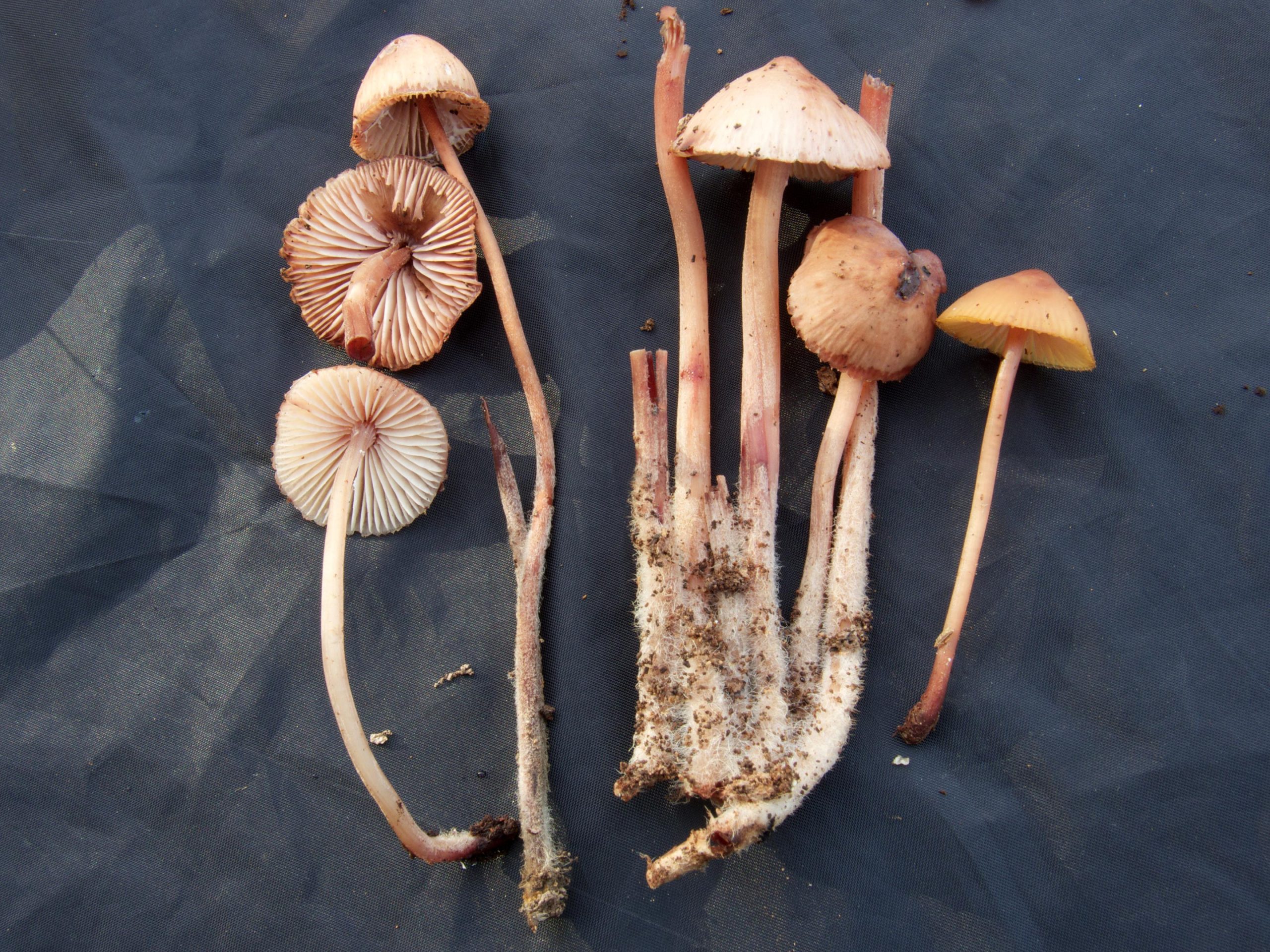
Research on various Mycena mushroom species revealed unexpectedly large genomes, suggesting a genetic capacity for diverse lifestyles, notably in Arctic strains where genomes are significantly larger.
The study, involving an international team and part of the 1000 Fungal Genomes project, uncovered genome expansions across all gene families, likely aiding adaptability in extreme environments.
Mycena Mushroom Genomes
Mycena mushrooms, also known as “bonnets,” have unexpectedly large genomes, according to a new scientific study of multiple species. The research was published today (June 27) in the journal Cell Genomics.
While the mushrooms had been thought to live by degrading dead organic material alone, the discovery suggests that they may instead have a collection of genes to enable them to adapt to different lifestyles as circumstances change, according to the researchers. Interestingly, they show that certain Mycena strains living in the Arctic have some of the largest mushroom genomes ever described.
Genome Expansion in Mycena Mushrooms
“As a group, Mycena has simply used every possible known trick from the playbook to expand their genomes and apparently for multiple different purposes that are not obviously connected to their known, supposedly preferred lifestyle,” says Christoffer Bugge Harder. With an original base for the work at the University of Oslo, Norway, he served as the lead author of a 28-person author team from universities in seven countries.

“Evolution tells us that non-advantageous traits tend to disappear over time, so an obvious implication is that adaptability and generalism in those large genome structures must be an advantage for these fungi,” says Francis Martin of the INRAE and the University of Lorraine in Champenoux, France. “This is despite the costs of having a large genome with lots of possibly unnecessary features that must be replicated in each cell division. This may be particularly true in an extreme environment like the Arctic, as also seen in plants.”
The Role of Mycena in Ecosystems and Their Genome Sequencing
The researchers set out to study Mycena based on their role as a main mushroom decomposer of litter and leaves in forest ecosystems. Despite their tiny fruiting bodies, Mycena have an important role in the global carbon cycle. This group of mushrooms had long been thought to live purely on dead organic material, but more recently it was found some species also make a living through cooperative or parasitic interactions with living plants. Mycenas are also bioluminescent—i.e., they glow in the dark—and earlier work describing the genomes of five Mycena species had investigated this phenomenon. To learn more about their direct lifestyle habits, the researchers now wanted to study a broad palette of Mycena species with different preferences for substrates.
Exploring Genome Diversity in Mycena Species
In the new study, they generated new genome sequences for 24 additional Mycena species and a related species now known as Atheniella floridula. The genomes were sequenced and annotated through the DOE Joint Genome Institute’s Community Science Program. The work is part of the 1000 Fungal Genomes project, which aims to explore genome diversity both across and within different groups of fungi, in this case the genus of Mycena.
The species included represent six decayer categories: wood generalists, broadleaf wood decayers, grass litter generalists, broadleaf litter decayers, coniferous litter decayers, and overall litter generalists. It also included three Arctic species. They added their new genomes to 33 additional genomes from non-Mycena species. They wanted to understand how the genomes had evolved and expanded over evolutionary time and how species might differ in plant cell-wall-degrading enzymes based on their lifestyle habits.
Surprising Genome Expansions and Their Evolutionary Implications
They were surprised to find that Mycena showed massive genome expansions overall, affecting all gene families regardless of their expected habits. The expansion appeared to be driven by the emergence of novel genes as well as gene duplications, enlarged collections of genes that produce enzymes for degrading polysaccharides, the proliferation of transposable elements, and horizontal gene transfers from other fungal species. They also found that two species collected in the Arctic had the largest genomes by far, at a size that is two to eight times bigger than Mycena living in temperate zones.
Observations of Adaptations in Arctic Mycena Species
“It was a particular surprise that both that the Arctic genomes were so especially expanded on top of the general Mycena expansion—and that Mycena had horizontally transferred genes from Ascomycetes,” Harder says. “Those species are also found in temperate areas, and we cannot see conclusively from our results whether these species are large because of a specific species effect or because of an Arctic effect.”
However, some Arctic plants have been shown to inflate their genomes with transposable elements or simply duplicate their entire genomes altogether compared to their close relatives in temperate areas, and it is of course tempting to suggest that a similar parallel evolution could be happening in Arctic mushrooms.
“The evolutionary transition from decomposer to symbiotic fungi is generally believed to have happened in parallel in several fungal groups throughout the course of evolution millions of years ago,” says Håvard Kauserud of the University of Oslo, Norway. “However, with Mycena, we appear to be seeing this gradual process in action happening right in front of our eyes.”
Reflections on Genome Sequencing and Ecological Deductions
“We know from other lines of research that Mycena, contrary to many other fungi, can adopt more than one possible lifestyle. The findings suggests that these multiple possible lifestyles are reflected in their genome structures, too,” Harder says.
The findings also have important implications for efforts to understand an organism’s habits from their genome sequences alone.
“This serves as a reminder that one cannot always easily deduce the main ecology or lifestyle of a fungus just from sequencing their genomes,” Martin said. “This is quite important to remember in an age where DNA sequencing is becoming cheaper and cheaper and more and more ubiquitous while traditional hands-on organism knowledge is less widespread in younger generations of biologists and harder to obtain funding for.”
Reference: “Extreme overall mushroom genome expansion in Mycena s.s. irrespective of plant hosts or substrate specializations” by Christoffer Bugge Harder, Shingo Miyauchi, Máté Virágh, Alan Kuo, Ella Thoen, Bill Andreopoulos, Dabao Lu, Inger Skrede, Elodie Drula, Bernard Henrissat, Emmanuelle Morin, Annegret Kohler, Kerrie Barry, Kurt LaButti, Asaf Salamov, Anna Lipzen, Zsolt Merényi, Botond Hegedüs, Petr Baldrian, Martina Stursova, Hedda Weitz, Andy Taylor, Maxim Koriabine, Emily Savage, Igor V. Grigoriev, László G. Nagy, Francis Martin and Håvard Kauserud, 27 June 2024, Cell Genomics.
DOI: 10.1016/j.xgen.2024.100586
Never miss a breakthrough: Join the SciTechDaily newsletter.
Follow us on Google and Google News.