
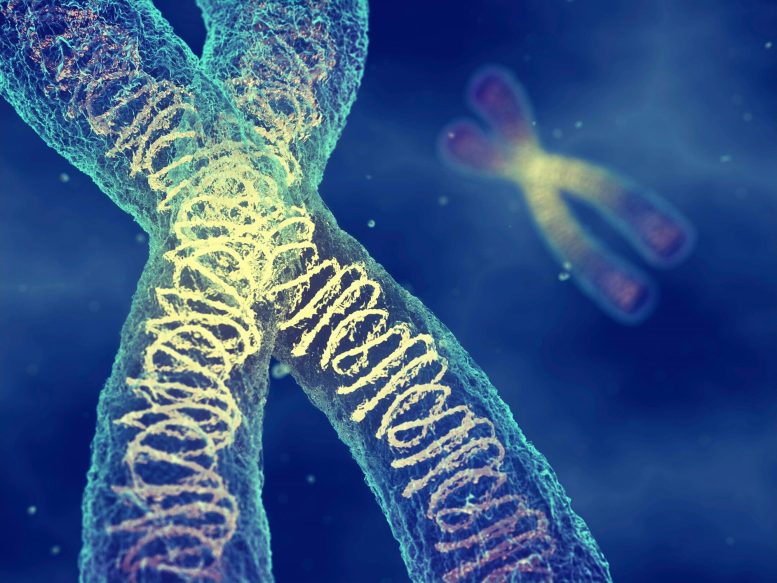
Analysis of the genome and proteome shows that eukaryotic evolution gave rise to the regulatory function of chromatin.
Two meters of DNA must fit into a nucleus that is just 8 millionths of a meter wide in practically every human cell. DNA must wrap around structural proteins called histones in order to solve the extreme space challenge, much like wool around a spool. This coiled genetic architecture, known as chromatin, shields DNA from harm and plays an important role in gene regulation.
Histones are found in both eukaryotes, living organisms with specialized cellular machinery like nuclei and microtubules, and archaea, a branch of the tree of life made up of single-celled microbes that are prokaryotic, which means they lack a nucleus.
Enzymes alter histones in eukaryotic cells, continually reshaping the genomic landscape to regulate gene expression and other genomic processes. Despite playing this crucial role, the precise origin of chromatin has remained a mystery.
Discovery of Chromatin’s Ancient Origins
Researchers at the Center for Genomic Regulation (CRG) now reveal that nature’s storage solution first evolved in ancient microbes living on Earth between one and two billion years ago. The research was recently published in Nature Ecology and Evolution.
To go back in time, the researchers exploited information encoded in current organisms’ genomes, grouping living forms based on the evolution of genes and proteins connected to chromatin. They looked at thirty distinct species found in water samples from Canada and France. The bacteria were identified using contemporary gene-sequencing technology, which enables species identification by filtering DNA. They were then grown in the laboratory for proteomic and genomic sequencing.
Prokaryotes vs Eukaryotes: Different Roles for Histones
The researchers discovered that prokaryotes lack the machinery required to alter histones, implying that archaeal chromatin had a basic structural function but did not regulate the genome at the time. In contrast, researchers found ample evidence of proteins that read, write and erase histone modifications in early diverging eukaryotic lineages such as the malawimonad Gefionella okellyi, the ancyromonad Fabomonas tropica, or the discoban Naegleria gruberi, microbes that had not been sampled until now.
“Our results underscore that the structural and regulatory roles of chromatin are as old as eukaryotes themselves. These functions are essential for eukaryotic life — since chromatin first appeared, it’s never been lost again in any life form,” says Dr. Xavier Grau-Bové, a post-doctoral researcher at the CRG and first author of the study. “We are now a bit closer to understanding its origin, thanks to the power of comparative analyses to uncover evolutionary events that occurred billions of years ago.”
Using the sequence data, the researchers reconstructed the repertoire of genes held by the Last Eukaryotic Common Ancestor, the cell that gave rise to all eukaryotes. This living organism had dozens of histone-modifying genes and lived between one and two billion years ago on Earth, which is itself estimated to be 4.5 billion years old. The authors of the study hypothesize that chromatin evolved in this microbe as a result of selective pressures in the primordial environment of Earth.
Viruses and Genome Parasites: Evolutionary Pressure to Develop Chromatin
Dr. Arnau Sebe-Pedrós, a researcher at the CRG and senior author of the study, points out that “viruses and transposable elements are genome parasites that regularly attack DNA of single-celled organisms. This could have led to an evolutionary arms race to protect the genome, resulting in the development of chromatin as a defensive mechanism in the cell that gave rise to all known eukaryotic life on Earth. Later on, these mechanisms were co-opted into elaborate gene regulation, as we observe in modern eukaryotes, particularly multicellular organisms.”
According to the authors of the study, future research could look at the evolution of histone-modifying enzymes in Asgardian archaea, microbes named after a mythological region inhabited by Norse gods that are often described as an evolutionary stepping stone between archaea and eukaryotes. The researchers found evidence that some species of Asgardian microbes, such as Lokiarchaeota, have histones with eukaryotic-like features, and could be the result of convergent evolution.
Reference: “A phylogenetic and proteomic reconstruction of eukaryotic chromatin evolution” by Xavier Grau-Bové, Cristina Navarrete, Cristina Chiva, Thomas Pribasnig, Meritxell Antó, Guifré Torruella, Luis Javier Galindo, Bernd Franz Lang, David Moreira, Purificación López-Garcia, Iñaki Ruiz-Trillo, Christa Schleper, Eduard Sabidó and Arnau Sebé-Pedrós, 9 June 2022, Nature Ecology & Evolution.
DOI: 10.1038/s41559-022-01771-6
The study is the result of a research project that started eight years ago. Led by researchers at the CRG, the work counts on the collaboration of the CRG-UPF Proteomics Unit, the Institut de Biologia Evolutiva (CSIC-UPF), Université Paris-Saclay, Université de Montreal, and the University of Vienna.
The study was funded the European Research Council, the Ministerio de Ciencia e Innovación, the Centro de Excelencia Severo Ochoa, and the Agencia Estatal de Investigación.
Never miss a breakthrough: Join the SciTechDaily newsletter.
Follow us on Google and Google News.
3 Comments
Chromatin evoĺved with the evolution of life and lost never is itself life.But,the esrth evolved to this.
The planet earth has own virtue for evolution of life.Çhromatin provides a fine example to suppòrt this.
Great the headlines read “Scientist finally discover the origin of chromatic”
But goes on to say “We are now a bit closer to understanding its origin, thanks to the power of comparative analyses to uncover evolutionary events that occurred billions of years ago.”
Another misleading article using words like hypothesize and phrases like ” we are now a bit closer to understanding its origin” is not what the headliner reads……