
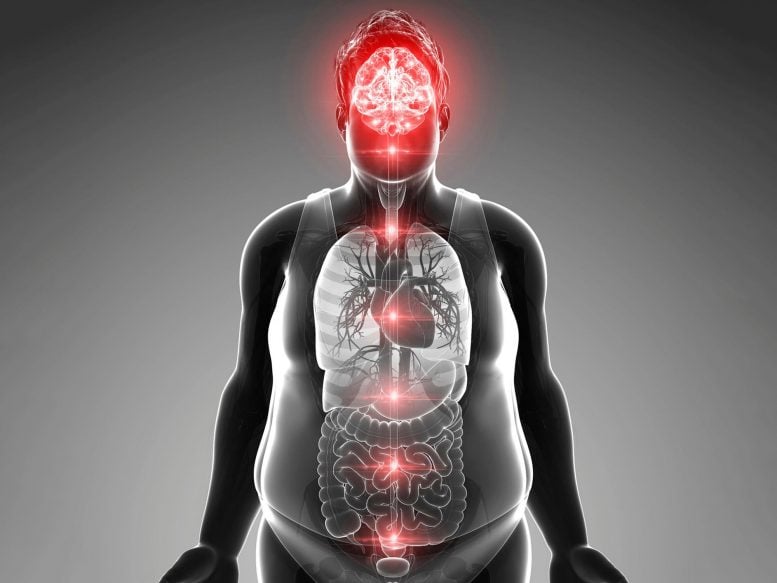
High-Fat Diet Disrupts Brain’s Satiety Clock
When rats are fed a high fat diet, this disturbs the body clock in their brain that normally controls satiety, leading to over-eating and obesity. That’s according to new research published in The Journal of Physiology.
The number of people with obesity has nearly tripled worldwide since 1975.[1] In England alone, 28% of adults are obese and another 36% are overweight.[2] Obesity can lead to several other diseases such as Type 2 diabetes, heart disease, stroke, and some types of cancer.[3]
This new research may be a cornerstone for future clinical studies that could restore the proper functioning of the body clock in the brain, to avoid overeating.
DVC: A Critical Clock for Controlling Appetite
Historically, it was believed that the master body clock was only located in a part of the brain called the hypothalamus. However, further research over the years has clarified that some control of our body’s daily rhythms (hormone levels, appetite, etc.) lies in several other parts of the brain and body, including a group of neurons in the evolutionary ancient brainstem, called the dorsal vagal complex (DVC).
Specifically, the DVC has been shown to control food intake by inducing satiety.
Research has also shown that in obesity, daily rhythms in food intake and the release of hormones related to eating, are blunted or eliminated.
However, it has not been clear if the malfunctioning of brain centers controlling appetite is a cause or the result of obesity.
This new research conducted at the Jagiellonian University in Krakow in collaboration with the University of Bristol found that high-fat diet fed rats, before they started to gain weight, showed changes in the DVC’s daily neuronal rhythms and the response of these neurons to appetite hormones.
Targeting the DVC to Combat Obesity
Thus, the researchers propose that disturbance in the DVC’s timekeeping leads to obesity, rather than being the result of excessive body weight.
The research was performed on two groups of rats: those fed a well-balanced control diet (10% kcal from fat) and a high-fat diet (70% kcal from fat).
To mimic the impact of unhealthy diet on humans, the researchers introduced the new diet to adolescent rats (4-week-old) and monitored their food intake across 24 hours for four consecutive weeks.
Electrophysiological recordings were performed to measure how DVC neuronal activity changes across 24h. The use of multi-electrode arrays allowed for simultaneous monitoring of around a hundred DVC neurons from each brainstem slice. This enabled the researchers to assess circadian changes of neuronal activity as well as neuronal responses to metabolically-relevant hormones in each of the diet groups.
While the human and mouse brainstem share common features, the major limitation of the study for its immediate translation to humans is that it was performed on nocturnal animals (rats). The peak of the DVC activity was observed at the end of day, which is the rest phase for rodents, but an active phase for people. Thus, it remains to be established if the phase of the brainstem clock is set to day and night, or whether it depends on patterns of rest and activity.
Future Pathways for Obesity Treatment
This study opens new research opportunities for trying to establish the strategy how to restore body clock function of the DVC, and therefore help tackle obesity.
Dr. Lukasz Chrobok, first author of the study said:
“I’m really excited about this research because of the possibilities it opens up to tackle the growing health issue of obesity. We still do not know what are the time cues which are able to reset or synchronize the brainstem clock. Hopefully, the restoration of daily rhythms in this satiety center before or after the onset of obesity may provide new therapeutic opportunities.”
Reference: “Rhythmic neuronal activities of the rat nucleus of the solitary tract are impaired by high-fat diet – implications for daily control of satiety” by Lukasz Chrobok, Jasmin D Klich, Anna M Sanetra, Jagoda S Jeczmien-Lazur, Kamil Pradel, Katarzyna Palus-Chramiec, Mariusz Kepczynski, Hugh D Piggins and Marian H Lewandowski, 6 September 2021, The Journal of Physiology.
DOI: 10.1113/JP281838
Notes
- https://www.who.int/news-room/fact-sheets/detail/obesity-and-overweight
- https://commonslibrary.parliament.uk/research-briefings/sn03336/
- https://www.nhs.uk/conditions/obesity/
Never miss a breakthrough: Join the SciTechDaily newsletter.
Follow us on Google and Google News.