
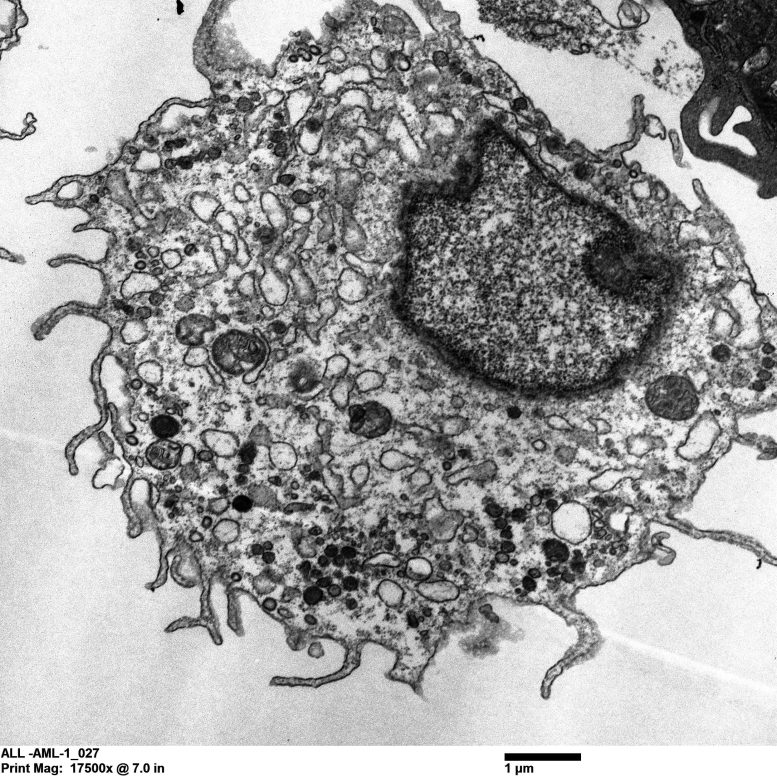
The development of a new cell culture model for human alveolar macrophages is set to propel research into respiratory illnesses. This innovation will aid in the exploration of a variety of conditions such as COVID-19, tuberculosis, asthma, cystic fibrosis, and chronic obstructive pulmonary disease.
Scientists at the Texas Biomedical Research Institute have successfully cultivated the alveolar macrophage, a vital immune cell within the lung, in a laboratory setting. This development of a cell culture model significantly simplifies and reduces the cost for global researchers investigating lung inflammatory disorders and exploring potential new treatments.
Macrophages are the “Pac-Man” of the immune system, eating up garbage throughout tissues in the body. Alveolar macrophages, in particular, reside in the lining of the lung’s air sacs where the exchange of air takes place. They are typically the initial immune cells to confront pathogens penetrating the deep sections of the lungs, such as SARS-CoV-2 or the bacteria responsible for TB.
“It is critical to study tissue-specific cells to better understand mechanisms of health and disease, and to screen potential new therapies,” says Texas Biomed Professor Larry Schlesinger, MD, and senior author of the paper published in the journal mBio.
Old vs. New
Human alveolar macrophages have been challenging to study because they reside deep in the lungs and are hard to access. Typically, they are collected through time-consuming and expensive lung washes, which involve using a bronchoscope to move through the throat and into the airways to collect fluid samples.
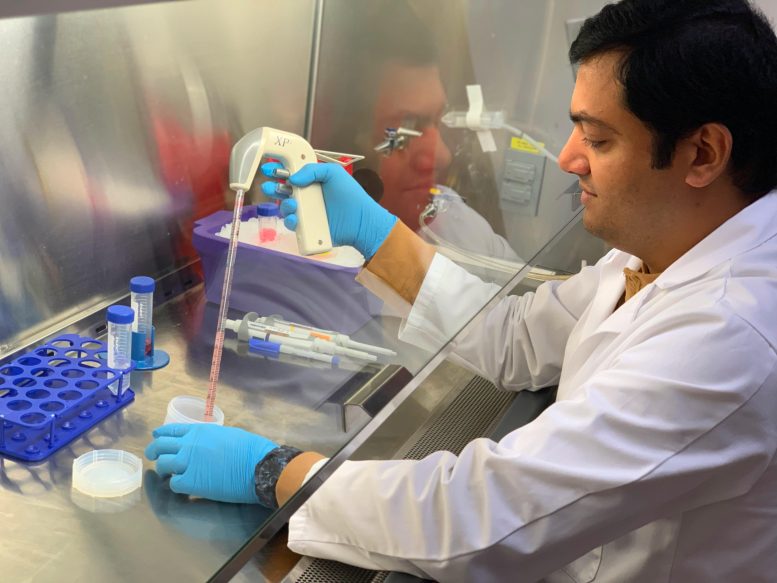
This new model starts with a simple blood draw. White blood cells are isolated and placed in Teflon jars with specialized cell culture components. Surfactant is added along with three different cytokine proteins, which are usually found in the alveolar lining fluid.
“We call it the magic cocktail,” says Susanta Pahari, Ph.D., a postdoctoral researcher at Texas Biomed and the first author of the paper. “We are mimicking the alveolar environment in cell culture. It makes the cells think they are in the lungs.”
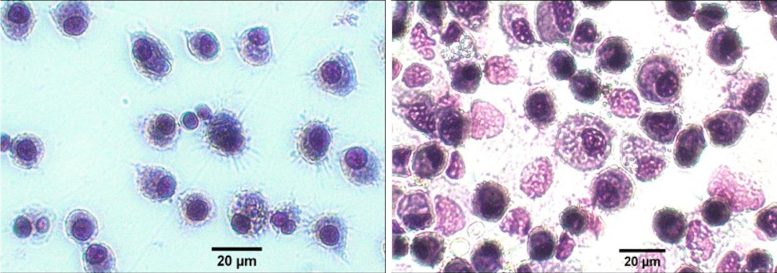
Within six days, the cells differentiate, or transform, into alveolar macrophage-like cells. The generated cells are 94% genetically similar to human alveolar macrophages collected from lung washes. The Texas Biomed team confirmed the model can be used to investigate TB and COVID-19; the cells readily take up the pathogens.
“It is very rewarding to develop something that can help the research community,” says Dr. Pahari. “We’ve already received numerous emails across the globe requesting macrophage development protocols. We are now looking into developing a kit that we can provide to make it even easier for others to replicate what we have done.”
Pivot & Improve
In a way, the advancement is a byproduct of the COVID-19 pandemic. When the pandemic hit, Dr. Pahari could not readily access human alveolar macrophages, and his research came to a grinding halt. So, he pivoted to focus on developing an alternative. It took years of trial and error to identify the most effective combination of components that go into the cocktail, as well as to conduct genetic testing and verification.
The model improves upon the standard approach used to create human macrophages in Dr. Schlesinger’s lab for many years.
“We’ve been using human monocyte-derived macrophages which themselves are an excellent model but they do not closely resemble the unique alveolar macrophages,” says Dr. Schlesinger.
Dr. Schlesinger notes that the approach that ultimately worked is reminiscent of the process to generate adult induced pluripotent stem cells, which place adult stem cells in a specific cocktail to help them revert to a state where they can then differentiate into totally new tissues.
“I am excited to see the full potential of the alveolar macrophage-like cells and if they can be integrated into next-generation lung organoids,” Dr. Schlesinger says.
Reference: “A new tractable method for generating human alveolar macrophage-like cells in vitro to study lung inflammatory processes and diseases” by Susanta Pahari, Eusondia Arnett, Jan Simper, Abul Azad, Israel Guerrero-Arguero, Chengjin Ye, Hao Zhang and Larry S. Schlesinger, 8 June 2023, mBio.
DOI: 10.1128/mbio.00834-23
Never miss a breakthrough: Join the SciTechDaily newsletter.
Follow us on Google and Google News.