
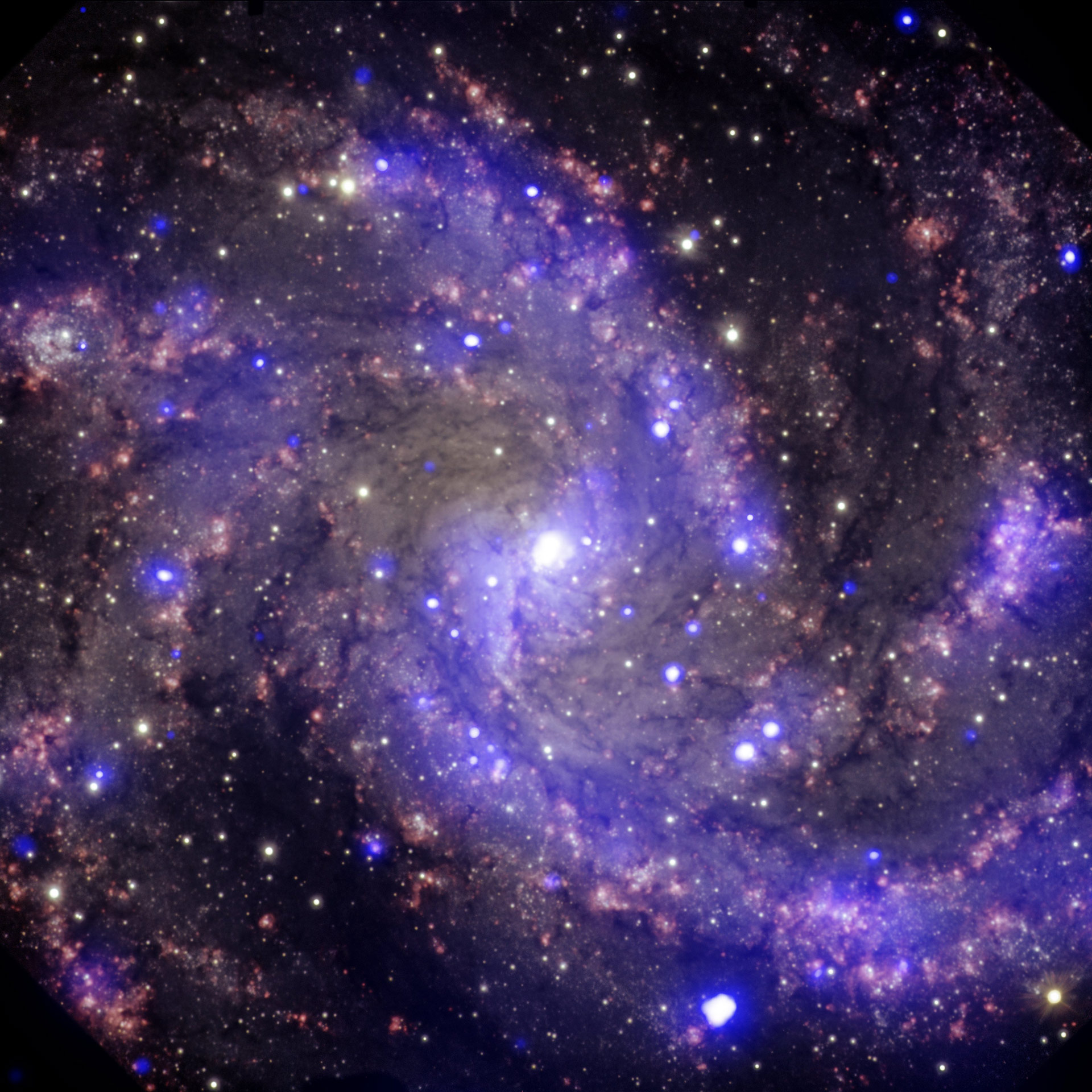
A recently held symposium by the HMS Department of Genetics asked experts to consider how genetic research can help people colonize other planets.
If you haven’t thought about reworking the human genome so people can colonize other planets, don’t worry. Plenty of people are on it.
Scientists of many stripes have been figuring out what barriers would keep us from calling distant, inhospitable galactic real estate “home” if—or when, depending on your point of view— we damage the Earth enough to face extinction. And then there’s the whole question of whether we should try to win a stay of execution for our species. After all, what makes us so special?
Those questions were just the beginning of a free-form symposium hosted March 13 by the HMS Department of Genetics on “Genetics, Biomedicine, and the Human Experience in Space,” the standing-room-only crowd in attendance fueled by pizza and unbridled curiosity.
Speakers quickly made clear why space travel and exploration over vast, uncharted distances depends on numerous, unknown factors hidden in our genes. Living with microgravity while being bombarded with cosmic rays can affect different people in different ways. Scientists want to know why—and which genes might make it better or worse.
Also, space is just cool.
The Role of Genetics
The session unleashed uninhibited discussion, with a fairly even split between prepared presentations and informed thinking-out-loud improv from the audience.
Before the event, symposium co-organizers Ting Wu and Susan Dymecki, both HMS professors of genetics, stated their belief that genetics will play a huge part in the success of humans off the planet.
“We are a medical school. Whether or not you agree with sending people into space, we are responsible for their health on and off the planet,” said Wu.
Well-known muscle and skeletal weakness and sleep disruption are not the only problems humans encounter in space. Physical concerns ride along with behavioral and neuropsychiatric issues aboard current spacecraft, not to mention whatever vehicles might ferry people farther away. It’s lonely out there.
Thinking about travel to Mars, one of our nearest neighbors, is daunting for robots, much less people. Just ask symposium guest Adam Steltzner, mechanical systems lead at the Jet Propulsion Lab, about the prodigious work that brought back what we know about the planet. Or Dorit Donoviel, deputy chief scientist and industry forum lead of the National Space Biomedical Research Institute, and assistant professor in the Department of Pharmacology and Center for Space Medicine at Baylor College of Medicine, who studies astronauts and the challenges they face, including problems with vision and headaches.
Focusing on Space
HMS geneticists spoke about the intersections between their scientific focus and space. Susan Dymecki said she began thinking about why cosmonauts in the former Soviet Union’s space program were forbidden from playing chess on board space flights. The answer involves aggression and impulsivity.
For HMS professor of genetics David Sinclair, this intersection involves the potential advantages of extant human variation and rallying our genetics to counter aging during long-distance travel spanning hundreds of thousands of years.
Bruce Yankner, HMS professor of genetics, talked about protecting the brain and memory in space. Wu presented her vision for using ultraconserved elements, which some consider to be among the most mysterious sequences of the human genome, to orchestrate chromosome behavior and thus protect genomes against cosmic radiation in space.
Mary Bouxsein, a biomechanical engineer and HMS assistant professor of orthopedic surgery at Beth Israel Deaconess Medical Center, a last-minute addition to the program, showed the devastating effects of space flight on bone, and how that might be prevented in space—and on Earth — with a newly developed therapy.
Genetics professor Gary Ruvkun, whose talk was entitled “What’s true for E. coli is true for the elephant” and our speculative kin on Gliese 667 Cf, (a potential Class M planet in the Gliese 667 star system), peppered the meeting with a positive view of the extinction of the human species and then proposed that, rather than travel to another planet, we “print” ourselves there. Conversely, we could print extraterrestrial life on Earth.
George Church, the Robert Winthrop Professor of Genetics, suggested using genomics to identify and engage human protective variants, speculating that, by ridding ourselves of our microbiome and taking advantage of variants that suppress pain, we might create a habitat in which surgeries can occur without anesthesia or need for sterilization.
Space is vast, cold, and hard for us humans, and outside of Earth, its planets, and moons—too hot, too cold, too toxic for life that evolved here— are not much more welcoming. Should we want to go there, and decide who is best suited to do so, a great deal more work needs to be done not only in jet propulsion but in human genetics.
Never miss a breakthrough: Join the SciTechDaily newsletter.
Follow us on Google and Google News.