

Climate Engineering Could Slow Antarctic Ice Loss
Scattering sunlight-reflecting particles in the atmosphere could slow rapid melting in West Antarctica and reduce the risk of catastrophic sea-level rise, according to a study led by Indiana University researchers.
The study, one of the first to look at how climate engineering might impact Antarctica, comes as scientists sound the alarm over the increasing likelihood of accelerated ice loss in West Antarctica this century. The work appears in the Journal of Geophysical Research: Atmospheres.
“Even if the world meets the ambitious target of limiting global warming to 1.5 degrees Celsius above pre-industrial levels — which we are not on track to do — we are going to see significant sea-level rise,” said Paul Goddard, an assistant research scientist in the IU College of Arts and Sciences’ Department of Earth and Atmospheric Sciences and the lead author of the study. “Exploring ways to reflect sunlight into space before it is absorbed into Earth’s climate system could help buy us more time to address climate change and avoid or delay climate tipping points, such as collapse of the West Antarctic Ice Sheet.”
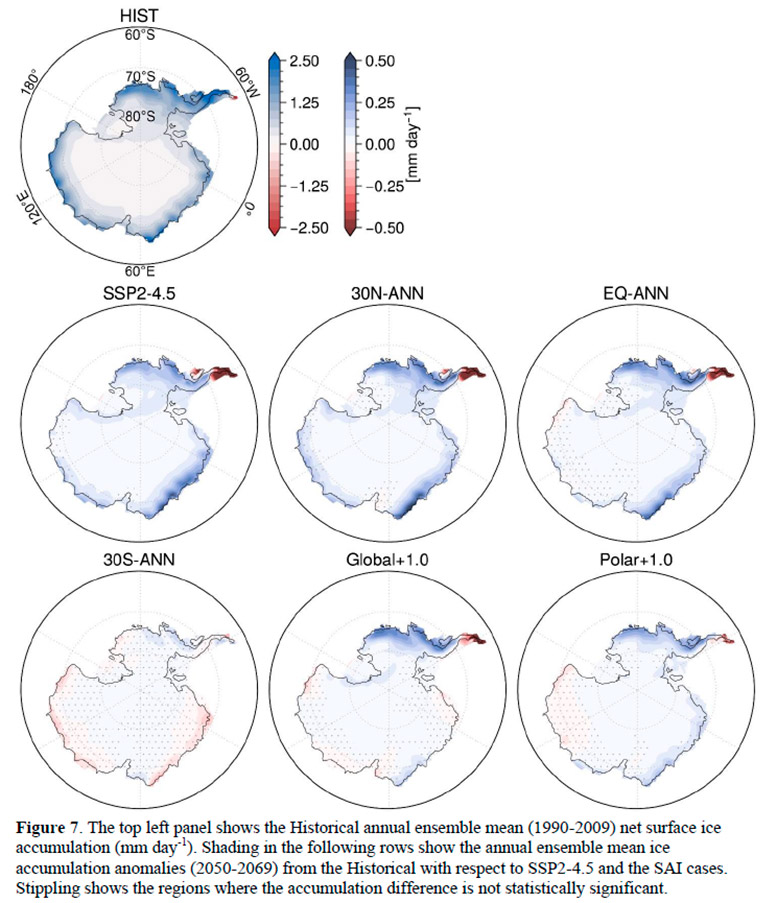
Scenario abbreviations: HIST (historical date from 1990-2009); SSP2-4.5 (moderate emissions scenario with no SAI); 30N-ANN (SAI at 30°N annually); EQ-ANN (SAI at the equator annually); 30S-ANN (SAI at 30°S annually); Global +1.0 (SAI at 30°N 30°N, 15°N, 15°S, 30°S annually), Polar +1.0 (SAI at 60°N, 60°S during the boreal spring and austral spring). Credit: Indiana University
In addition to Goddard, co-authors on the paper include IU earth and atmospheric sciences assistant professor Ben Kravitz; Douglas MacMartin and Daniele Visioni of Cornell University; Ewa Bednarz with the National Oceanic and Atmospheric Administration; and Walker Lee of the National Center for Atmospheric Research.
Stratospheric Aerosol Injection
The study explored a form of climate engineering called stratospheric aerosol injection, in which large amounts of tiny sulfur droplets are released into the stratosphere by a fleet of airplanes as a proposed method for keeping global temperatures in check.
The approach mimics what happens when a large volcano spews vast amounts of particles into the upper atmosphere and precipitates a cooling effect that can last months to years. It was recently discussed in a White House report outlining a potential research program on stratospheric aerosol injection and marine cloud brightening, another proposed strategy for cooling the planet.
Ten of the hottest years on record have occurred in the past 14 years. That’s including 2023, which is on track to supplant 2016 as the hottest year ever recorded. The spike in global temperatures has coincided with unprecedented heat waves, wildfires, flash flooding and other climate-related impacts around the world.

Computer Simulations
In their study, IU researchers and collaborators used high-performance computers and global climate models to simulate different stratospheric aerosol injection scenarios, identifying the cooling strategy with the most potential to slow Antarctic ice loss. A portion of the data analysis conducted for the study took place on IU University Information Technology Services’ large-memory computer cluster, Carbonate.
“Where you release the aerosols matters a lot and can affect the climate differently,” Goddard said. “In this case, we found that releasing stratospheric aerosols at multiple latitudes within the tropics and sub-tropics, with a greater proportion in the Southern Hemisphere, is the best strategy for preserving land ice in Antarctica because it helps keep warm ocean waters away from the ice shelves.”

Different Scenarios and Findings
Researchers simulated 11 different stratospheric aerosol injection scenarios. Three cases spanned multiple latitudes — considered the most likely approach for how stratospheric aerosols injection might be implemented — with temperature targets of 1.5, 1 and 0.5 degrees Celsius above pre-industrial levels. The simulations, which started in 2035 and ran through 2070, included a moderate emissions scenario with no stratospheric aerosol injection that served as a key point of comparison.
Though simulated scenarios with stratospheric aerosol injection at multiple latitudes showed benefits in terms of Antarctic ice loss, further study is needed to quantify the change in melt rates, Goddard said.
Notably, several single-latitude injection scenarios actually accelerated Antarctic ice loss due to a southward shift of prevailing winds drawing warm ocean waters toward the ice shelves.
“If we’re ever going to engineer the climate, how we do it really matters,” Goddard said.
Some of the risks related to stratospheric aerosol injection, for example, include changes in regional precipitation patterns and the possibility of “termination shock,” a rapid rebound of global temperatures to pre-stratospheric aerosols injection levels should the decades-long treatment be interrupted.
Broadening Understanding of Geoengineering
The study adds to an expanding body of knowledge about the benefits and drawbacks of deliberately cooling the planet, a concept that is being discussed more widely as the effects of climate change become more prominent, Kravitz said.
“If society decides it wants to do geoengineering someday, we need to better understand what we know and what we don’t know,” he said. “We’re starting to fill some of these knowledge gaps on the risks and regional effects of managing solar radiation, but there’s a lot more research that needs to be done before anyone can say whether it’s a good idea to actually move forward with it. That’s true as much for Antarctica as it is for the rest of the planet.”
Reference: “Stratospheric Aerosol Injection Can Reduce Risks to Antarctic Ice Loss Depending on Injection Location and Amount” by P. B. Goddard, B. Kravitz, D. G. MacMartin, D. Visioni, E. M. Bednarz and W. R. Lee, 15 November 2023, Journal of Geophysical Research: Atmospheres.
DOI: 10.1029/2023JD039434
Never miss a breakthrough: Join the SciTechDaily newsletter.
Follow us on Google and Google News.
3 Comments
HUBRIS!
So, like to gamble?
Of course, apart from computer modelling, the results of this harebrained scheme will have been tested to ensure it is safe and effective.
You know – just like the gene therapy “vaccines”!