
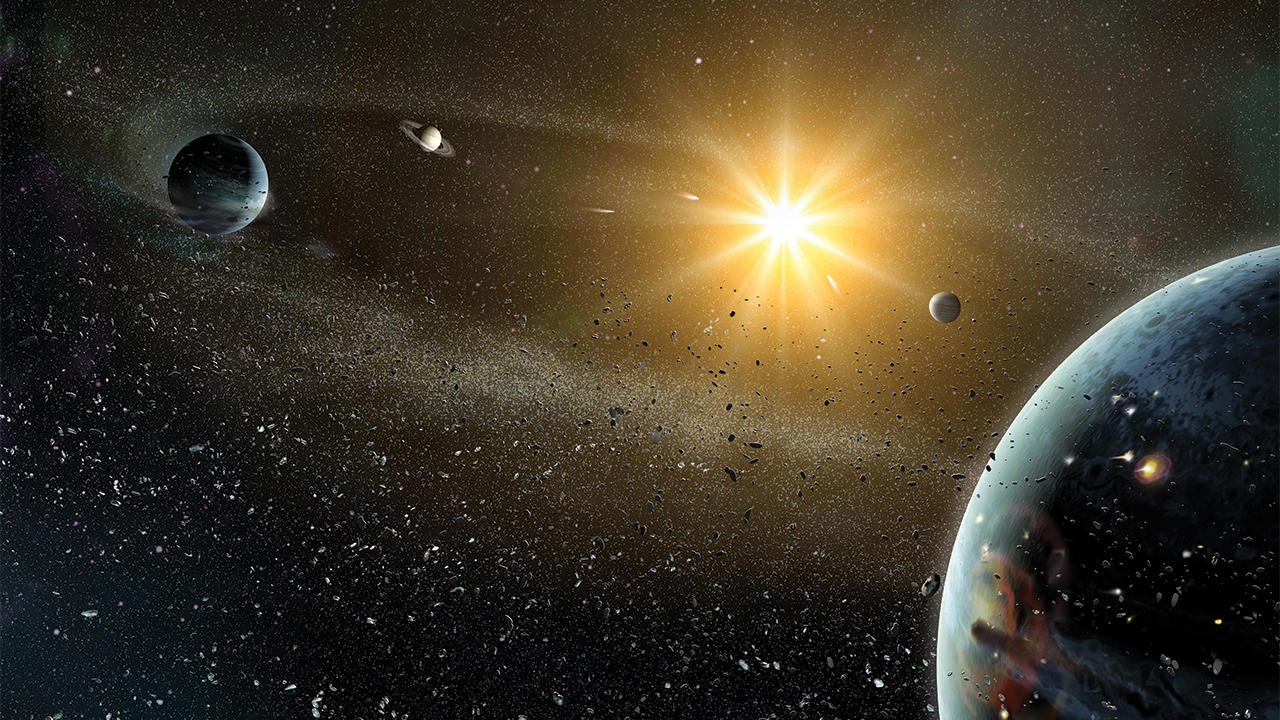
The research also reveals how they can prevent life in other solar systems.
In some planetary systems, large gas giants can act as agents of chaos, posing a threat to the habitability of their neighboring Earth-like planets. New studies show that these giants tend to kick smaller planets out of orbit and wreak havoc on their climates.
Jupiter, by far the biggest planet in our solar system, plays an important protective role. Its enormous gravitational field deflects comets and asteroids that might otherwise hit Earth, helping create a stable environment for life. However, giant planets elsewhere in the universe do not necessarily protect life on their smaller, rocky planet neighbors.
The Threat to the Habitable Zone
A new Astronomical Journal paper details how the pull of massive planets in a nearby star system are likely to toss their Earth-like neighbors out of the “habitable zone.” This zone is defined as the range of distances from a star that are warm enough for liquid water to exist on a planet’s surface, making life possible.
Unlike most other known solar systems, the four giant planets in HD 141399 are farther from their star. This makes it a good model for comparison with our solar system where Jupiter and Saturn are also relatively far from the sun.
“It’s as if they have four Jupiters acting like wrecking balls, throwing everything out of whack,” said Stephen Kane, UC Riverside astrophysicist and author of the journal paper.
Taking data about the system’s planets into account, Kane ran multiple computer simulations to understand the effect of these four giants. He wanted specifically to look at the habitable zone in this star system and see if an Earth could remain in a stable orbit there.
“The answer is yes, but it’s very unlikely. There are only a select few areas where the giants’ gravitational pull would not knock a rocky planet out of its orbit and send it flying right out of the zone,” Kane said.
Destructive Influence Beyond the Habitable Zone
While this paper shows giant planets outside the habitable zone destroying the chances for life, a second, related paper shows how one big planet in the middle of the zone would have a similar effect.
Also published in the Astronomical Journal, this second paper examines a star system only 30 light years away from Earth called GJ 357. For reference, the galaxy is estimated to be 100,000 light years in diameter, so this system is “definitely in our neighborhood,” Kane said.
Earlier studies found that a planet in this system, named GJ 357 d, resides in the system’s habitable zone and has been measured at about six times the mass of the Earth. However, in this paper titled “Agent of Chaos,” Kane shows the mass is likely much bigger.
“It’s possible GJ 357 d is as much as 10 Earth masses, which means it’s probably not terrestrial, so you couldn’t have life on it,” Kane said. “Or at least, it would not be able to host life as we know it.”
In the second part of the paper, Kane and his collaborator, UCR planetary science postdoctoral scholar Tara Fetherolf, demonstrate that if the planet is much larger than previously believed, it is certain to prevent more Earth-like planets from residing in the habitable zone alongside it.
Though there are also a select few locations in the habitable zone of this system where an Earth could potentially reside, their orbits would be highly elliptical around the star. “In other words, the orbits would produce crazy climates on those planets,” Kane said. “This paper is really a warning, when we find planets in the habitable zone, not to assume they are automatically capable of hosting life.”
Ultimately, the pair of papers shows how uncommon it is to find the right set of circumstances to host life elsewhere in the universe. “Our work gives us more reasons to be very grateful for the particular planetary configuration we have in our solar system,” Kane said.
References: “Surrounded by Giants: Habitable Zone Stability Within the HD 141399 System” by Stephen R. Kane, 10 October 2023, The Astronomical Journal.
DOI: 10.3847/1538-3881/acfb01
“GJ 357 d: Potentially Habitable World or Agent of Chaos?” by Stephen R. Kane and Tara Fetherolf, 20 October 2023, The Astronomical Journal.
DOI: 10.3847/1538-3881/acff5a
Never miss a breakthrough: Join the SciTechDaily newsletter.
Follow us on Google and Google News.