
New research on the Denali Fault reveals three geologic sites were once united in a suture zone, marking the integration of Wrangellia into North America. The study uses inverted metamorphism and monazite analysis to trace tectonic history.
New research has revealed that three sites along a 620-mile segment of Alaska’s Denali Fault were once part of a smaller, unified geologic structure, marking the final connection of two ancient land masses. Over millions of years, this structure was torn apart by tectonic forces.
The study, led by Sean Regan, an associate professor at the University of Alaska Fairbanks (UAF) Geophysical Institute and the UAF College of Natural Science and Mathematics, is featured on the cover of the December issue of Geology, the journal of the Geological Society of America.
Regan served as the lead author of the research paper, with contributions from UAF doctoral student McKenzie Miller, recent master’s graduate Sean Marble, and research assistant professor Florian Hofmann. Additional co-authors represent St. Lawrence University, the South Dakota School of Mines and Technology, and the University of California, Santa Barbara.
Importance of the Denali Fault
“Our understanding of lithospheric growth, or plate growth, along the western margin in North America, is becoming clearer, and a big part of that is related to the reconstruction of strike-slip faults such as the Denali Fault,” Regan said. “We’re starting to recognize those primary features involved in the stitching, or the suturing, of once-distant land masses to the North American plate.”
The research focused on formations at three locations: the Clearwater Mountains of Southcentral Alaska, the Kluane Lake region of Canada’s southwestern Yukon, and the Coast Mountains near Juneau. Previous thinking among geologists is mixed, with some suggesting the three locations formed individually.
Regan’s historical reconstruction of 300 miles of horizontal movement on the Denali Fault over millions of years found that the three locations at one time formed a terminal suture zone. A terminal suture zone represents the final integration of tectonic plates or crustal fragments into a larger mass.
Regan’s work defines one of several places where the Wrangellia Composite Terrane, an oceanic plate that originated far from its current position, accreted to the western edge of North America between 72 million and 56 million years ago.
“When you think about geologists crawling around Earth’s surface trying to understand what the heck happened, it makes some sense that they might not link things that are so far apart,” Regan said of the three sites he studied. “With different geologists working in different areas, the dots don’t really get connected until you can reconstruct deformation on the Denali Fault.”
Role of Inverted Metamorphism
Regan’s reconstruction focused on the three sites’ inverted metamorphism, a geological phenomenon where rocks formed under higher temperatures and pressures are found overlying rocks formed under lower temperatures and pressures. This is the reverse of the typical sequence observed in regional metamorphism, where temperature and pressure generally increase with depth.
Inverted metamorphism is a key indicator of tectonic complexity and helps geologists reconstruct the processes of crustal deformation and mountain building.
“We showed that each of these three independent inverted metamorphic belts all formed at the same time under similar conditions,” Regan said. “And all occupy a very similar structural setting. Not only are they the same age, they all behaved in a similar fashion. They decrease in age, structurally, downward.”
Regan connected the three locations by analyzing their monazite, which consists of the rare earth elements lanthanum, cerium, neodymium, and sometimes yttrium. He collected monazite from the two Alaska locations and used Kluane data published earlier in the year by another scientist.
“It is just the most special little mineral,” Regan said. “It can participate in a lot of reactions, so we can use it as a way to track the mineralogical evolution of a rock.”
Regan began his quest after reading a 1993 paper by researchers at the University of Alberta and the University of British Columbia and published in Geology. That paper asserted similarities in the Denali Fault region later studied by Regan, but only went as far as labeling them as a single metamorphic-plutonic belt.
A metamorphic-plutonic belt is a region characterized by the close association of metamorphic rocks and plutonic rocks that form as a result of intense tectonic activity, typically during mountain-building processes. These belts are commonly found in areas where tectonic plates converge.
“It was amazing to me that the 1993 paper hadn’t caught more attention back in the day,” Regan said. “I had this paper hung up on my wall for the last four years, because I thought it was really ahead of its time.”
Reference: “Orogen-scale inverted metamorphism during Cretaceous–Paleogene terminal suturing along the North American Cordillera, Alaska, USA” by Sean P. Regan, Mark E. Holland, Trevor S. Waldien, McKenzie Miller, Peter Taylor, Andrew Kylander-Clark, Sean Marble and Florian Hofmann, 11 October 2024, Geology.
DOI: 10.1130/G52614.1
Never miss a breakthrough: Join the SciTechDaily newsletter.
Follow us on Google and Google News.
7 Comments
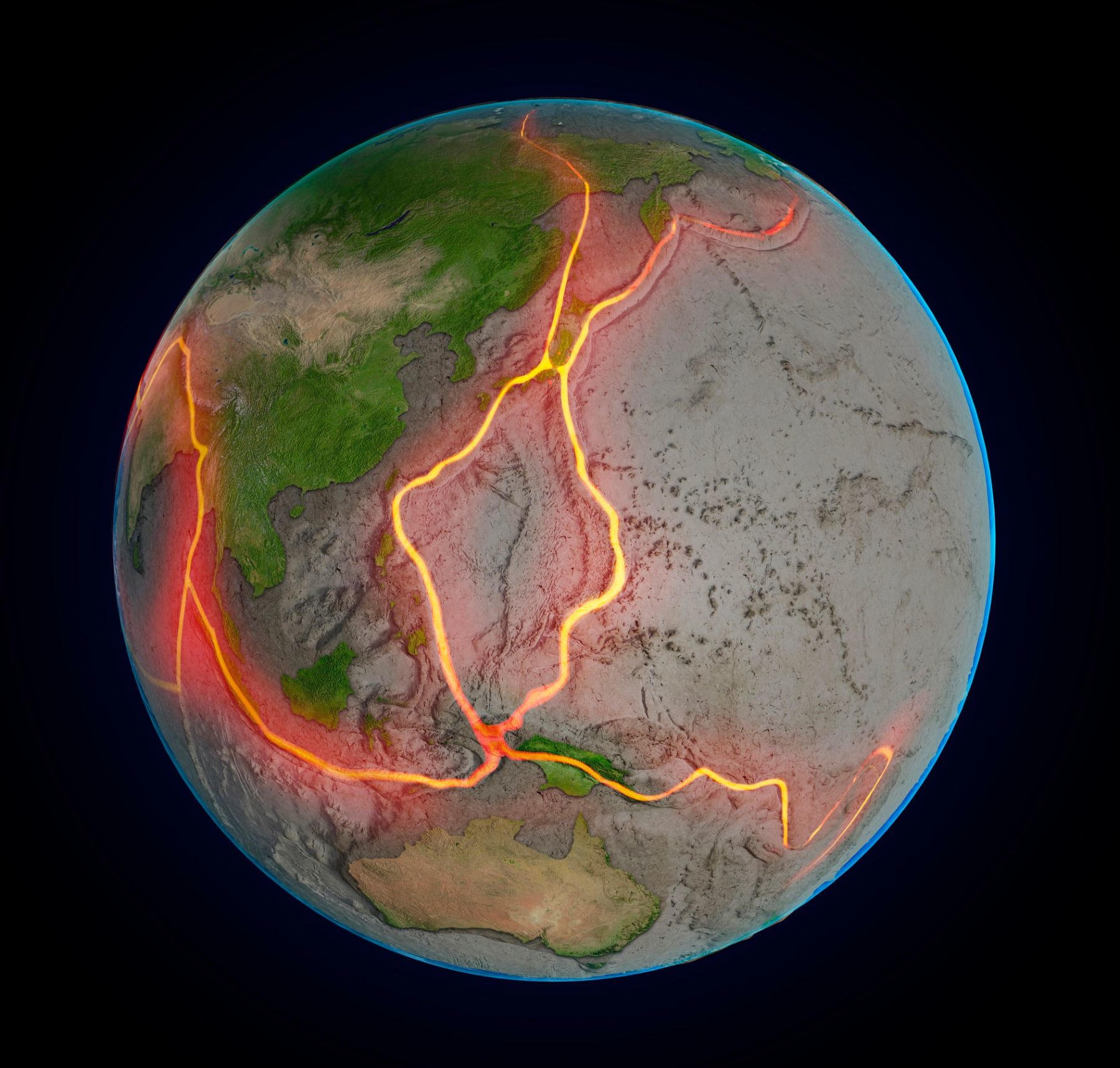
Never heard of the Denali Faults or Wrangellia. What’s stranger is that the illustration virtually ignores Alaska & instead presents plates of the western Pacific.
Or the TIntina fault. Look for Nick Zentner “Alaska A-Z” series on YouTube to learn more.
Perhaps a word was mistakenly omitted from the title. “Denali Fault’s discontinuity” (or something like that) would make sense.
The Wrangellia Terrane is a well-known subject among North American geologists, and the Denali Fault is for real — in fact, it produced a big earthquake in 2002 that made news around the world.
The illustration, as John Bayer noted, is not particularly helpful in this context.
All in all, it’s an interesting and seemingly factual research news item. Maybe the author should have taken a little more time to recover from the holiday before posting it.
It’s a late reposting of an earlier university press release first presented Dec 19 of an October published paper, well before the holidays (see “UAF news and information” pages), with proper illustrations.
The author, Rod Boyce, is not responsible for SdiTechDaily (mis)illustrations. But the adaptation is somewhat problematic, SciTechDaily hasn’t properly credited Boyce and has reworded the initial parts more than seem necessary.
The preasumention over million years of past,what it was itself is an landmark,so what today’s morden society is well equipped to handle the advert………