
Close Menu
    Facebook X (Twitter) Instagram
    SciTechDaily
    • Biology
    • Chemistry
    • Earth
    • Health
    • Physics
    • Science
    • Space
    • Technology
    Facebook X (Twitter) Pinterest YouTube RSS
    SciTechDaily
    Home»Physics»Giant Nonlinearity of UV Hybrid Light-Matter States With a Wide Bandgap Semiconductor Waveguide
    Physics

    Giant Nonlinearity of UV Hybrid Light-Matter States With a Wide Bandgap Semiconductor Waveguide

    By EPFLJune 9, 2021No Comments3 Mins Read
    Facebook Twitter Pinterest Telegram LinkedIn WhatsApp Email Reddit
    Share
    Facebook Twitter LinkedIn Pinterest Telegram Email Reddit
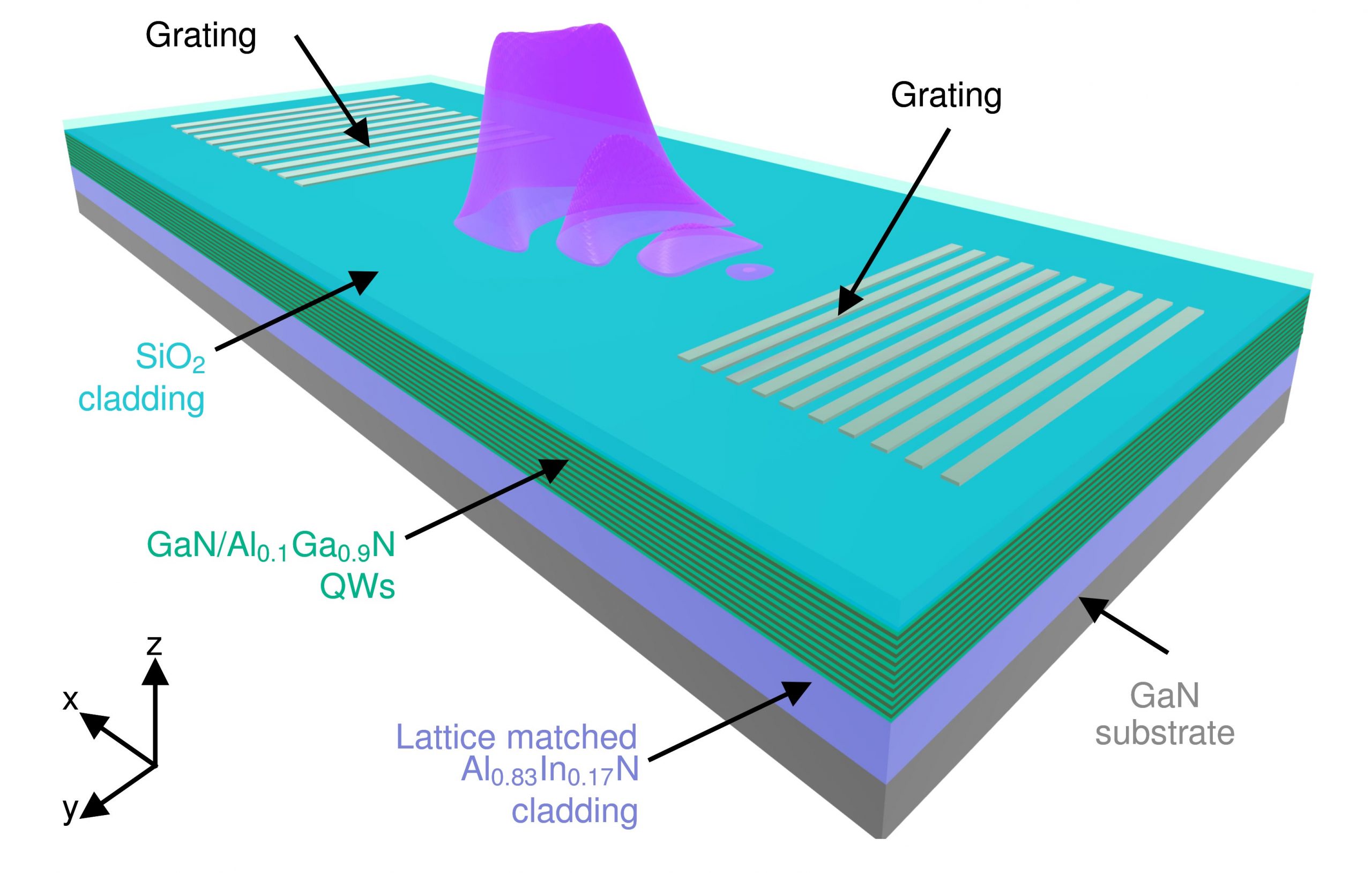
    AlInGaN Polariton Waveguide Structure Schematic
    Schematic of AlInGaN polariton waveguide structure. Credit: Dr. Paul Walker, University of Sheffield

    Breakthrough UV photonics with AlInGaN enables room-temperature ultrafast nonlinearity.

    The field of ultrafast nonlinear photonics has now become the focus of numerous studies, as it enables a host of applications in advanced on-chip spectroscopy and information processing. The latter in particular requires a strongly intensity-dependent optical refractive index that can modulate optical pulses faster than even picosecond timescales and on sub-millimeter scales suitable for integrated photonics.

    Despite the tremendous progress made in this field, there is currently no platform providing such features for the ultraviolet (UV) spectral range, which is where broadband spectra generated by nonlinear modulation can be used for new on-chip ultrafast chemical and biochemical spectroscopy devices.

    Now, an international team of scientists including EPFL has achieved giant nonlinearity of UV hybrid light-matter states (“exciton-polaritons”) up to room temperature in a waveguide made of AlInGaN, a wide bandgap semiconductor material behind the solid-state lighting technology (e.g. white LEDs) and blue laser diodes.

    Published in Nature Communications, the study is a collaboration between the University of Sheffield, ITMO Saint Petersburg, Chalmers University of Technology, the University of Iceland, and the LASPE at EPFL’s Institute of Physics of the School of Basic Sciences.

    . Record-Breaking UV Nonlinear Performance

    The scientists used a compact 100 μm-long device, to measure an ultrafast nonlinear spectral broadening of UV pulses with a nonlinearity 1000 times larger than that observed in common UV nonlinear materials, which is comparable to non-UV polariton devices.

    Using AlInGaN is a significant step toward a new generation of integrated UV nonlinear light sources for advanced spectroscopy and measurement. “The AlInGaN system is a highly robust and mature semiconductor platform that shows strong excitonic optical transitions up to room temperature in the UV spectral range,” says EPFL’s Raphaël Butté, who worked on the study.

    The authors state: “The nonlinear exciton interactions in our system are comparable to those in other polariton material systems, such as GaAs and perovskites, which, however, do not simultaneously operate in the UV and up to room temperature.”

    Reference: “Ultrafast-nonlinear ultraviolet pulse modulation in an AlInGaN polariton waveguide operating up to room temperature” by D. M. Di Paola, P. M. Walker, R. P. A. Emmanuele, A. V. Yulin, J. Ciers, Z. Zaidi, J.-F. Carlin, N. Grandjean, I. Shelykh, M. S. Skolnick, R. Butté and D. N. Krizhanovskii, 9 June 2021, Nature Communications.
    DOI: 10.1038/s41467-021-23635-6

    Never miss a breakthrough: Join the SciTechDaily newsletter.
    Follow us on Google and Google News.

    Electrical Engineering Electromagnetics EPFL Materials Science Photonics Semiconductors
    Share. Facebook Twitter Pinterest LinkedIn Email Reddit

    Related Articles

    Scientists Reinvent a Classic Material To Help Power the Future of Quantum Tech

    Newly Proven Physics: Smuggling Light Through Opaque Materials

    First Experimental Reconstruction of a Bloch Wavefunction

    Topological Circuits That Force Photons To Never Bounce Back

    Breakthrough Discovery Could Help Electronic Devices Last Longer

    Innovative Technology for Building Ultralow-Loss Integrated Photonic Circuits

    Surprise in Solid-State Physics: Magnetic Effect Without a Magnet

    Researchers Combine Excited States of Two Materials into a New Quantum Mechanical State

    Metamaterials Amplify the Photonic Spin Hall Effect

    Leave A Reply Cancel Reply

    • Facebook
    • Twitter
    • Pinterest
    • YouTube

    Don't Miss a Discovery

    Subscribe for the Latest in Science & Tech!

    Trending News

    Artificial Sweeteners May Harm Future Generations, Study Suggests

    Splashdown! NASA Artemis II Returns From Record-Breaking Moon Mission

    What If Consciousness Exists Beyond Your Brain

    Scientists Finally Crack the 100-Million-Year Evolutionary Mystery of Squid and Cuttlefish

    Beyond “Safe Levels”: Study Challenges What We Know About Pesticides and Cancer

    Researchers Have Found a Dietary Compound That Increases Longevity

    Scientists Baffled by Bizarre “Living Fossil” From 275 Million Years Ago

    Your IQ at 23 Could Predict Your Wealth at 27, Study Finds

    Follow SciTechDaily
    • Facebook
    • Twitter
    • YouTube
    • Pinterest
    • Newsletter
    • RSS
    SciTech News
    • Biology News
    • Chemistry News
    • Earth News
    • Health News
    • Physics News
    • Science News
    • Space News
    • Technology News
    Recent Posts
    • What if Dark Matter Has Two Forms? Bold New Hypothesis Could Explain a Cosmic Mystery
    • Researchers Expose Hidden Chemistry of “Ore-Forming” Elements in Biology
    • Geologists Reveal the Americas Collided Earlier Than We Thought
    • 20x Difference: Study Reveals True Source of Airborne Microplastics
    • Scientists Uncover Hidden Force Powering Yellowstone’s Supervolcano
    Copyright © 1998 - 2026 SciTechDaily. All Rights Reserved.
    • Science News
    • About
    • Contact
    • Editorial Board
    • Privacy Policy
    • Terms of Use

    Type above and press Enter to search. Press Esc to cancel.