

A glacier in Antarctica is rapidly redirecting ice from a neighboring glacier, revealing a new and urgent dynamic in ice flow with implications for global sea-level rise.
A glacier in Antarctica is committing what scientists call “ice piracy,” stealing ice from a neighboring glacier in a way that has never before been observed over such a short period.
Until now, this kind of glacial behavior was thought to occur over hundreds or even thousands of years.
But new high-resolution satellite data shows that one large glacier has been steadily diverting ice from its slower-moving neighbor over less than 18 years.
Researchers from the University of Leeds say it is unprecedented to directly observe this kind of change in the direction of ice flow within Antarctica in such a short timespan. They consider the discovery a key step in understanding Antarctica’s future and its impact on global sea level rise.
The findings were published in the journal The Cryosphere.
The study, led by the University of Leeds, found that seven ice streams in West Antarctica have sped up since 2005. One stream nearly doubled in speed by 87 percent at the point where the glacier meets the ocean, while three others increased by 60 to 84 percent. In 2022, six of the streams reached average speeds of more than 700 meters per year—roughly the length of seven football pitches, which is exceptionally fast for glacial movement.
The research team used satellite imagery to track changes in ice speed across the Pope, Smith, and Kohler (PSK) region of West Antarctica.
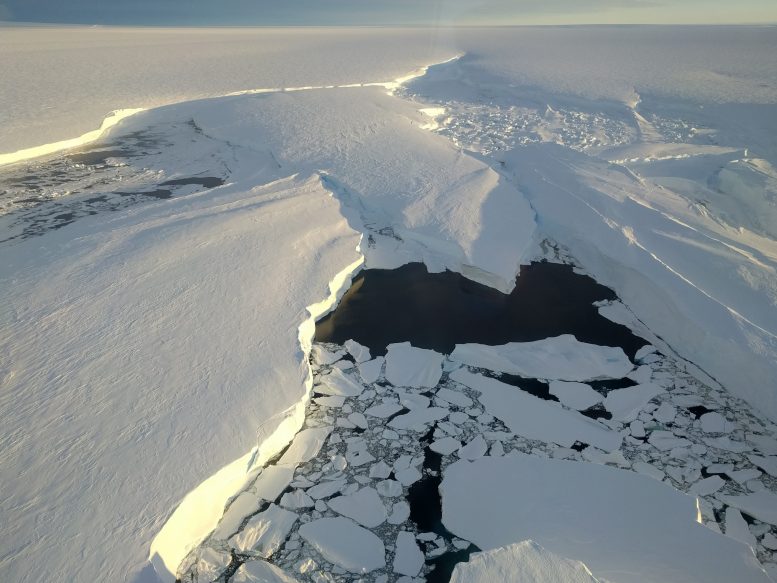
On average, ice streams at the grounding line—the point where glaciers and ice shelves begin to float—accelerated by 51 percent since 2005. These grounding lines are key indicators of ice-sheet instability, as shifts in their position reveal an imbalance with ocean conditions and influence how ice flows further inland.
However, the research team found that one piece of data was particularly striking.
In stark contrast to the widespread acceleration observed between 2005 and 2022 on all other glaciers in the region, the ice stream on Kohler West slowed by 10%. The fastest rate of speed change was observed on its neighbor, Kohler East, as well as Smith West Glacier, which were flowing around 560 m/yr faster in 2022 compared to 2005.
Nowadays, several glaciers around Antarctica are responding to climate change by flowing faster into the ocean. When the flow of a glacier speeds up, its ice becomes more stretched and thins at the same time, yet the Kohler West ice stream has slowed down.
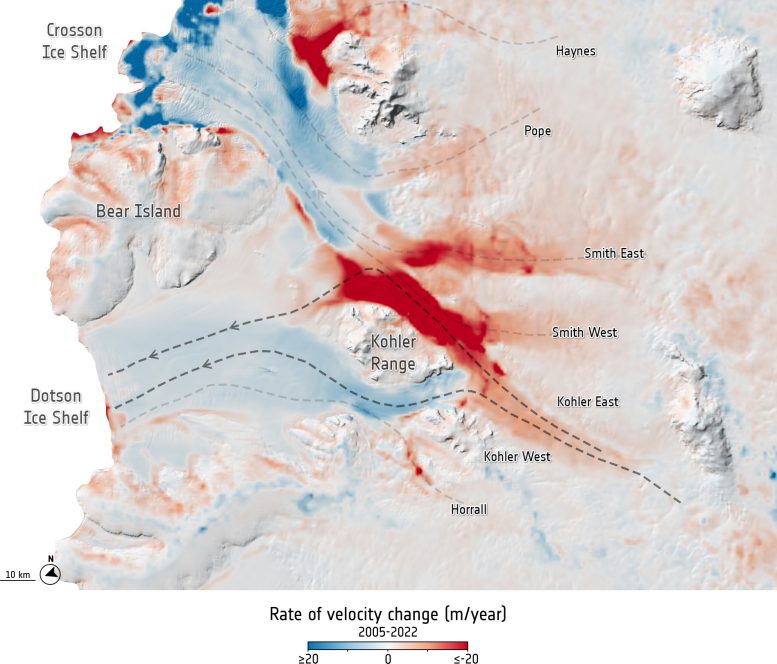
Lead author Dr Heather L. Selley, who undertook this work as a PhD researcher in the School of Earth and Environment at the University of Leeds, said: “We think that the observed slowdown on Kohler West Glacier is due to the redirection of ice flow towards its neighbor, Kohler East. This is due to the large change in Kohler West’s surface slope, likely caused by the vastly different thinning rates on its neighboring glaciers.
“Because Kohler East’s ice stream is flowing and thinning faster as it travels, it absorbs, or “steals” ice from Kohler West.
“This is effectively an act of ‘ice piracy’, where ice flow is redirected from one glacier to another, and the accelerating glacier is essentially ‘thieving’ ice from its slowing neighbor.”
She added: “We didn’t know ice streams could ‘steal’ ice from each over such a short period, so this is a fascinating discovery.
“It’s unprecedented as we’re seeing this from satellite data and it’s happening at a rate of under 18 years, whereas we’ve always thought it was this extremely long, slow process.”
International collaboration
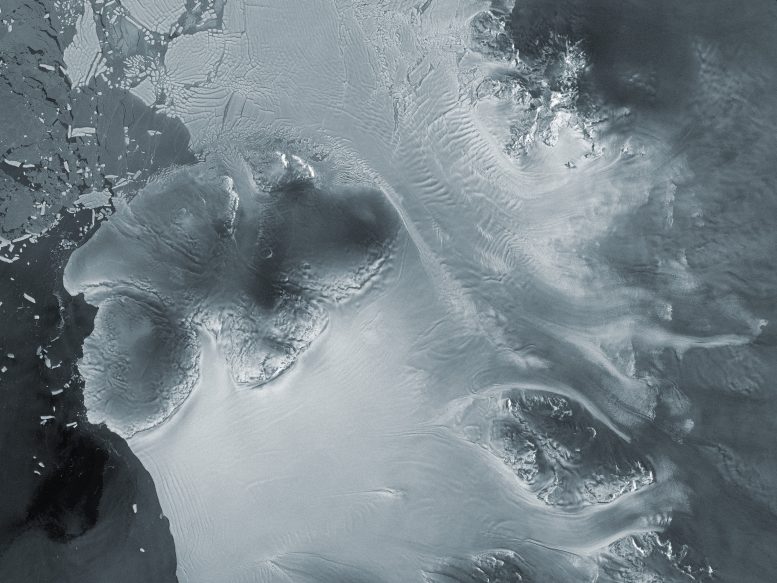
The team calculated the ice velocity using a tracking technique which measures the displacement of visible features at or near the ice surface, such as crevasses or rifts. Data on ice-thinning rates from the European Space Agency’s (ESA) CryoSat mission was also used in the study.
Leeds worked in collaboration with researchers from the British Antarctic Survey (BAS) and the UK Centre for Polar Observation and Modelling (CPOM) which is led from Northumbria University, on the study, using data provided by satellites belonging to ESA, Japan Aerospace Exploration Agency, Canadian Space Agency, and NASA.
Pierre Dutrieux, study co-author and climate researcher at BAS, said: “This study provides an interesting demonstration of ice piracy, where flow into one glacier gradually switches to flow into another glacier, as the ocean melts the grounding zone and re-configures ice flow.”
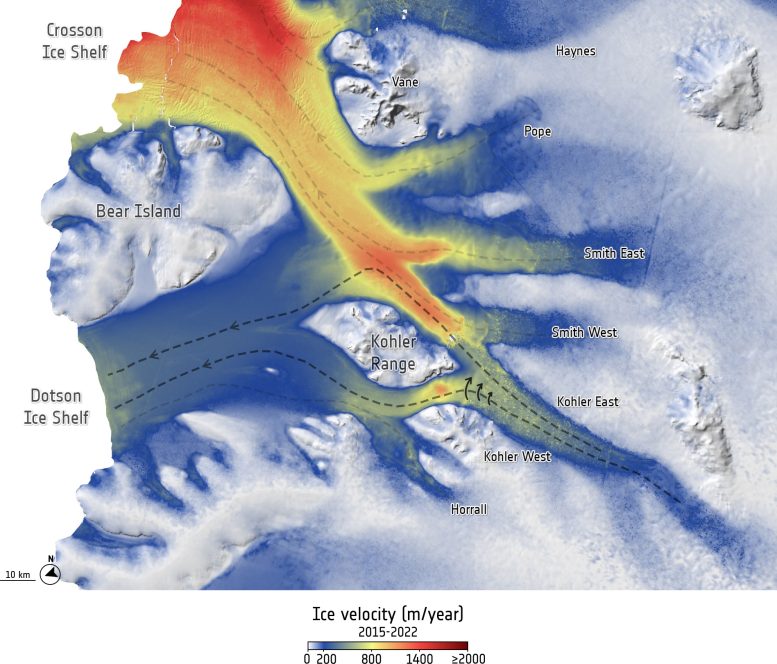
The team set out to establish mechanisms and impact of changes in conditions that impact how fast the ice flows, such as warming of the ocean, change in ocean circulation, change in air temperature, and the amount of snow falling.
They found that redirection of ice flow and ‘piracy’ at previously unobserved rates has changed the amount of ice flowing into the floating shelves that are fed by these streams.
Crosson Ice Shelf, around 40 miles wide – roughly the distance from Leeds to Manchester – and Dotson ice shelf, around 30 miles wide – roughly the distance from Leeds to York – are two of the most rapidly changing outlets in West Antarctica, displaying both significant thinning and grounding-line retreat in recent decades.
Future effects
Professor Anna Hogg, study co-author and Professor of Earth Observation in Leeds’ School of Earth and Environment, said: “The changes in flow direction have substantially altered the ice mass flux into Dotson and Crosson Ice Shelves, likely playing an important role in maintaining Dotson and accelerating the deterioration of Crosson.
“This suggests that ice flow redirection is an important new process in contemporary ice sheet dynamics, which is required to understand present-day structural change in glaciers and the future evolution of these systems.”
Over 410 million people could be at risk from rising sea levels by 2100 as a result of the climate crisis. Observed sea level rise data shows that global sea levels have already risen by more than 10 cm over the last decade.
Dr Martin Wearing, ESA Digital Twin Earth Scientist and Polar Science Cluster Coordinator, said, “This new study highlights the unique ability of satellites to provide both the temporal and spatial coverage required to assess change in the polar regions.
“Using data from Copernicus Sentinel-1 and ESA’s Earth Explorer CryoSat, the team has revealed the complex evolution of ice flow in part of West Antarctica over the past few decades. Understanding these changing dynamics and what drives them is crucial for improved projections of future ice-sheet change and contributions to sea-level rise.”
Reference: “Speed-up, slowdown, and redirection of ice flow on neighboring ice streams in the Pope, Smith, and Kohler region of West Antarctica” by Heather L. Selley, Anna E. Hogg, Benjamin J. Davison, Pierre Dutrieux and Thomas Slater, 8 May 2025, The Cryosphere.
DOI: 10.5194/tc-19-1725-2025
The research was funded by UKRI Natural Environment Research Council (NERC), ESA and NASA Headquarters.
Never miss a breakthrough: Join the SciTechDaily newsletter.
Follow us on Google and Google News.
3 Comments
I find these articles very interesting. And information
That one need to no..
There also appears to be reports of Antarctica making ice,particularly in the last 12 months…. Are those findings considered correct….
The continent of Antarctica has different conditions make a unique and it’s phenomenon bizarre that’s make it interesting and amusing as it’s not discovery in our iwn planet. (I apologize, English is not my first language)