
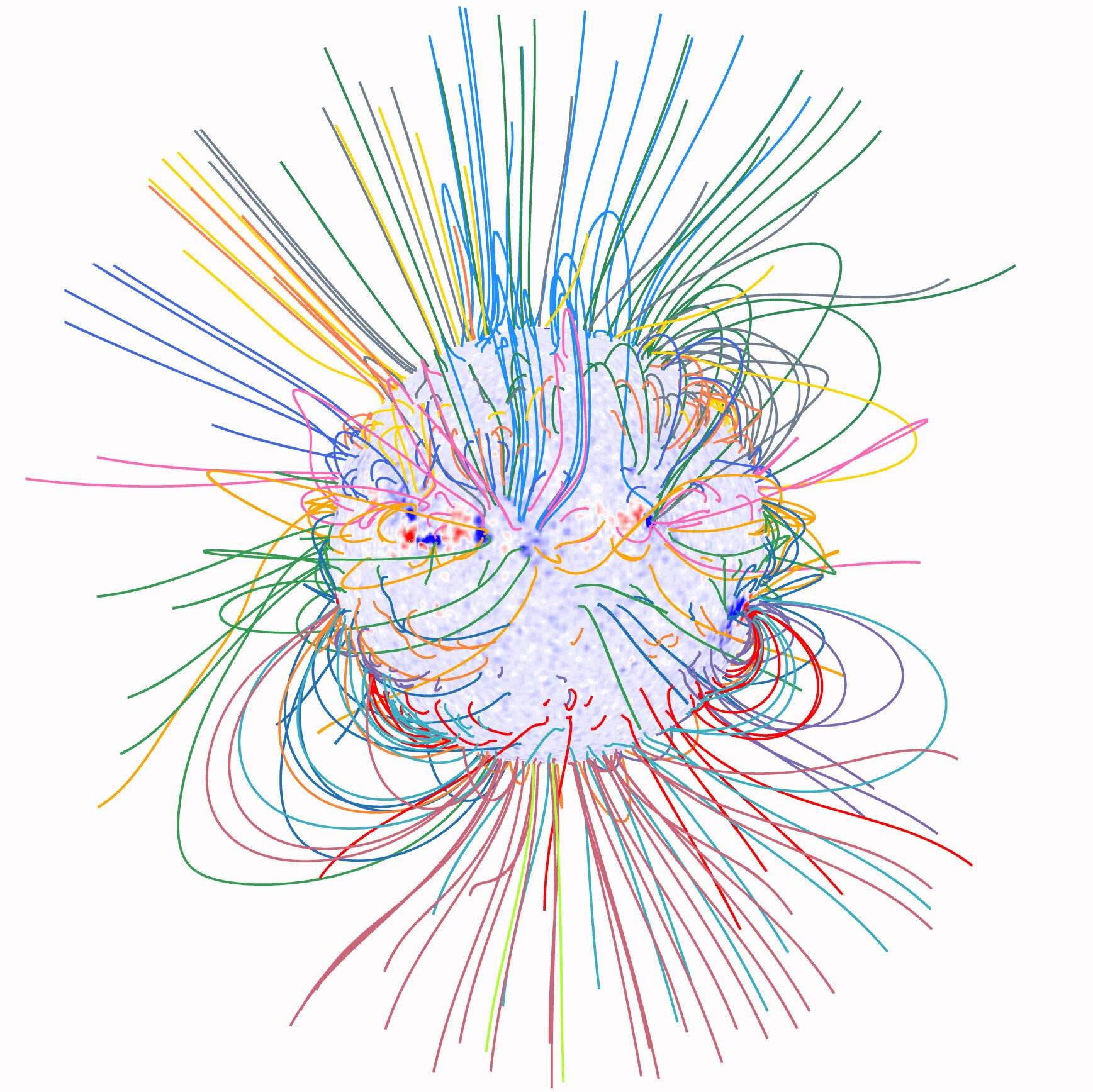
An international team led by Professor Tian Hui from Peking University has recently measured the global magnetic field of the solar corona for the first time. The team used observations from the Coronal Multi-channel Polarimeter, an instrument designed by Dr. Steve Tomczyk at the National Center for Atmospheric Research, USA. Their results have been recently published in the magazines of Science and Science China Technological Sciences. Yang Zihao, a first-year graduate student at Peking University, is the first author of both papers.
The Sun is a magnetized star, and its magnetic field plays a critical role in shaping the solar atmosphere. The 11-year solar cycle, the spectacular solar eruptions, and the million-degree solar corona are all driven or governed by the evolution of the solar magnetic field. Due to the magnetic coupling of different atmospheric layers, information on the magnetic field of the whole atmosphere is required to study the interplay between the solar plasma and magnetic field. However, routine measurements of the solar magnetic field have only been achieved at the photospheric level (solar surface). More than one century has passed since the first measurement of the solar magnetic field, we still do not have a precise knowledge of the magnetic field in the upper solar atmosphere, especially the corona, which impedes our complete understanding of the solar magnetism and its interaction with the solar plasma.
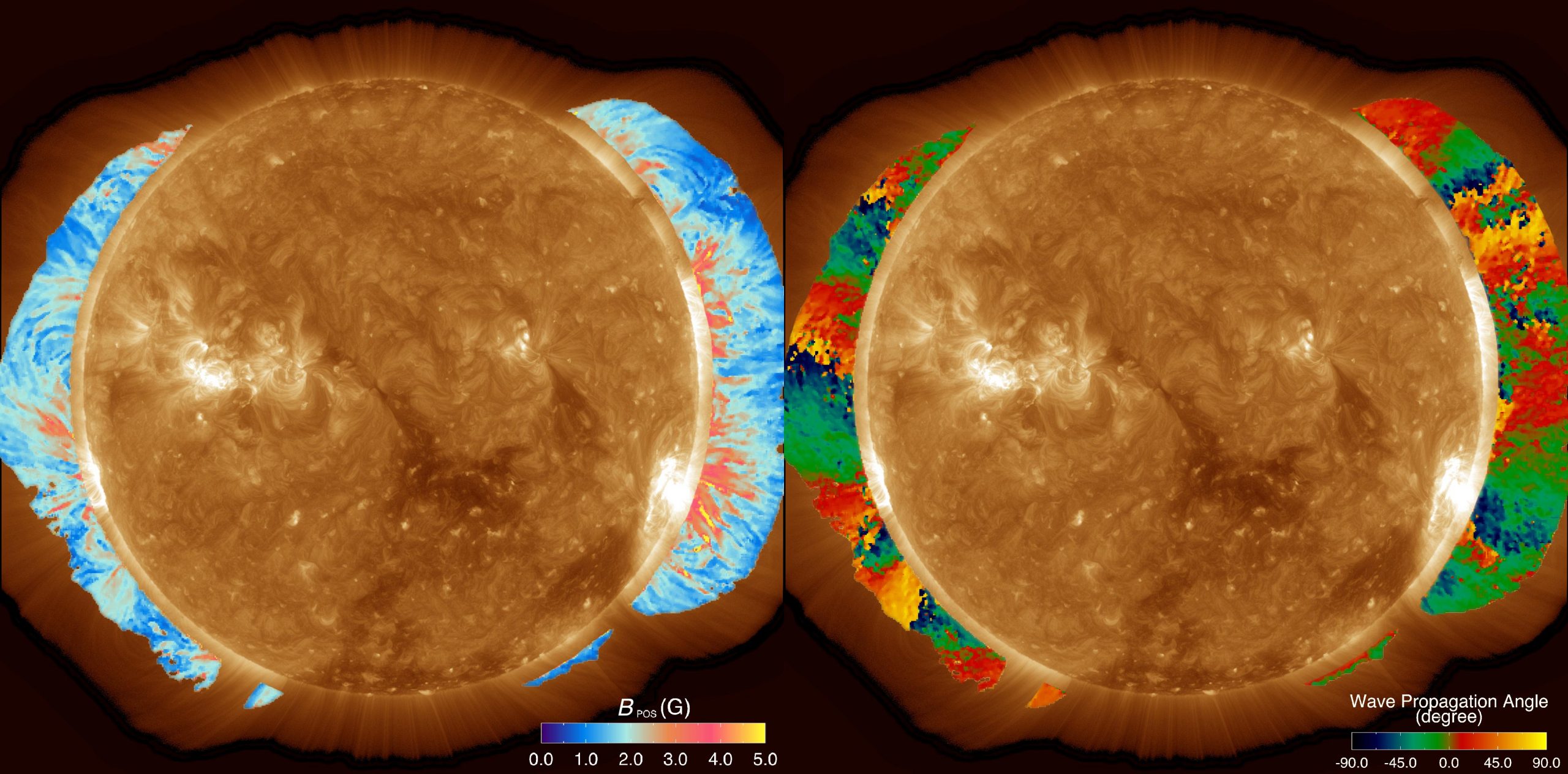
More than 20 years ago, a technique called coronal seismology or magnetoseismology has been introduced for coronal magnetic field diagnostics. This method makes use of magnetohydrodynamic (MHD) oscillations or waves that are observed in coronal loops or other coronal structures. From the MHD theory, the observed wave parameters can be used to infer the average magnitudes of the magnetic field in the oscillating structures. However, these oscillations/waves are just occasionally observed in small regions of the corona, and thus their potential for magnetic field diagnostics is limited.
CoMP is a coronagraph with a 20-cm aperture. Using the Fe XIII 1074.7 nm and 1079.8 nm infrared spectral lines, it can observe the solar corona in the range of about 1.05 to 1.35 solar radii from the solar center through imaging spectroscopy and spectropolarimetry. The Doppler image sequence obtained from CoMP observations often reveal the prevalence of propagating periodic disturbances, indicating the ubiquitous presence of transverse MHD waves in the corona. The team has successfully applied the magnetoseismology method to these pervasive waves. They have extended the previously developed wave-tracking technique to the whole field of view, and obtained the global distribution of the wave phase speed. The intensity ratio of the two Fe XIII lines is sensitive to the electron density, thus has been used to derive the global map of coronal electron density. Combing the wave-tracking and density diagnostic results, they have successfully mapped the magnetic field in the global corona.
This is the first time that a global map of the coronal magnetic field has been obtained through actual coronal observations, thus marking a leap toward solving the problem of coronal magnetic field measurements. In principle, with this technique, global coronal magnetic field maps could now be routinely obtained, filling in the missing part of the measurements of the Sun’s global magnetism. Together with simultaneously measured photospheric magnetograms, these synoptic coronal magnetograms will provide critical information to advance our understanding of the magnetic coupling between different atmospheric layers as well as the physical mechanisms responsible for solar eruptions and solar cycles.
Read Solar Physicists Measure Global Magnetic Field of the Solar Corona for the First Time for more on this research.
References:
“Global maps of the magnetic field in the solar corona” by Zihao Yang, Christian Bethge, Hui Tian, Steven Tomczyk, Richard Morton, Giulio Del Zanna, Scott W. McIntosh, Bidya Binay Karak, Sarah Gibson, Tanmoy Samanta, Jiansen He, Yajie Chen and Linghua Wang, 7 August 2020, Science.
DOI: 10.1126/science.abb4462
“Mapping the magnetic field in the solar corona through magnetoseismology” by ZiHao Yang, Hui Tian, Steven Tomczyk, Richard Morton, XianYong Bai, Tanmoy Samanta and YaJie Chen, 28 August 2020, Science China Technological Sciences.
DOI: 10.1007/s11431-020-1706-9
Never miss a breakthrough: Join the SciTechDaily newsletter.
Follow us on Google and Google News.