

Typically viewed as unrelated problems, global warming and plastic pollution are instead inextricably trapped in a “vicious circle” where one feeds the other, researchers in Sweden report in Nature Communications. The mutually-reinforcing relationship escalates global warming, the degradation of materials, plastic waste and the leaching of toxic chemicals into the biosphere.
Plastics that we rely on every day will deteriorate more rapidly because of rising global temperatures, and one effect will be a demand for more plastics. Xinfeng Wei, a researcher in polymeric materials at KTH Royal Institute of Technology in Stockholm, says meeting that demand will further compound greenhouse emissions that drive up the global temperature.
“A self-reinforcing cycle is formed, creating a vicious circle between climate change and plastic pollution,” Wei says.
In 2019, plastics generated 3.4 percent of global greenhouse gas emissions, or about 1.8 billion tons, mostly on account of their production and conversion from fossil fuels, according to the Organisation for Economic Co-operation and Development (OECD). By 2060 that amount is expected to more than double.
Feedback Loop
The researchers describe a feedback loop linking these emissions with heat, moisture, and the weakening structural bonds that lend a wide range of advantageous properties to polymers, the term for materials—like plastic and rubber—which are formed from long chains of large molecules.
“The higher the increase in temperature, the more the materials’ properties are compromised,” Wei says. The stiffness of commonly used plastics like polyethylene, polypropylene, and polyvinyl chloride decreases by more than 20 percent as temperatures climb between 23 and 40°C, he says.
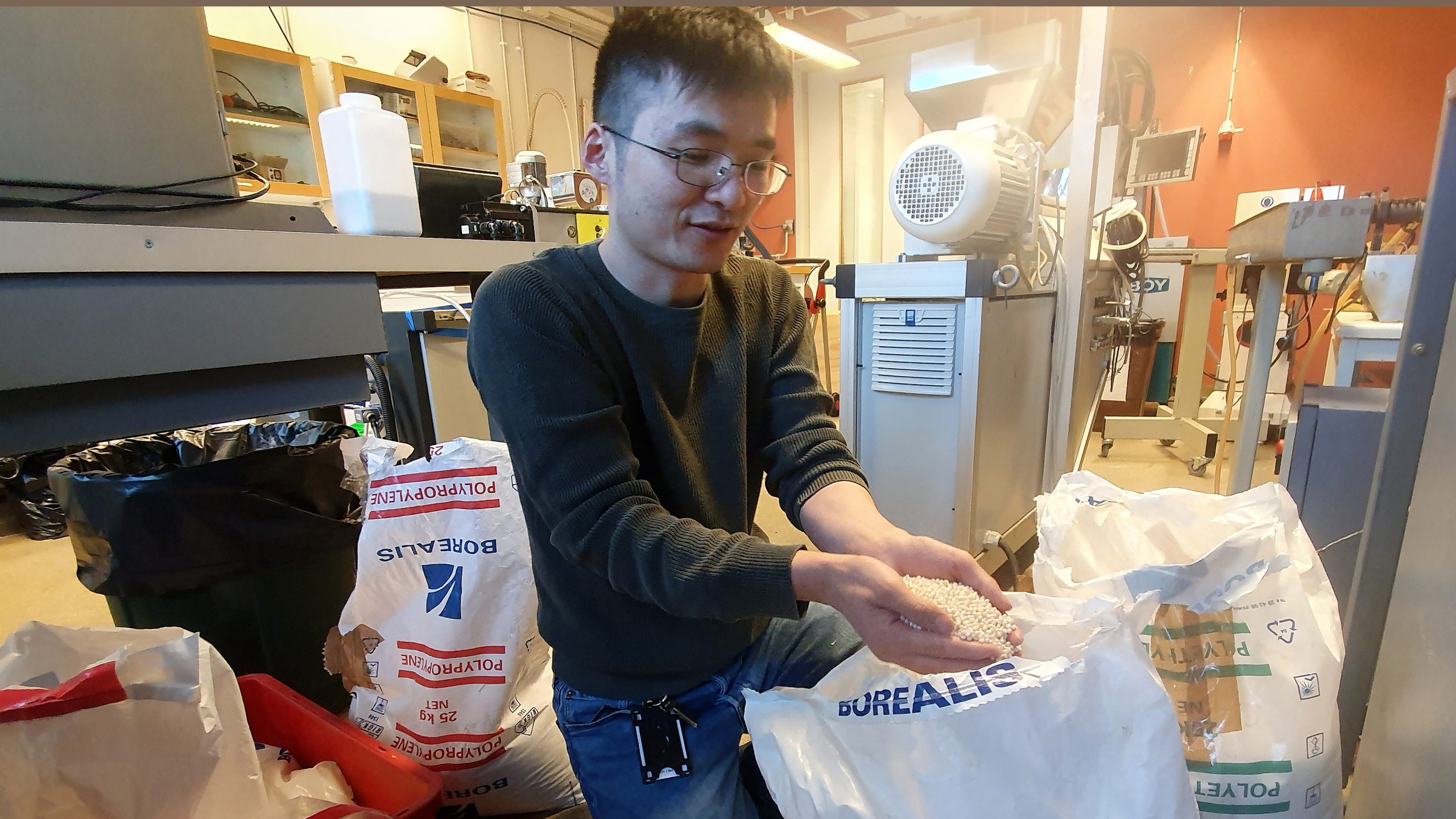
This deterioration means more frequent replacement of polymer products—everything from clothing to auto parts and appliances—and consequently greater manufacturing volumes and rates.
Knock-on effects range from rendering food packaging unreliable to the fouling of waterways and fish habitats by an increase in microplastics, he says.
Environmental Impact
The report also documents the release of volatile organic compounds (VOCs) in a warming climate as well as other hazardous compounds including lubricants, flame retardants, plasticizers, antioxidants, colorants, and UV/heat stabilizers. Heat will accelerate diffusion, evaporation, and leaching of these substances into the air, soil, and water, the report says.
The researchers draw attention to the combined effects of heat and moisture, which rise together due to global warming. “A warmer atmosphere increases the evaporation of moisture and can also hold more water vapor,” Wei says.
That’s bad news for many materials, but it wreaks particular havoc on plastics when combined with heat. “The combined effects of rising temperature and moisture create very challenging conditions for these polymers,” Wei says.
To tackle the challenge of plastic pollution and climate change, Wei and the co-authors urged attention and mobilization of efforts across all sectors involved in the plastic lifecycle.
Reference: “Plastic pollution amplified by a warming climate” by Xin-Feng Wei, Wei Yang and Mikael S. Hedenqvist, 6 March 2024, Nature Communications.
DOI: 10.1038/s41467-024-46127-9
Never miss a breakthrough: Join the SciTechDaily newsletter.
Follow us on Google and Google News.
5 Comments
Stop relying so heavily on plastics is the answer.
Many applications that use plastics can be replaced with plant based options.
“The combined effects of rising temperature and moisture create very challenging conditions for these polymers,”
It sounds like he is talking about plastics exposed to the elements, not things used in the home or the interior of cars. Engineers don’t just slap any old polymer into an application. They take into account what the environment will be and whether it will be exposed to solar UV, and specify plastics that will be expected to last the design-life of the application. I think that they are trying a little too hard to link plastic pollution with publishable climate change. The real issue is how to do a better job of re-cycling single- or limited-use plastics and prevent contamination of the environment with micro-particles.
Like most everything associated man-made global warming I don’t take what supposed experts say as unquestionable truth when it always comes down to what north America and Europe must sacrifice all the while their leaders continue flying personal jets to annual international get-togethers feeling grand about themselves. Start asking why all this concern barely ever mentions clean nuclear power and the elephant in the room, China.
I just hate it when I leave a bottle of water on the table outside, and then reach for it and have it disintegrate in my hand.
If I am reading this correctly, the authors are actually trying to claim that a change in environmental temperature of (presumably) a degree or two will actually affect the frequency of replacing the plastic components of “clothing to auto parts and appliances”, and thereby increasing manufacturing volumes, among other impacts. This is insane. Cars sit in the sun, clothes go in dryers, most appliances are *designed* to tolerate heat.