
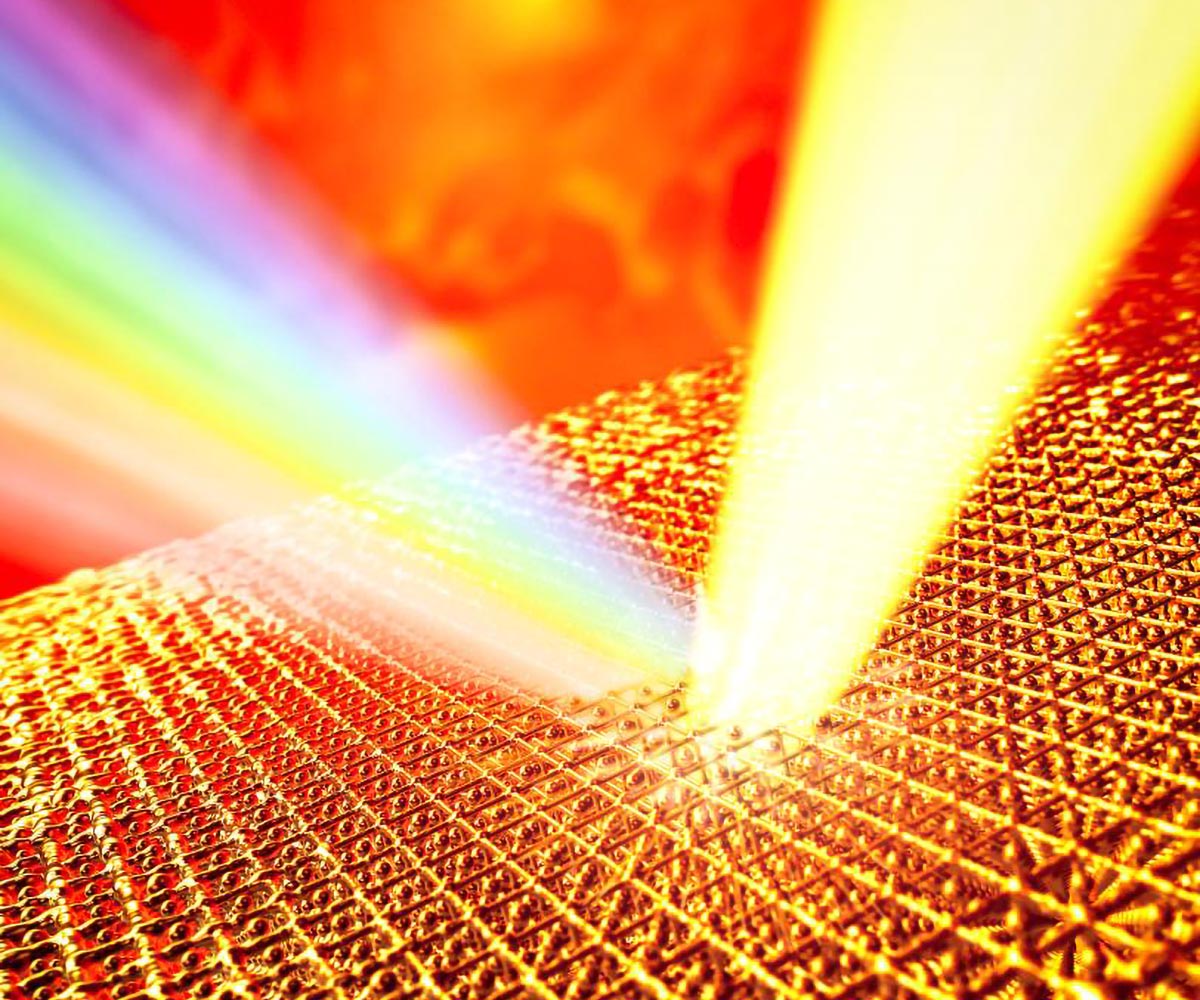
Scientists have made the first-ever direct measurement of atomic temperatures in extreme materials, shattering a four-decade-old theory about how far solids can be superheated.
Using a powerful laser and ultrabright X-rays, researchers at SLAC and collaborating institutions heated gold to an astonishing 19,000 K, more than 14 times its melting point, while it remained solid. This breakthrough not only redefines the limits of matter under extreme conditions but also opens the door to new insights into planetary interiors, fusion energy research, and high-energy density physics.
Measuring the Unmeasurable: Cracking the Heat Code
Measuring the temperature of extremely hot matter is one of the toughest challenges in science. From the turbulent plasma of the Sun to the crushing pressures deep inside planets and the intense environments within fusion reactors, certain materials reach a state known as “warm dense matter,” with temperatures climbing to hundreds of thousands of degrees kelvin.
For scientists, knowing the exact temperature of these materials is essential for understanding how they behave. Yet, until recently, getting an accurate reading was nearly impossible.
“We have good techniques for measuring density and pressure of these systems, but not temperature,” said Bob Nagler, staff scientist at the Department of Energy’s SLAC National Accelerator Laboratory. “In these studies, the temperatures are always estimates with huge error bars, which really holds up our theoretical models. It’s been a decades-long problem.”
Breaking the Boundaries of Theory
Now, in a breakthrough reported in the journal Nature, researchers have achieved the first direct measurement of atomic temperature in warm dense matter. Unlike previous approaches that depend on complex models, this method calculates temperature by tracking the actual speed of atoms. In their first experiment, the team heated solid gold well past its predicted thermal limit, overturning a physics theory that had stood for forty years.
“This wasn’t our original goal, but that’s what science is about – discovering new things you didn’t know existed.”
Tom White Associate Professor of Physics at University of Nevada, Reno
Nagler and researchers at SLAC’s Matter in Extreme Conditions (MEC) instrument co-led this study with Tom White, associate professor of physics at University of Nevada, Reno. The group includes researchers from Queen’s University Belfast, the European XFEL (X-ray Free-Electron Laser), Columbia University, Princeton University, University of Oxford, University of California, Merced, and the University of Warwick, Coventry.
Taking the Temperature – Laser, Gold, and X-Rays
For nearly a decade, this team has worked to develop a method that circumvents the usual challenges of measuring extreme temperatures – specifically, the brief duration of the conditions that create those temperatures in the lab and the difficulty of calibrating how these complex systems affect other materials.
“Finally, we’ve directly and unambiguously taken a direct measurement, demonstrating a method that can be applied throughout the field,” White said.
At SLAC’s MEC instrument, the team used a laser to superheat a sample of gold. As heat flashed through the nanometer-thin sample, its atoms began to vibrate at a speed directly related to their rising temperature. The team then sent a pulse of ultrabright X-rays from the Linac Coherent Light Source (LCLS) through the superheated sample. As they scattered off the vibrating atoms, the X-rays’ frequency shifted slightly, revealing the atoms’ speed and thus their temperature.
“The novel temperature measurement technique developed in this study demonstrates that LCLS is at the frontier of laser-heated matter research,” said Siegfried Glenzer, director of the High Energy Density Science division at SLAC and co-author on the paper. “LCLS, paired with these innovative techniques, play an important role in advancing high energy density science and transformative applications like inertial fusion.”
An Unexpected Overheating Discovery
The team was thrilled to have successfully demonstrated this technique – and as they took a deeper look at the data, they discovered something even more exciting.
“We were surprised to find a much higher temperature in these superheated solids than we initially expected, which disproves a long-standing theory from the 1980s,” White said. “This wasn’t our original goal, but that’s what science is about – discovering new things you didn’t know existed.”
The Science of Superheating and Risk
Every material has specific melting and boiling points, marking the transition from solid to liquid and liquid to gas, respectively. However, there are exceptions. For instance, when water is heated rapidly in very smooth containers – such as a glass of water in a microwave – it can become “superheated,” reaching temperatures above 212 degrees Fahrenheit (100 degrees Celsius) without actually boiling. This occurs because there are no rough surfaces or impurities to trigger bubble formation.
But this trick of nature comes with an increased risk: The further a system strays from its normal melting and boiling points, the more vulnerable it is to what scientists call a catastrophe – a sudden onset of melting or boiling triggered by slight environmental change. For example, water that has been superheated in a microwave will boil explosively when disturbed, potentially causing serious burns.
While some experiments have shown it is possible to bypass these intermediary limits by rapidly heating materials, “the entropy catastrophe was still viewed as the ultimate boundary,” White explained.
Gold That Defied the Entropy Catastrophe
In their recent study, the team discovered that the gold had been superheated to an astonishing 19,000 kelvins (33,740 degrees Fahrenheit) – more than 14 times its melting point and well beyond the proposed entropy catastrophe limit – all while maintaining its solid crystalline structure.
“If our first experiment using this technique led to a major challenge to established science, I can’t wait to see what other discoveries lie ahead.”
Bob Nagler SLAC Staff Scientist
The Surprising Secret: Heat Fast Enough
“It’s important to clarify that we did not violate the Second Law of Thermodynamics,” White said with a chuckle. “What we demonstrated is that these catastrophes can be avoided if materials are heated extremely quickly – in our case, within trillionths of a second.”
The researchers believe that the rapid heating prevented the gold from expanding, enabling it to retain its solid state. The findings suggest that there may not be an upper limit for superheated materials, if heated quickly enough.
Implications for Planetary and Fusion Science
Nagler noted that researchers who study warm dense matter have likely been surpassing the entropy catastrophe limit for years without realizing it, due to the absence of a reliable method for directly measuring temperature.
“If our first experiment using this technique led to a major challenge to established science, I can’t wait to see what other discoveries lie ahead,” Nagler said.
As just one example, White and Nagler’s teams used this method again this summer to study the temperature of materials that have been shock-compressed to replicate the conditions deep inside planets.
Nagler is also eager to apply the new technique – which can pinpoint atom temperatures from 1,000 to 500,000 kelvins – to ongoing inertial fusion energy research at SLAC. “When a fusion fuel target implodes in a fusion reactor, the targets are in a warm dense state,” Nagler explained. “To design useful targets, we need to know at what temperatures they will undergo important state changes. Now, we finally have a way to make those measurements.”
Reference: “Superheating gold beyond the predicted entropy catastrophe threshold” by Thomas G. White, Travis D. Griffin, Daniel Haden, Hae Ja Lee, Eric Galtier, Eric Cunningham, Dimitri Khaghani, Adrien Descamps, Lennart Wollenweber, Ben Armentrout, Carson Convery, Karen Appel, Luke B. Fletcher, Sebastian Goede, J. B. Hastings, Jeremy Iratcabal, Emma E. McBride, Jacob Molina, Giulio Monaco, Landon Morrison, Hunter Stramel, Sameen Yunus, Ulf Zastrau, Siegfried H. Glenzer, Gianluca Gregori, Dirk O. Gericke and Bob Nagler, 23 July 2025, Nature.
DOI: 10.1038/s41586-025-09253-y
This work was funded in part by the DOE National Nuclear Security Administration and Office of Science Fusion Energy Sciences. LCLS is a DOE Office of Science user facilities.
Never miss a breakthrough: Join the SciTechDaily newsletter.
Follow us on Google and Google News.
2 Comments
Gold Survives 33,740°F, Overturning a 40-Year Physics Theory.
VERY GOOD!
Ask the researchers:
Are you saying that the 40-Year Physics Theory are pseudoscience?
Topology provides stability blueprints, but specific physics (spatial features, gravitational collapse, fluid viscosity, quantum measurement) dictates vortex generation, evolution, and decay. If researchers are interested in this, please visit https://zhuanlan.zhihu.com/p/1933484562941457487 and https://zhuanlan.zhihu.com/p/1925124100134790589.
I have doubts that the temperatures were ‘pinpointed,’ but they _are_ far more accurate measurements than the old estimates.