
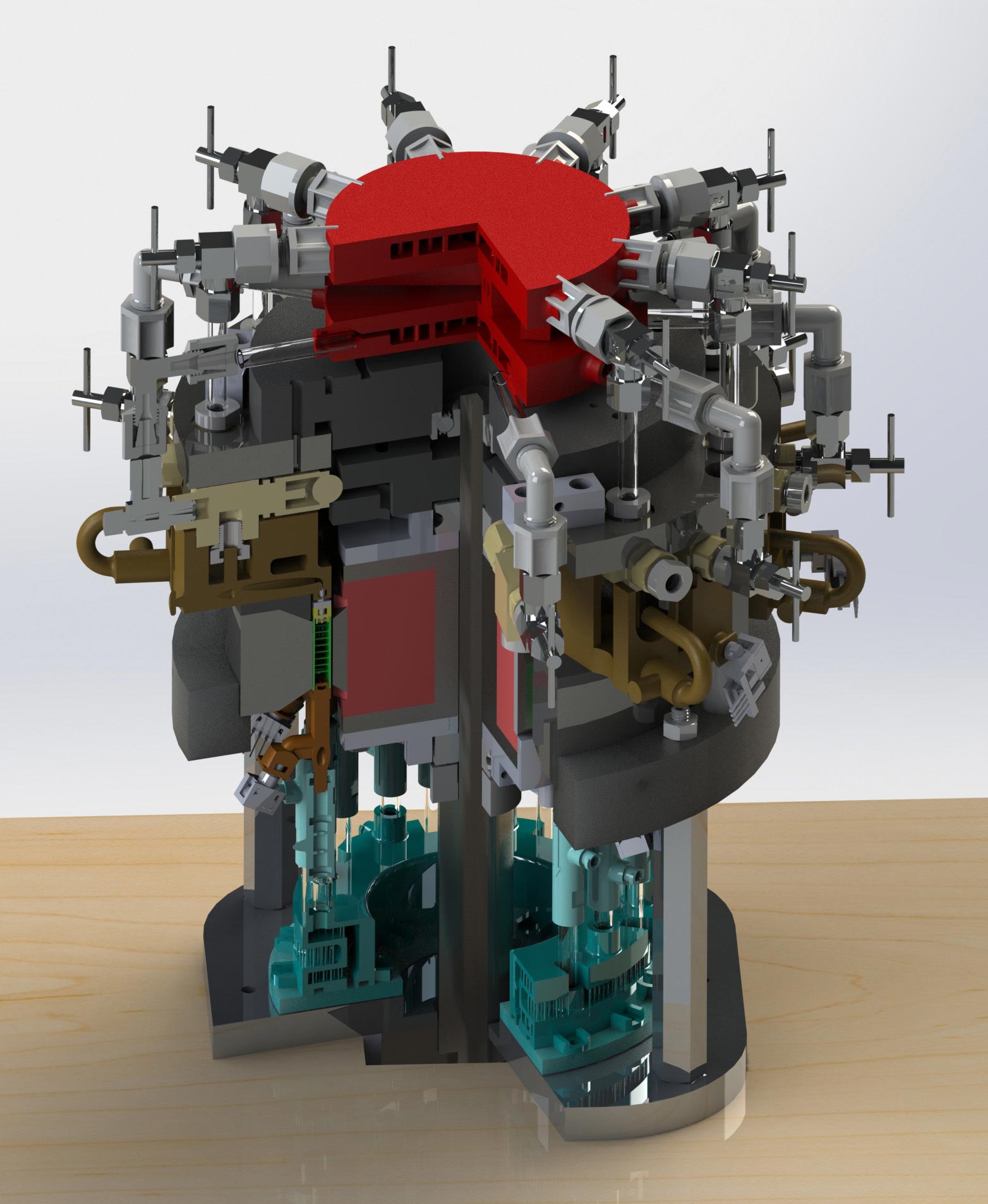
Scientists have developed a magnetocaloric heat pump that matches conventional systems in cost, weight, and performance, eliminating harmful refrigerants. By optimizing materials and design, the pump achieves comparable power density, offering a greener and efficient alternative for heating and cooling.
Researchers from the U.S. Department of Energy’s Ames National Laboratory have developed a magnetocaloric heat pump that rivals traditional vapor-compression heat pumps in terms of weight, cost, and performance. Vapor-compression technology, which has been the foundation of heating and cooling systems for over a century, relies on refrigerants that pose significant environmental risks. These refrigerants contribute to global carbon emissions and, when leaked, release chemicals harmful to both humans and ecosystems.
Magnetocaloric heat pumps offer a promising alternative for heating and cooling by eliminating refrigerant emissions and operating with greater energy efficiency. However, until now, magnetocaloric devices have struggled to match vapor-compression systems in all three critical areas: weight, cost, and performance. This new advancement marks a significant step toward more sustainable heating and cooling technology.
Julie Slaughter, the research team leader, explained that their investigation began by building a magnetocaloric heat pump. “We first looked at what is out there, and how close the existing magnetocaloric devices are to matching compressors,” she said. “Next we developed a baseline design and then asked, ‘Okay, now how far can we push the technology?’”
A magnetocaloric heat pump works by changing the magnetic field applied to a magnetocaloric material while pumping fluid to move heat. Slaughter explained that this is typically done with permanent magnets. The core of the device involves spinning permanent magnets relative to the magnetocaloric material and using magnetic steel to keep the magnetic field contained. The arrangement of these three pieces plays a major role in the team’s predictions as they examined how to make the heat pump more power-dense.
Advancing Material Use and Efficiency
Another part of their investigation involved evaluating the two most common magnetocaloric materials used in these heat pumps. Gadolinium and lanthanum-iron-silicon-hydride-based material.
“In our baseline device, we kept it simple by using a single material, gadolinium. Lanthanum-iron-silicon materials have a higher power capability than gadolinium. So, that naturally increases the power density. They’re just not as readily available and require multiple materials in one device to get good performance,” said Slaughter. “In our evaluations, we included estimates of LaFeSi performance for the most power-dense devices.”
Slaughter’s team focused on using space and materials more efficiently, and reducing the amount of permanent magnet material and magnetic steel needed for the pump to operate efficiently. These efforts helped to make the core system pieces match the weight of compressors available today.
“We were able to show that we are competitive with the power density of some of the compressors that are out there today,” said Slaughter. “The permanent magnets and the magnetic steel make up most of the mass rather than the expensive magnetocaloric material, and that’s really helpful for affordability. We assumed, if a device weighs about the same, the cost will be about the same in mass production.”
Reference: “Scalable and compact magnetocaloric heat pump technology” by Julie Slaughter, Lucas Griffith, Agata Czernuszewicz and Vitalij Pecharsky, 28 October 2024, Applied Energy.
DOI: 10.1016/j.apenergy.2024.124696
Never miss a breakthrough: Join the SciTechDaily newsletter.
Follow us on Google and Google News.
30 Comments
Good news
Why would you use refrigerants in a heat pump?
Marc, ALL the heat pumps I know of a an hvac contractor use refrigerant. Heat pumps are an advanced type of air conditioner that uses a reversing valve to heat or cool (as desired) the space. Most heat pumps use outside air or ground loops to heat/cool the refrigerant before transferring it inside to heat/ cool the occupied space.
Conventional heat pump can not work efficiently below the boiling temperature of the refrigerant. Will this technology have a temperature constraint below which it will not work?
Great question.
I want to know as well.
Note “fluid”, yet they never expand on this “fluid”. Fluid is used to transfer heat.
How much lower temperature in the space can be achieved by using this heat pump.
Kind regards
So they are still using a fluid, what is the fluid ?
In this context a fluid can be a liquid, gas, or a phase change material. This fluid is likely a liquid aqueous solution that carries low temperature heat to, and waste heat away from the magnetic materials.
The reason it is used is to increase “h” the coefficient of convective heat transfer, as well as “c” the specific heat capacity of the fluid as compared to air, as well as pumping costs as compared to air,
Marc, may be aware of ware source type of heat
Pumps only.
lower boiling and vapor points.
The use of a refrigerant permits efficient heat capture, even in very cold settings, like Alaska or Canada.
Consider, even when you have the house frigid cold, and the outdoors is raging hot, the hot side of the condenser coil remains quite hot.
The same applies here, you are just refrigerating the outdoors. (In contravention of what your mom told you.)
This is because the refrgerant is a gas at atmospheric pressures, but a liquid just a little past that. When the pressure is released, the rapid ‘boiling’ draws thermal energy from the envirionment, to a degree well below freezing. (which is why can work in Alaska to pull heat from the outside air) When compressed, it is forced to condense, and th heat is rapdly communicated to the condenser core.
The short version:
It’s a freezer run backwards.
‘Cause one don’t get heaterants….
Easier way to say it.. even though it’s been answered for you mark, is that – the refrigerator uses a heat pump to pump the heat out of the refrigeration unit.. and refrigerants are used to transfer the heat. Freon is a refrigerant for example. which is used in the motors on a refrigerator, it is pumped through the coils to transfer the heat from inside the box to outside the box.
“Refrigerants”, as they known in the industry, are scientifically known as HTFs (or Heat Transfer Fluids). A heat pump is simply a reversible refrigeration cycle.
Heat Cold
It’s just a term to describe a ‘Heat energy carrier’ that moves energy from high-heat (hot) to low-heat (cold).
In physical science, there’s not really any such thing as “cold” (except to describe a feeling or perception). “Cold” is simply a relative lack of heat energy in a material or environment.
Hope that helps your understanding. 😊
The article was terribly written. It would seem by the description that it replaces the compressor it does not replace the refrigerants.
On the contrary. This is ALL about the compressor, whether you understand the science or not.
The working fluid can be anything non-corrosive or nontoxic in the temperature range of interest.
The preamble was very clear. This was about a fortuitous and studied assembly of materials with the right properties. They did stellar research work on something Einstein patented more than 70 years ago and now it works economically.
Because you are transferring heat from outside to inside. Cooling outside air and dumping the heat inside. Refrigerator does the same thing.
And the heat has to go somewhere. So, a colloquial term becomes a technical one. But it’s all the same tech until magnetostrictive.
Your article makes no sense. It’s a pump not the actual “fluid”. what fluid are we talking about here? Refrigerant is the current fluid we use. Are you saying water? Ammonia is actually very environmentally friendly but it is a health hazard. Your article says to pump fluid , so…. What does any of this have to do with refrigerant?
More than likely they use something similar to antifreeze in a water cooling style loop, where it has contact with the magnetocaloric material (think of a replacing a CPU with a magnetocaloric material).
Well if you replace the CPU, with a magnetocaloric material. You would have a device with no central processing unit.. lol … If you meant the CPU heatsink then I understand the sentiment 😉
So how big is the loop for the water being used? Is this even viable in a subdivision/city setting? The only people who can even use modern day geothermal systems live in the country.
The run the lines vertically
They mention that they only used Gadolinium to transfer heat after compressing it magnetically. Not to nowing the properties of that element makes it hard to get the concept. The fact they aren’t using a fluorinated refrigerant is their bragging right.
Gadolinium as a working fluid? With a melting temperature of 2,400°F?
OK, I barely graduated high school but have been in the HVAC industry for 47 years and for the life of me cannot figure out how you can get cooling (heat removal/capture) out of this device from the information provided. If the fluid is anything other than a substance that changes temperature with pressure, you will only get heating (adding heat by compression). Cooling (heat removal/capture), comes from decompression and, the change of state must occur below the human comfort temperature (72 deg. F), minus the Delta T needed for the transfer of heat into the fluid substance being used. I don’t know of any fluid other than refrigerants that will efficiently provide the needed heat transfer at the correct temperatures to maintain space comfort in both heating and cooling. That said, it’s not the refrigerants that are the problem, they are actually very efficient, it’s the inability of the global industry to make products that don’t leak along with installers and technicians that follow the rules regarding the venting of refrigerants. If Kyoto Protocol was followed globally, this probably wouldn’t be a topic of conversation.
Here is the answer folks:
The article is saying electromagnetic heatpumps using water or air as their fluid can perform at a competitive cost and weight to traditional systems that use refrigerant.
The principle between the two types of system are different
It isn’t using a compressor to store energy in fluid through mechanical transfer of energy.
It alternates electromagnetic fields to excite the unique material imagine all the molecules running to look left then running to look right over and over and getting hotter and hotter. All those wiggling molecules release thermal energy.
Want to cool the room? This is the magic part. If I just apply a magnetic field 1 time and let the electromagnetic relax back to disorder state it actually pulls more energy than I applied to it creating a net cooling effect. Repeat this over and over and you are cooling the room. The fluid transfer to an exchanger of some sort is the same.
But again, due to the redesign and material advancements these systems dont need to use refrigerant to match performance of compressor based systems. Before you jump down my throat. Yes using refrigerant vs air or water would further increase a magneticheat exchangers efficiency.
Rather than compressing and decompressing, they magnetize / demagnetize. Not 100% sure, but I don’t think they’re splitting the magnetize / demagnetize sections of the process like you could a outdoor compressor and inside condensor. Maybe a glycol loop to the device outside, kind of like a wood burning boiler setup, except this box/’boiler’ could heat or chill the glycol loop.
Interesting concept . . . though I can’t help but wonder, how much and from where is Gadolinium going to come from, definitely a rare earth element.
I don’t know why they don’t use the technology already being used for lager chillers and use CO2 for the refrigerant and the maglift variable speed compressor has no oil and it doesn’t have the inrush of amps on start up or the running load amps of the reciprocating compressor and the noise level is nothing like that of the reciprocating compressor or screw compressor or centrifugal the chill water pumps make more noise than the compressor
If the performance increase refers to the coefficient of performance, there should be a statement of that.
Could the principles driving this heat pump be used in a heat engine? There is a disappointingly low level of research into novel prime movers, excepting rocket engines by SpaceX.