
PNNL created nature-inspired nanocrystals with exceptional light-harvesting capabilities, suitable for bioimaging and solar applications.
Inspired by nature, researchers at Pacific Northwest National Laboratory (PNNL), along with collaborators from Washington State University, created a novel material capable of capturing light energy. This material provides a highly efficient artificial light-harvesting system with potential applications in photovoltaics and bioimaging.
The research provides a foundation for overcoming the difficult challenges involved in the creation of hierarchical functional organic-inorganic hybrid materials. Nature provides beautiful examples of hierarchically structured hybrid materials such as bones and teeth. These materials typically showcase a precise atomic arrangement that allows them to achieve many exceptional properties, such as increased strength and toughness.
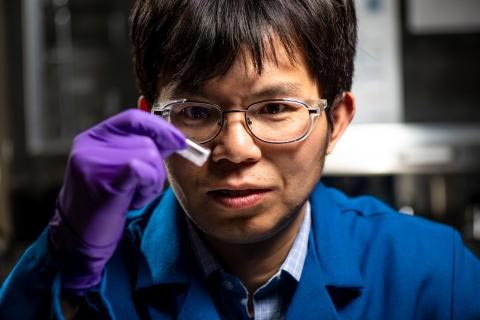
PNNL materials scientist Chun-Long Chen, corresponding author of this study, and his collaborators created a new material that reflects the structural and functional complexity of natural hybrid materials. This material combines the programmability of a protein-like synthetic molecule with the complexity of a silicate-based nanocluster to create a new class of highly robust nanocrystals. They then programmed this 2D hybrid material to create a highly efficient artificial light-harvesting system.
“The sun is the most important energy source we have,” said Chen. “We wanted to see if we could program our hybrid nanocrystals to harvest light energy—much like natural plants and photosynthetic bacteria can—while achieving a high robustness and processibility seen in synthetic systems.” The results of this study were published May 14, 2021, in Science Advances.
Big Dreams, Tiny Crystals
Though these types of hierarchically structured materials are exceptionally difficult to create, Chen’s multidisciplinary team of scientists combined their expert knowledge to synthesize a sequence-defined molecule capable of forming such an arrangement. The researchers created an altered protein-like structure, called a peptoid, and attached a precise silicate-based cage-like structure (abbreviated POSS) to one end of it. They then found that, under the right conditions, they could induce these molecules to self-assemble into perfectly shaped crystals of 2D nanosheets. This created another layer of cell-membrane-like complexity similar to that seen in natural hierarchical structures while retaining the high stability and enhanced mechanical properties of the individual molecules.
“As a materials scientist, nature provides me with a lot of inspiration,” said Chen. “Whenever I want to design a molecule to do something specific, such as act as a drug delivery vehicle, I can almost always find a natural example to model my designs after.”
Designing Bio-Inspired Materials
Once the team successfully created these POSS-peptoid nanocrystals and demonstrated their unique properties including high programmability, they then set out to exploit these properties. They programmed the material to include special functional groups at specific locations and intermolecular distances. Because these nanocrystals combine the strength and stability of POSS with the variability of the peptoid building block, the programming possibilities were endless.
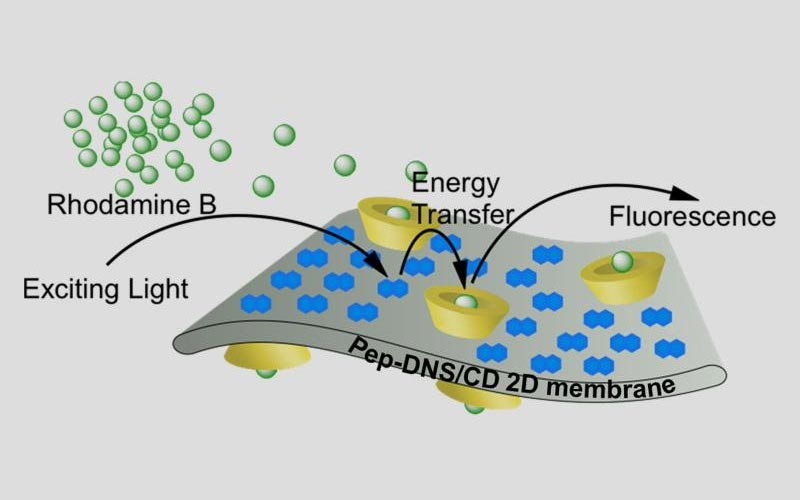
Once again looking to nature for inspiration, the scientists created a system that could capture light energy much in the way pigments found in plants do. They added pairs of special “donor” molecules and cage-like structures that could bind an “acceptor” molecule at precise locations within the nanocrystal. The donor molecules absorb light at a specific wavelength and transfer the light energy to the acceptor molecules. The acceptor molecules then emit light at a different wavelength. This newly created system displayed an energy transfer efficiency of over 96%, making it one of the most efficient aqueous light-harvesting systems of its kind reported thus far.
Demonstrating the Uses of POSS-Peptoids for Light Harvesting
To showcase the use of this system, the researchers then inserted the nanocrystals into live human cells as a biocompatible probe for live cell imaging. When light of a certain color shines on the cells and the acceptor molecules are present, the cells emit light of a different color. When the acceptor molecules are absent, the color change is not observed. Though the team only demonstrated the usefulness of this system for live cell imaging so far, the enhanced properties and high programmability of this 2D hybrid material leads them to believe this is one of many applications.
“Though this research is still in its early stages, the unique structural features and high energy transfer of POSS-peptoid 2D nanocrystals have the potential to be applied to many different systems, from photovoltaics to photocatalysis,” said Chen. He and his colleagues will continue to explore avenues for application of this new hybrid material.
Reference: “Programmable two-dimensional nanocrystals assembled from POSS-containing peptoids as efficient artificial light-harvesting systems” by Mingming Wang, Yang Song, Shuai Zhang, Xin Zhang, Xiaoli Cai, Yuehe Lin, James J. De Yoreo and Chun-Long Chen, 14 May 2021, Science Advances.
DOI: 10.1126/sciadv.abg1448
Other authors of this study include: James De Yoreo, Mingming Wang, Shuai Zhang, and Xin Zhang from PNNL and Song Yang and Yuehe Lin from Washington State University. Shuai Zhang, James De Yoreo, and Chun-Long Chen are also affiliated with the University of Washington. This work was supported by the U.S. Department of Energy Basic Energy Sciences program as part of the Center for the Science of Synthesis Across Scales, an Energy Frontier Research Center located at the University of Washington.
Never miss a breakthrough: Join the SciTechDaily newsletter.
Follow us on Google and Google News.
3 Comments
Bonjour….merci….
very good
Very cool, use nature to teach.