

Astronomers are astounded by a rare cosmic alignment showcasing highly magnified star-forming regions in distant galaxies.
What, why, how? The cosmos is full of questions. Still, astronomers using NASA’s James Webb Space Telescope were surprised to find a distant, red galaxy distorted into the shape of a question mark. A specific, rarely-seen type of natural gravitational lens is causing the galaxy to appear multiple times.
The lensing also magnifies the galaxy and its spiral companion, allowing astronomers to pinpoint specific regions of star formation, using a combination of infrared data from Webb and ultraviolet data from NASA’s Hubble Space Telescope.
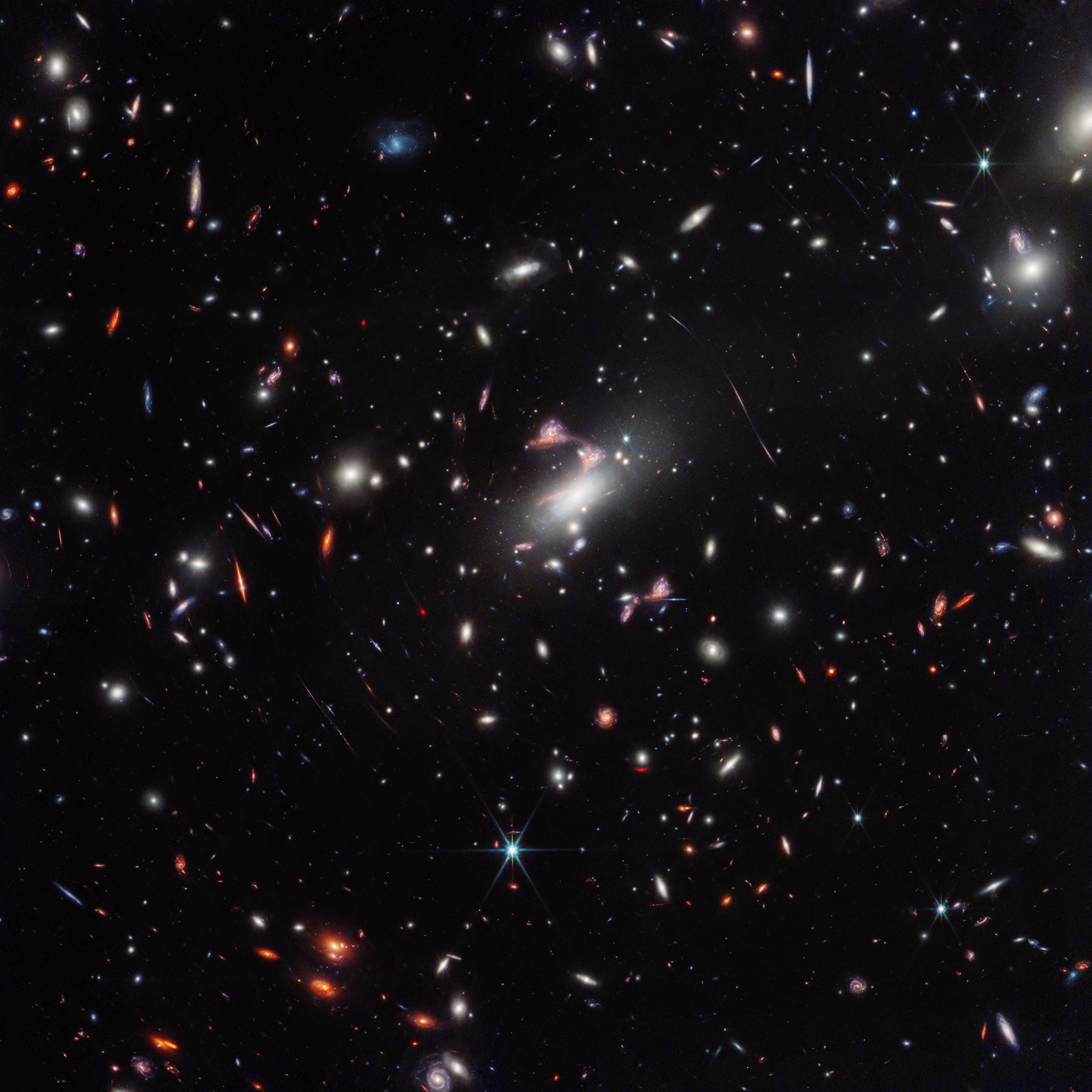
The rarely seen type of lensing captured here, which astronomers term hyperbolic umbilic, created five repeated images of one galaxy pair. The red, elongated member of this pair traces the familiar shape of a question mark across the sky due to the distortion, with another unrelated galaxy happening to be in just the right space-time to appear like the question mark’s dot – especially for humans who love to recognize familiar shapes and patterns.
Credit: NASA, ESA, CSA, STScI, Vicente Estrada-Carpenter (Saint Mary’s University)
Webb Space Telescope Reveals Distorted Galaxy Forming Cosmic Question Mark
It’s 7 billion years ago, and the universe’s heyday of star formation is beginning to slow. What might our Milky Way galaxy have looked like at that time? Astronomers using NASA’s James Webb Space Telescope have found clues in the form of a cosmic question mark, the result of a rare alignment across light-years of space.
“We know of only three or four occurrences of similar gravitational lens configurations in the observable universe, which makes this find exciting, as it demonstrates the power of Webb and suggests maybe now we will find more of these,” said astronomer Guillaume Desprez of Saint Mary’s University in Halifax, Nova Scotia, a member of the team presenting the Webb results.
Insights From Enhanced Galaxy Observation
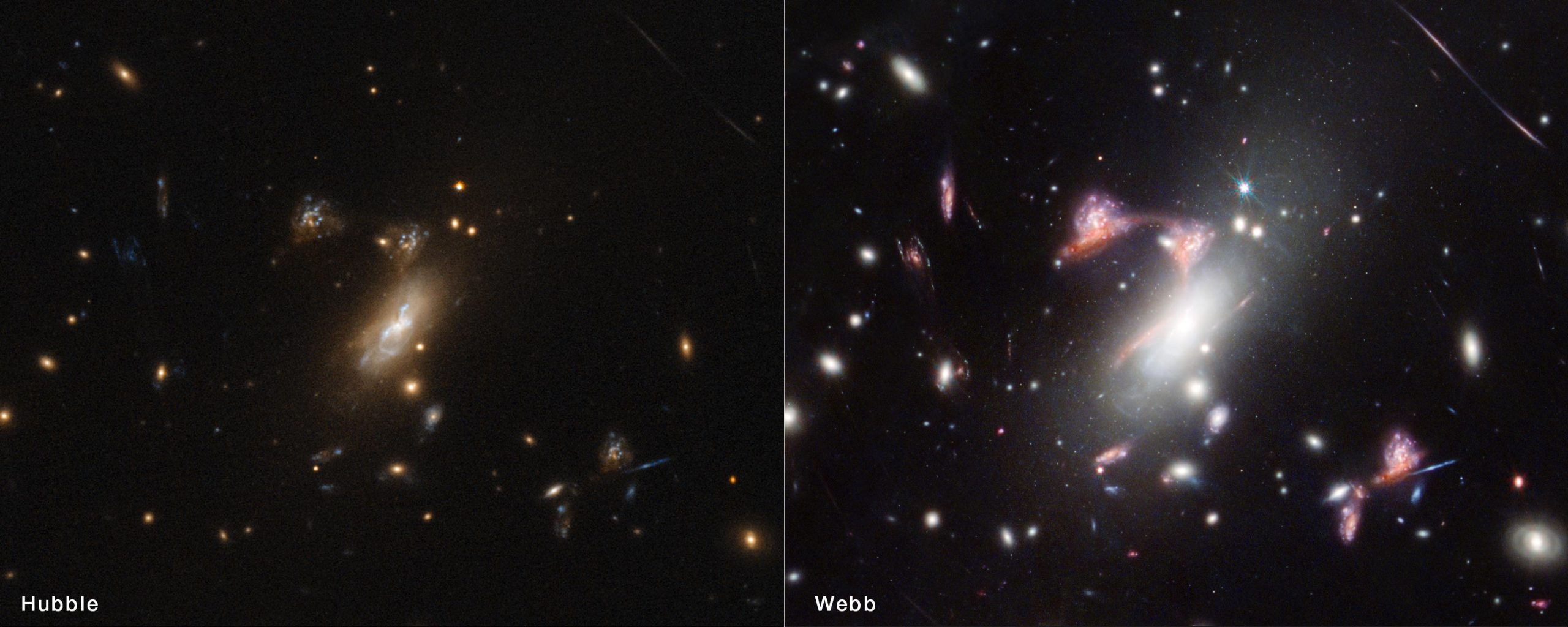
While this region has been observed previously with NASA’s Hubble Space Telescope, the dusty red galaxy that forms the intriguing question-mark shape only came into view with Webb. This is a result of the wavelengths of light that Hubble detects getting trapped in cosmic dust, while longer wavelengths of infrared light are able to pass through and be detected by Webb’s instruments.
This video explains how very distant galaxies are magnified through the phenomenon of gravitational lensing. Gravitational lenses can magnify the light from distant galaxies that are at or near the peak of star formation. This effect allows researchers to study the details of early galaxies too far away to be seen with even the most powerful space telescopes. Credit: NASA, ESA, STScI, Leah Hustak (STScI)
Astronomers used both telescopes to observe the galaxy cluster MACS-J0417.5-1154, which acts like a magnifying glass (see video above) because the cluster is so massive it warps the fabric of space-time. This allows astronomers to see enhanced detail in much more distant galaxies behind the cluster. However, the same gravitational effects that magnify the galaxies also cause distortion, resulting in galaxies that appear smeared across the sky in arcs and even appear multiple times. These optical illusions in space are called gravitational lensing.
The red galaxy revealed by Webb, along with a spiral galaxy it is interacting with that was previously detected by Hubble, are being magnified and distorted in an unusual way, which requires a particular, rare alignment between the distant galaxies, the lens, and the observer — something astronomers call a hyperbolic umbilic gravitational lens. This accounts for the five images (see annotated image below) of the galaxy pair seen in Webb’s image, four of which trace the top of the question mark. The dot of the question mark is an unrelated galaxy that happens to be in the right place and space-time, from our perspective.
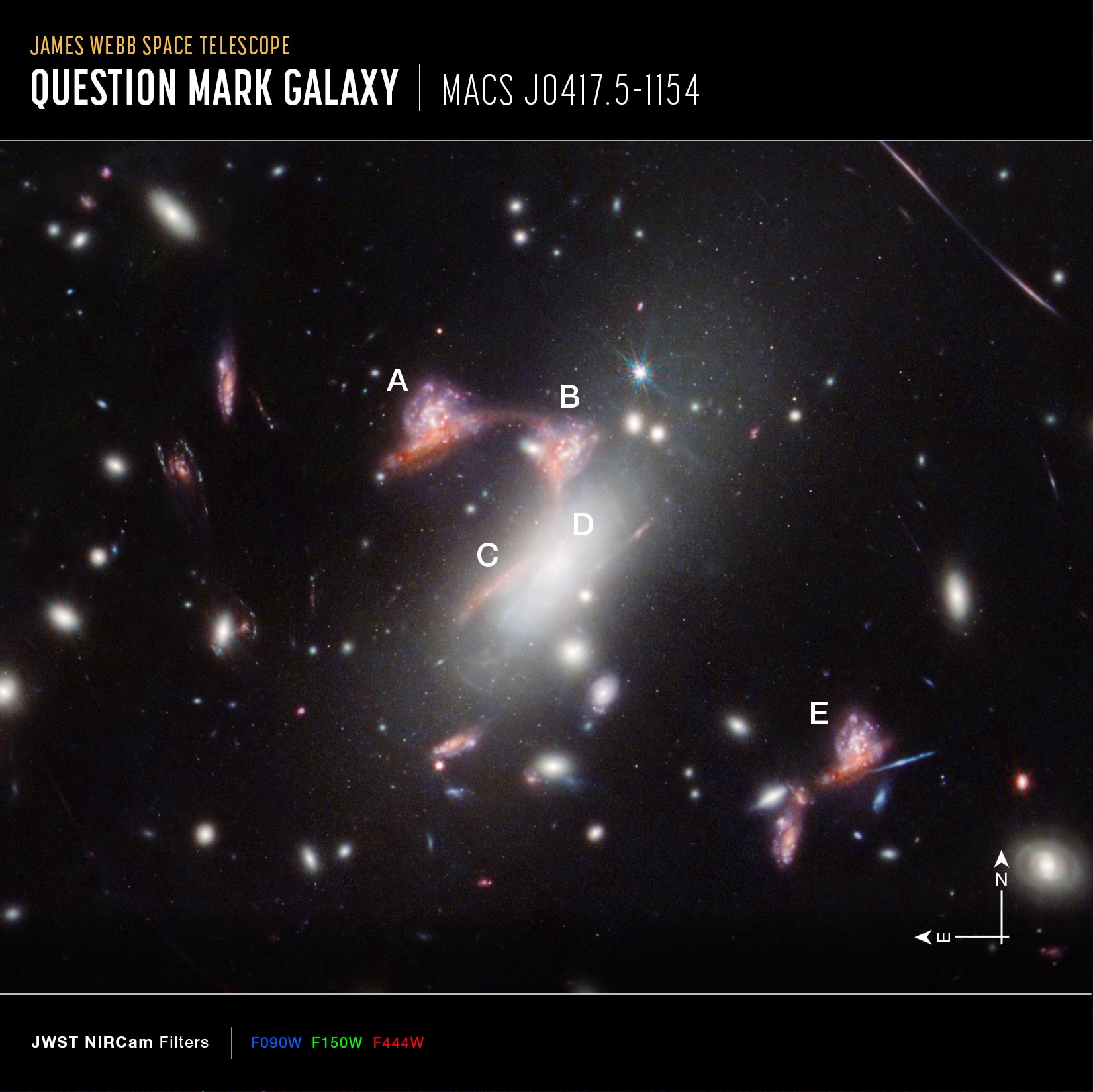
This image also includes compass arrows, scale bar, and color key for reference. The scale bar is labeled in arcseconds, which is a measure of angular distance on the sky. There are 60 arcminutes in a degree and 60 arcseconds in an arcminute. (The full Moon has an angular diameter of about 30 arcminutes.) The actual size of an object that covers one arcsecond on the sky depends on its distance from the telescope.
This image shows infrared wavelengths of light that have been translated into visible-light colors. The color key at the bottom of the image shows which filters from Webb’s NIRCam (Near-Infrared Camera) instrument were used. The color of each filter name is the visible light color assigned to represent the infrared light detected by that filter.
Credit: NASA, ESA, CSA, STScI, Vicente Estrada-Carpenter (Saint Mary’s University)
Unraveling the Mysteries of Star Formation
In addition to producing a case study of the Webb NIRISS (Near-Infrared Imager and Slitless Spectrograph) instrument’s ability to detect star formation locations within a galaxy billions of light-years away, the research team also couldn’t resist highlighting the question mark shape. “This is just cool looking. Amazing images like this are why I got into astronomy when I was young,” said astronomer Marcin Sawicki of Saint Mary’s University, one of the lead researchers on the team.
“Knowing when, where, and how star formation occurs within galaxies is crucial to understanding how galaxies have evolved over the history of the universe,” said astronomer Vicente Estrada-Carpenter of Saint Mary’s University, who used both Hubble’s ultraviolet and Webb’s infrared data to show where new stars are forming in the galaxies. The results show that star formation is widespread in both. The spectral data also confirmed that the newfound dusty galaxy is located at the same distance as the face-on spiral galaxy, and they are likely beginning to interact.
Galactic Interactions Through Time
“Both galaxies in the Question Mark Pair show active star formation in several compact regions, likely a result of gas from the two galaxies colliding,” said Estrada-Carpenter. “However, neither galaxy’s shape appears too disrupted, so we are probably seeing the beginning of their interaction with each other.”
“These galaxies, seen billions of years ago when star formation was at its peak, are similar to the mass that the Milky Way galaxy would have been at that time. Webb is allowing us to study what the teenage years of our own galaxy would have been like,” said Sawicki.
The Webb images and spectra in this research came from the Canadian NIRISS Unbiased Cluster Survey (CANUCS). The research paper is published in the Monthly Notices of the Royal Astronomical Society.
Reference: “When, where, and how star formation happens in a galaxy pair at cosmic noon using CANUCS JWST/NIRISS grism spectroscopy” by Vicente Estrada-Carpenter, Marcin Sawicki, Gabe Brammer, Guillaume Desprez, Roberto Abraham, Yoshihisa Asada, Maruša Bradač, Kartheik G Iyer, Nicholas S Martis, Jasleen Matharu, Lamiya Mowla, Adam Muzzin, Gaël Noirot, Ghassan T E Sarrouh, Victoria Strait and Chris J Willott, 31 May 2024, Monthly Notices of the Royal Astronomical Society.
DOI: 10.1093/mnras/stae1368
The James Webb Space Telescope is the world’s premier space science observatory. Webb is solving mysteries in our solar system, looking beyond to distant worlds around other stars, and probing the mysterious structures and origins of our universe and our place in it. Webb is an international program led by NASA with its partners, ESA (European Space Agency) and CSA (Canadian Space Agency).
Never miss a breakthrough: Join the SciTechDaily newsletter.
Follow us on Google and Google News.
2 Comments
In an infinite universe, every possible configuration of galaxies will occur.
A poop-shaped formation.