
Close Menu
    Facebook X (Twitter) Instagram
    SciTechDaily
    • Biology
    • Chemistry
    • Earth
    • Health
    • Physics
    • Science
    • Space
    • Technology
    Facebook X (Twitter) Pinterest YouTube RSS
    SciTechDaily
    Home»Chemistry»Great Potential – Traditional Medicine Plant Discovered To Emit Ethereal Blue Hue
    Chemistry

    Great Potential – Traditional Medicine Plant Discovered To Emit Ethereal Blue Hue

    By American Chemical SocietyApril 21, 2023No Comments3 Mins Read
    Facebook Twitter Pinterest Telegram LinkedIn WhatsApp Email Reddit
    Share
    Facebook Twitter LinkedIn Pinterest Telegram Email Reddit
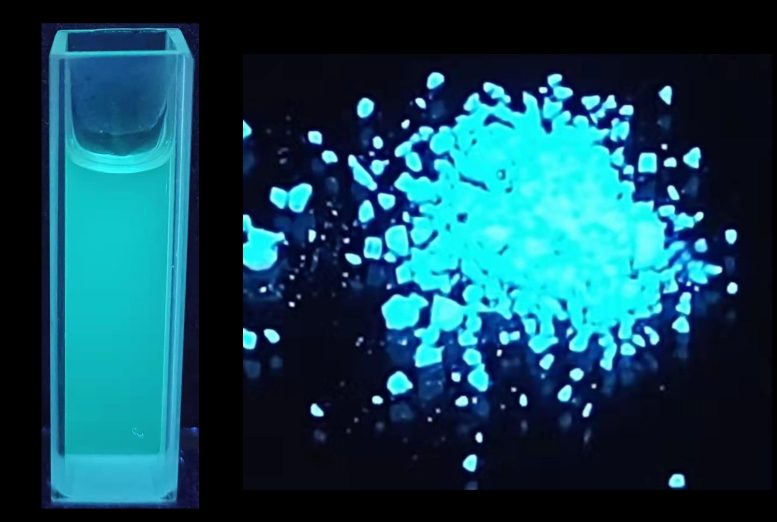
    Fluorescent Blue Coumarins in a Folk Medicine Plant
    A fluorescent compound from a plant root could help image cells quickly. Credit: Adapted from ACS Central Science 2023, DOI: 10.1021/acscentsci.3c00012

    Researchers discovered two natural fluorescent coumarins in Toddalia asiatica roots that glow under UV light and are safe for bioimaging. The compounds simplify live cell imaging and offer a biocompatible alternative to synthetic AIEgens.

    Plants that emit a glowing light under ultraviolet (UV) light are no longer just a fantasy seen in science fiction TV shows and movies. The roots of a medicinal plant known as Toddalia asiatica or orange climber, have been found to emit an ethereal blue glow. Researchers reporting in the journal ACS Central Science have now uncovered two coumarin molecules that may be the source of this fluorescence.

    These natural coumarins possess unique fluorescent qualities, and one of the substances holds the potential of being utilized for medical imaging in the future.

    Fluorescent substances take in UV light that’s directed at them and release vibrantly colored visible light. And some glow even more brightly when they are close together, a phenomenon seen in compounds called aggregation-induced emission luminogens (AIEgens).

    They are key components in some optical devices, cellular imaging techniques, and environmental sensors. However, these molecules are usually made in a lab, and many are toxic. Some plants already have this ability, so, Ben Zhong Tang, Zheng Zhao, Xiao-Dong Luo, and colleagues turned to nature to find naturally occurring and safer AIEgens.

    The researchers dried orange climber roots, crushed them into a powder, and then isolated and identified coumarin compounds with aggregation-induced emission properties: 5-methoxyseselin (5-MOS) and 6-methoxyseselin (6-MOS).

    When dissolved in an organic solvent, 5-MOS exhibited a blue-green glow and 6-MOS had a slightly dimmer blue glow. In addition, both AIEgens had low cytotoxicity and good biocompatibility.

    Then in a final series of experiments, the team found that mitochondria could be clearly identified in live cells stained with 5-MOS without any additional processing, making cell imaging easier and faster than with most current methods. The newly reported compound is a natural, plant-derived option that could advance bioimaging, the researchers say.

    Reference: “Natural Coumarin Isomers with Dramatically Different AIE Properties: Mechanism and Application” by Shan-Shan Chen, Haoran Wang, Bo Wu, Qiyao Li, Junyi Gong, Yun-Li Zhao, Yun Zhao, Xia Xiao, Jacky W. Y. Lam, Zheng Zhao, Xiao-Dong Luo and Ben Zhong Tang, 19 April 2023, ACS Central Science.
    DOI: 10.1021/acscentsci.3c00012

    The study was funded by the High-level Talent Promotion and Training Project of Kunming; Project of Yunnan Characteristic Plant Screening and R&D Service CXO Platform; Science, Technology and Innovation Commission of Shenzhen Municipality; Shenzhen Key Laboratory of Functional Aggregate Materials; the Research Grants Council of Hong Kong; the Innovation and Technology Commission; the Open Fund of Guangdong Provincial Key Laboratory of Luminescence from Molecular Aggregates; and South China University of Technology; and the China Postdoctoral Science Foundation.

    Never miss a breakthrough: Join the SciTechDaily newsletter.
    Follow us on Google and Google News.

    American Chemical Society Fluorescence Medical Imaging Plants
    Share. Facebook Twitter Pinterest LinkedIn Email Reddit

    Related Articles

    Scientists Develop Literal “Power Plants” That Harness Energy From Wind and Rain

    Scientists Have Developed a Living “Bio-Solar Cell” That Runs on Photosynthesis

    New Polyurethane Designed to Easily Degrade for Reuse

    Degradable Polyurethane Gives Its Components a Second Life

    Chocolate Interferes With Cannabis Potency Testing

    New Nano-Thermometer Takes Temperature Inside Single Cells

    Perfect Shot of Espresso Every Time With Chemistry

    Scientists Reveal Chemical Code for Nitrogen Fixation

    Scientists Discover a New Source of Greenhouse Gases

    Leave A Reply Cancel Reply

    • Facebook
    • Twitter
    • Pinterest
    • YouTube

    Don't Miss a Discovery

    Subscribe for the Latest in Science & Tech!

    Trending News

    The Universe Is Expanding Too Fast and Scientists Can’t Explain Why

    “Like Liquid Metal”: Scientists Create Strange Shape-Shifting Material

    Early Warning Signals of Esophageal Cancer May Be Hiding in Plain Sight

    Common Blood Pressure Drug Shows Surprising Power Against Deadly Antibiotic-Resistant Superbug

    Scientists Uncover Dangerous Connection Between Serotonin and Heart Valve Disease

    Scientists Discover a “Protector” Protein That Could Help Reverse Hair Loss

    Bone-Strengthening Discovery Could Reverse Osteoporosis

    Scientists Uncover Hidden Trigger Behind Stem Cell Aging

    Follow SciTechDaily
    • Facebook
    • Twitter
    • YouTube
    • Pinterest
    • Newsletter
    • RSS
    SciTech News
    • Biology News
    • Chemistry News
    • Earth News
    • Health News
    • Physics News
    • Science News
    • Space News
    • Technology News
    Recent Posts
    • A Common Diabetes Drug May Hold the Key to Stopping HIV From Coming Back
    • Ancient “Syphilis-Like” Disease in Vietnam Challenges Key Scientific Assumptions
    • Drinking Alcohol To Cope in Your 20s Could Damage Your Brain for Life
    • Scientists Crack Alfalfa’s Chromosome Mystery After Decades of Debate
    • Ancient Ant-Plant Alliance Collapses As Predatory Wasps Move In
    Copyright © 1998 - 2026 SciTechDaily. All Rights Reserved.
    • Science News
    • About
    • Contact
    • Editorial Board
    • Privacy Policy
    • Terms of Use

    Type above and press Enter to search. Press Esc to cancel.