
Rice University’s Laboratory Creates a New Imaging Tool With the Potential for Cancer Treatment
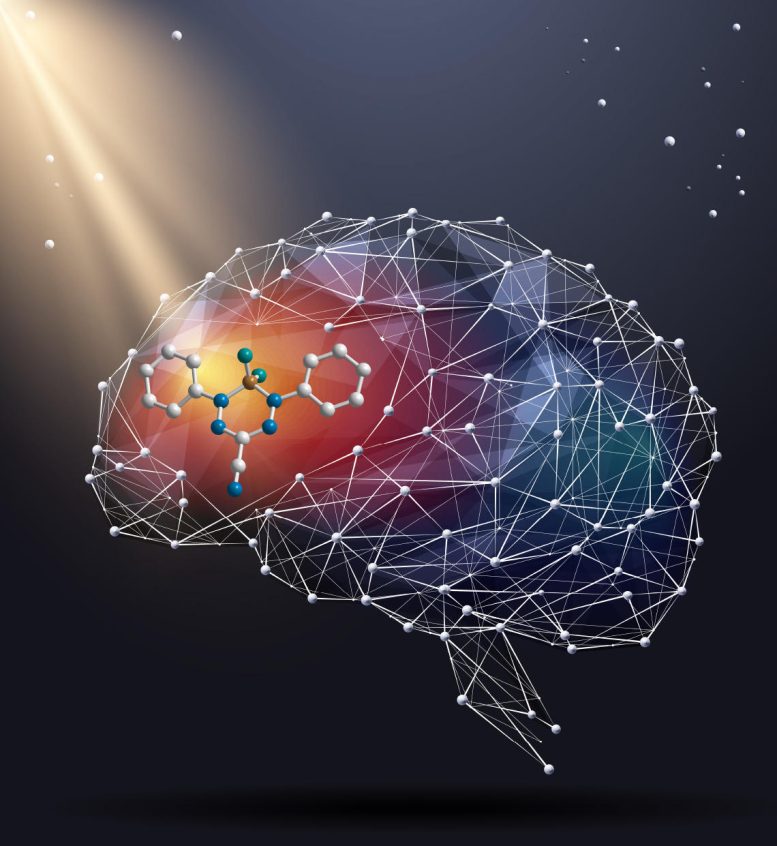
Talk about a bright idea: Lighting up the brain is no longer just a figure of speech, thanks to innovative chemists at Rice University and Stanford University.
Rice University’s Han Xiao and Stanford University’s Zhen Cheng, along with collaborators, have created a non-invasive brain imaging tool that sheds light on previously inaccessible structures and functions. Their unique small-molecule dye, known as a fluorophore, is the first of its kind to penetrate the blood-brain barrier. Furthermore, in a study on mice, the dye was able to distinguish between healthy brain tissue and a glioblastoma tumor.
“This could be very useful for imaging-guided surgery, for example,” Xiao said. “Using this dye, a doctor could determine where the boundary is between normal brain tissue versus tumor tissue.”
The study is featured on the cover of the Journal of the American Chemical Society.
If you’ve been to an aquarium or a nightclub, you’ve probably noticed the colorful glow that some objects or surfaces emit under a black light. Known as fluorescence, this glowing effect can be useful for rendering visible things that otherwise go unnoticed.

“Fluorescence imaging has been applied for imaging cancer in different parts of our body,” Xiao said. “The advantages of a fluorescence probe include high resolution and the ability to adapt the probe to read for different substances or activities.”
A Game-Changing NIR-II Dye Scaffold
The deeper a tissue or organ is, the longer the wavelengths needed to discern the presence of fluorescent small molecules. For this reason, the second near-infrared (NIR-II) channel with wavelengths of 1,000 to 1,700 nanometers is especially important for deep-tissue imaging. For reference, visible light wavelengths range from 380 to 700 nanometers.
“Our tool is really valuable for deep imaging because it functions in the NIR-II region,” Xiao said. “In contrast to NIR-II wavelengths, fluorescent effects within the visible spectrum or with near-infrared wavelengths between 600 and 900 nanometers (NIR-I) will only get you skin-deep.”
Brain imaging poses a particular challenge not only because of tissue depth and accessibility but also because of the blood-brain barrier, a layer of cells that acts as a very selective filter to restrict the passage of substances from the circulatory system to the central nervous system.
Overcoming the Blood-Brain Barrier with Compact Design
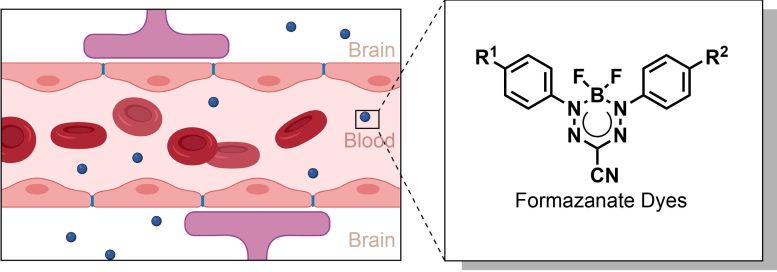
“People always want to know what exactly is happening in the brain, but it’s very hard to design a molecule that can penetrate the blood-brain barrier. Up to 98% of small-molecule drugs approved by the Food and Drug Administration (FDA) cannot,” Xiao said.
“Generally speaking, the reason a NIR-II dye molecule tends to be big is because it is a conjugated structure with many double bonds,” he continued. “This is a true problem and the reason why we have been unable to use fluorescence in brain imaging until now. We tried to address this issue by developing this new dye scaffold that is very small but has a long emission wavelength.”
Unlike the other two known NIR-II dye scaffolds, which are not capable of crossing the blood-brain barrier, the one developed by Xiao is more compact, which makes it a great candidate for probes or drugs targeting the brain. “In the future, we could modify this scaffold and use it to look for a lot of different metabolites in the brain,” Xiao said.
Longer Lifespan for Enhanced Imaging
Beyond the brain, the dye developed by Xiao has much greater lasting power than indocyanine green, the only NIR small-molecule dye approved by the FDA for use as a contrast agent. A longer lifespan means researchers have more time to record the fluorescent trace before it disappears.
“When exposed to light, the indocyanine green dye trace deteriorates in seconds, whereas our dye leaves a stable trace for more than 10 minutes,” Xiao said.
Reference: “Photostable Small-Molecule NIR-II Fluorescent Scaffolds that Cross the Blood–Brain Barrier for Noninvasive Brain Imaging” by Shichao Wang, Hui Shi, Lushun Wang, Axel Loredo, Sergei M. Bachilo, William Wu, Zeru Tian, Yuda Chen, R. Bruce Weisman, Xuanjun Zhang, Zhen Cheng and Han Xiao, 13 December 2022, Journal of the American Chemical Society.
DOI: 10.1021/jacs.2c11223
The study was funded by the Cancer Prevention and Research Institute of Texas, the National Institutes of Health, the U.S. Department of Defense, the Welch Foundation, the National Science Foundation, the Hamill Foundation, the John S. Dunn Foundation, and Stanford University Department of Radiology.
Never miss a breakthrough: Join the SciTechDaily newsletter.
Follow us on Google and Google News.