

Greenland’s rapidly melting ice sheet is not only raising sea levels but also stirring life in the ocean,
NASA-supported researchers found that glacial runoff near Jakobshavn Glacier lifts nutrient-rich deep waters to the surface, fueling summer phytoplankton blooms by up to 40%.
Greenland’s Ice Sheet Sends Nutrients Skyward
Runoff from Greenland’s vast ice sheet is stirring nutrients from deep in the ocean and helping phytoplankton flourish, according to new research backed by NASA. Published in Nature Communications: Earth & Environment, the study used advanced computer simulations to model the interaction of marine life and water movement in a turbulent Greenland fjord. Understanding what fuels these tiny, plantlike organisms is a top priority for oceanographers, since they absorb carbon dioxide and form the foundation of global fisheries.
Greenland’s ice sheet, which in places is a mile thick, is losing about 293 billion tons (266 billion metric tons) of ice each year. In the height of summer melt, more than 300,000 gallons (1,200 cubic meters) of fresh water rush into the ocean every second from beneath Jakobshavn Glacier, also known as Sermeq Kujalleq, the most active glacier in the region. This enormous flow of water plunges hundreds of feet beneath the sea surface before mixing with surrounding currents.
When warm summer air melts the surface of a glacier, the meltwater bores holes down through the ice. It makes its way all the way down to the bottom of the glacier where it runs between the ice and the glacier bed, and eventually shoots out in a plume at the glacier base and into the surrounding ocean.
Buoyant Meltwater Feeds Life
The meltwater plume is lighter than the surrounding salty ocean water. As it rises, scientists have proposed that it carries with it vital nutrients such as iron and nitrate — the latter a key component of fertilizer — delivering them to phytoplankton drifting at the surface.
These microscopic organisms may be tiny, far smaller than a pinhead, but they are giants in terms of ecological importance. Found in every ocean from the tropics to the poles, they feed krill and other small creatures, which in turn sustain larger marine animals, including fish and whales.
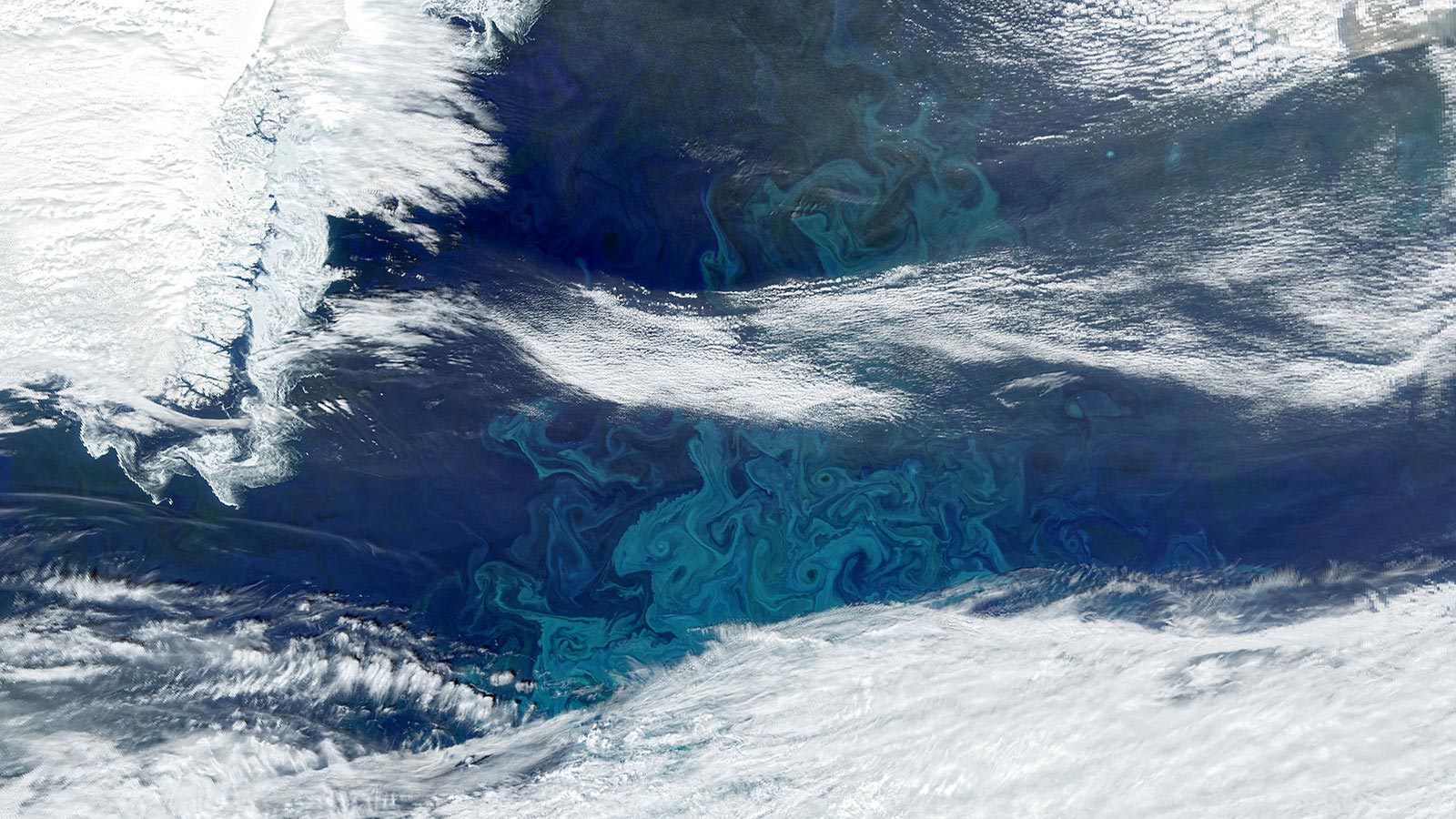
Credit: NASA
Arctic Blooms and a Testing Challenge
Previous work using NASA satellite data found that the rate of phytoplankton growth in Arctic waters surged 57% between 1998 and 2018 alone. An infusion of nitrate from the depths would be especially pivotal to Greenland’s phytoplankton in summer, after most nutrients been consumed by prior spring blooms. But the hypothesis has been hard to test along the coast, where the remote terrain and icebergs as big as city blocks complicate long-term observations.
“We were faced with this classic problem of trying to understand a system that is so remote and buried beneath ice,” said Dustin Carroll, an oceanographer at San José State University who is also affiliated with NASA’s Jet Propulsion Laboratory in Southern California. “We needed a gem of a computer model to help.”
ECCO-Darwin: Ocean Science Powerhouse
To re-create what was happening in the waters around Greenland’s most active glacier, the team harnessed a model of the ocean developed at JPL and the Massachusetts Institute of Technology in Cambridge. The model ingests nearly all available ocean measurements collected by sea- and satellite-based instruments over the past three decades. That amounts to billions of data points, from water temperature and salinity to pressure at the seafloor. The model is called Estimating the Circulation and Climate of the Ocean-Darwin (ECCO-Darwin for short).
Simulating “biology, chemistry, and physics coming together” in even one pocket along Greenland’s 27,000 miles (43,000 kilometers) of coastline is a massive math problem, noted lead author Michael Wood, a computational oceanographer at San José State University. To break it down, he said the team built a “model within a model within a model” to zoom in on the details of the fjord at the foot of the glacier.
Supercomputers Reveal Nutrient Surge
Using supercomputers at NASA’s Ames Research Center in Silicon Valley, they calculated that deepwater nutrients buoyed upward by glacial runoff would be sufficient to boost summertime phytoplankton growth by 15 to 40% in the study area.
Could increased phytoplankton be a boon for Greenland’s marine animals and fisheries? Carroll said that untangling impacts to the ecosystem will take time. Melt on the Greenland ice sheet is projected to accelerate in coming decades, affecting everything from sea level and land vegetation to the saltiness of coastal waters.
“We reconstructed what’s happening in one key system, but there’s more than 250 such glaciers around Greenland,” Carroll said. He noted that the team plans to extend their simulations to the whole Greenland coast and beyond.
Carbon Cycle Balancing Act
Some changes appear to be impacting the carbon cycle both positively and negatively: The team calculated how runoff from the glacier alters the temperature and chemistry of seawater in the fjord, making it less able to dissolve carbon dioxide. That loss is canceled out, however, by the bigger blooms of phytoplankton taking up more carbon dioxide from the air as they photosynthesize.
Wood added: “We didn’t build these tools for one specific application. Our approach is applicable to any region, from the Texas Gulf to Alaska. Like a Swiss Army knife, we can apply it to lots of different scenarios.”
Reference: “Increased melt from Greenland’s most active glacier fuels enhanced coastal productivity” by Michael Wood, Dustin Carroll, Ian Fenty, Clément Bertin, Basil Darby, Stephanie Dutkiewicz, Mark Hopwood, Ala Khazendar, Lorenz Meire, Hilde Oliver, Tara Parker and Josh Willis, 5 August 2025, Communications Earth & Environment.
DOI: 10.1038/s43247-025-02599-1
Never miss a breakthrough: Join the SciTechDaily newsletter.
Follow us on Google and Google News.
5 Comments
“When warm summer air melts the surface of a glacier, the meltwater bores holes down through the ice.”
It is probably the heat provided by sunlight that is responsible for the surface melting. It is well known that pebbles and cobbles are commonly found sitting in ice pedestals in cold regions. That wouldn’t be the case if air temperature were responsible for the melting:
https://cdn.theatlantic.com/assets/media/img/photo/2019/05/lake-baikal-ice-formations-photos/b11_1029357658/main_900.jpg?1559067104
I suppose the heat provided by the sun could warm the air………..and that might melt the ice even under a surface moraine of rock debris that insulates the ice from sunnlight. If the sun didn’t heat the air one might get the cold, and even frosty, nights one can get in deserts. Said pebbles and cobbles could act to insulate the ice from warm air and /or sunlight. Dark pebbles might warm up more quickly under sunlight than white ice or light-coloured cobbles and pebbles and thus drill holes in the ice. Some interesting physics involved.
Rob, have you ever noticed that on a sunny day in Winter, the air (as measured with a thermometer) can be below freezing while the thin coating of snow or ice on sidewalks and pavement are melting?
Alas; we don’t get decent winters these days; just cold damp air and rain. Must be global warming at work…..again……When we did get decent winters in northern UK, I was too young to notice what you state. However, I recall once getting bogged in a small glacial river running across sub-zero snowpack on an Antarctic glacier, and yes it had been a nice sunny 24 hours for several days.
Well man, I am just a high-school student who likes geography. Not really much I can add to this post. I ain’t that advanced. I understand about 60% of what is being discussed . Other than that I am just reading for the sake of it.🤷♀️🤷♀️ If any of you have any tips for geography… well man I’m all ears. 😅😅