

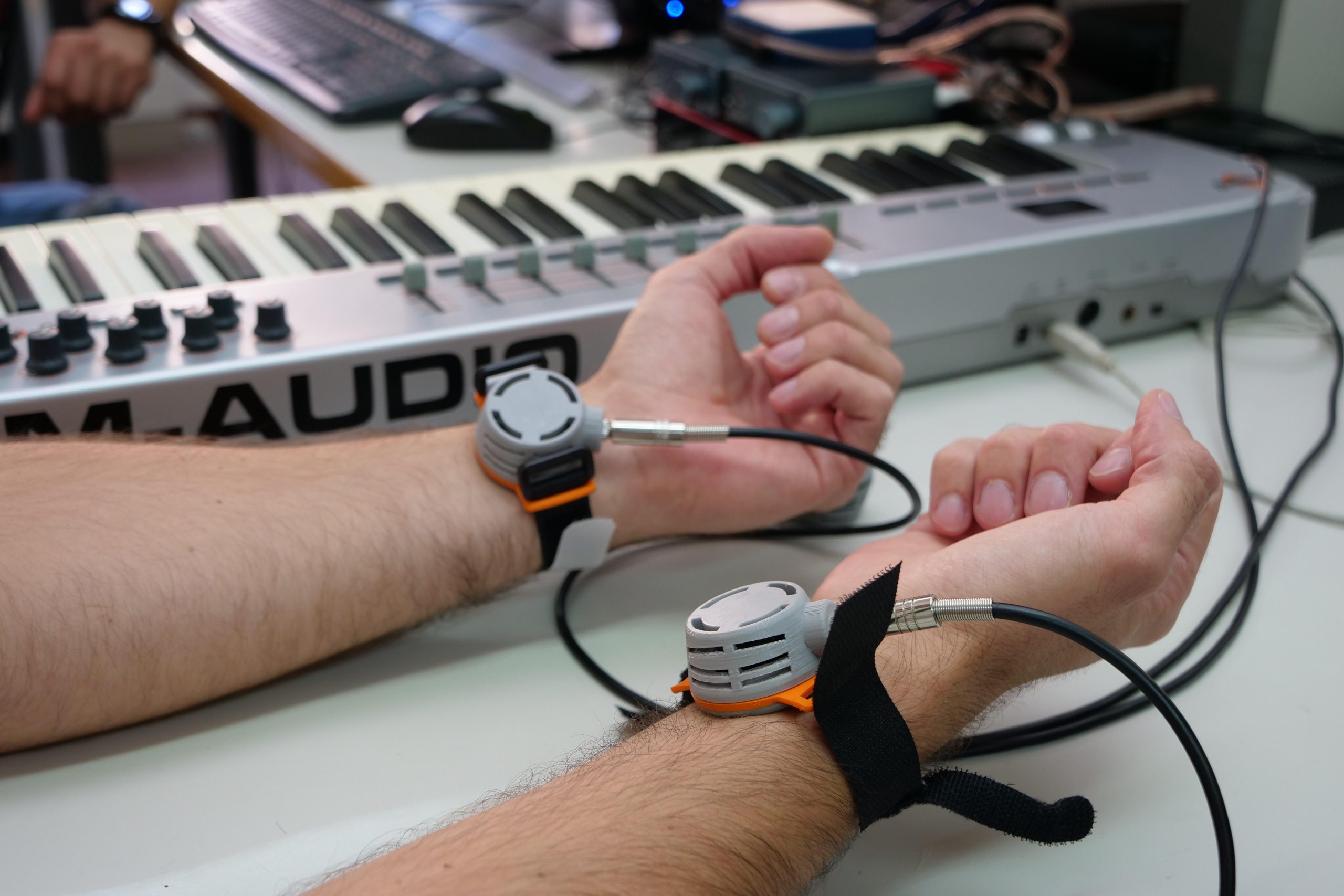
An audio-tactile algorithm created by University of Malaga scientists conveys melodic information through vibration.
A ground-breaking prototype developed by experts from the Department of Electronics at the University of Malaga and members of the R&D group “Electronics for Instrumentation and Systems,” will allow those with hearing loss to listen to music through the sense of touch.
It consists of an audio-tactile algorithm that transforms monophonic music into tangible stimuli based on vibration utilizing “tactile illusions.” According to the researchers, “It’s like ‘hacking’ the nervous system to receive a different response to the real stimulus sent.”
“What we want to achieve in the long term is for people who do not hear to be able to ‘listen’ to music”, assures researcher Paul Remache, the main author of this paper, who insists on the power of music to influence mood, as well as its possibilities as a therapy for mental disorders and treatment of pain.
The researchers predict that this will lead to a portable terminal that may be brought to a concert since this prototype will be easily transferable to technological devices like smartphones.
Researchers of the Department of Electronics have developed an audio-tactile algorithm that conveys melodic information through vibration. Credit: University of Malaga
Mapping Music
This young researcher, working with professors Andrés Trujillo and Fernando Vidal from the UMA, developed an algorithm that can transform musical features and structures taken from MIDI files—Musical Instrument Digital Interface—into “vibrotactile stimuli.”
“It’s something similar to mapping music”, explains Remache, who adds that this is possible because this type of file not only can be played and generate sound, but also provide “symbolic representations”.
Controlling Vibrations
Current models do not warrant the correspondence between the emotional response to music and the vibrotactile version of it. In view of this, these engineers of the UMA propose an arrangement of the “tactile illusions” in order to improve and extend the spectrum of musical features, adding dynamics to the vibration in the form of movement, changes of direction, and location.
“It is a challenging process since the perceptible frequency range of the skin is lower than that of the auditory system, which may cause the loss of some musical features”, they explain.

Different Emotional Response
The results of the first experiments, in which more than fifty volunteers participated, indicate that the arrangement of “tactile illusions” elicits more positive than negative emotions. They are also perceived as more agreeable and stimulating than the audio, provoking a different emotional response from that of the original music.
Smart Instrumentation and Application in Healthcare
This first prototype was presented in the 11th International Workshop on Haptic & Audio Interaction Design (United Kingdom) –the biggest international event specialized in these areas of study– after being published in the scientific journal LNCS. At present, the researchers of the UMA are working on a second model and continuing with the experiments.
The research is the product of Paul Remache’s doctoral thesis and is part of the National Plan project “Smart instrumentations and application in healthcare.”
Reference: “Mapping Monophonic MIDI Tracks to Vibrotactile Stimuli Using Tactile Illusions” by Byron Remache-Vinueza, Andrés Trujillo-León, Maria-Alena Clim, Fabián Sarmiento-Ortiz, Liliana Topon-Visarrea, Alexander Refsum Jensenius and Fernando Vidal-Verdú, 18 August 2022, Lecture Notes in Computer Science.
DOI: 10.1007/978-3-031-15019-7_11
Never miss a breakthrough: Join the SciTechDaily newsletter.
Follow us on Google and Google News.
3 Comments
It’s called a subwoofer. 😅
I’m not sure I understand this. None conduction is ready a thing and harmonic frequencies down to the sub level already trigger vibrations you can feel so…
Even with bone conduction the vibrations move scilia in the cochlea, so if those are damaged or is the audatory nerve etc. (hearing in general) isn’t working someone still won’t hear.
I’m guessing the mapping takes the frequencies of sound over the maybe larger range of frequencies the ear can hear and squishes or moves them to a range that can be felt instead, and then to vibrations. I think it’s a neat idea, for the hearing impaired.