
Magnetic Fields Help Black Holes Reach Deeper Into Galaxies
Black holes potentially have an even larger influence on the galaxies around them than we thought. And the Stratospheric Observatory for Infrared Astronomy (SOFIA) provided a new way to look at their impact.
Active galactic nuclei (AGN) — the central region of a galaxy, which houses its supermassive black hole — are classified by how strong of a jet they produce, shooting matter away at near light speed. Since the jets are mostly visible at radio wavelengths, they are described as either radio loud or radio quiet.
“We see that some AGN have very powerful radio jets and some don’t, even though all AGN are intrinsically the same — they all have a supermassive black hole in the center and accrete mass,” said Enrique Lopez-Rodriguez, a research scientist at Stanford University’s Kavli Institute for Particle Astrophysics and Cosmology and lead author on the new SOFIA finding. “We don’t understand why some of them are so powerful, and some of them are not.”
Now, using SOFIA, Lopez-Rodriguez and his team have found that the polarization of infrared light from AGN also increases with their radio loudness, providing a new way to study black hole characteristics.
Motivated by the 2018 SOFIA discovery that the infrared light from the strongest known radio-loud AGN, Cygnus A, was highly polarized, the researchers developed a follow-up observation program with SOFIA to determine whether there’s a relationship between infrared polarization and radio loudness, and if so, why. They looked at the magnetic fields of a total of nine AGN, four of them radio loud and five radio quiet.
Magnetic Fields in Radio-Loud AGN
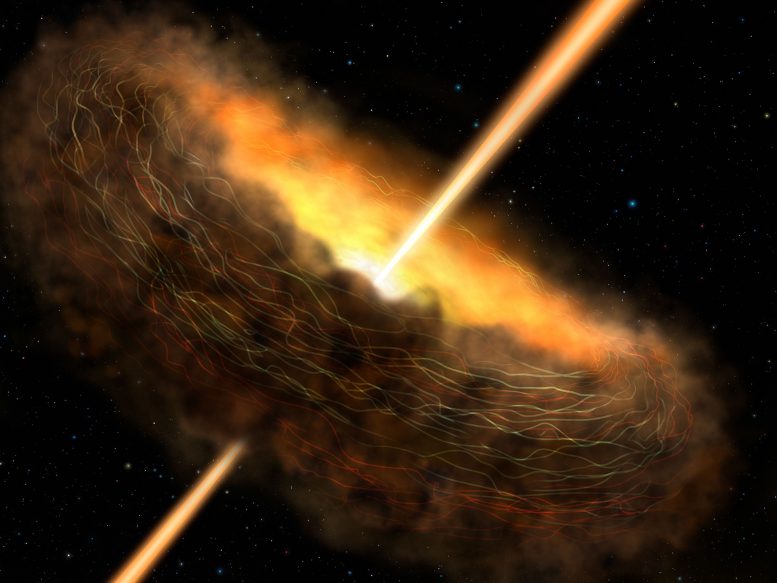
From SOFIA observations of light polarization, astronomers can deduce the structure of the magnetic field in the region. In the AGN sample Lopez-Rodriquez and his team studied, these polarizations show that in radio-loud AGN — AGN with strong jets — there’s a donut-shaped magnetic field perpendicular to the jets, along the equator of the AGN. That only radio-loud AGN have such a strong toroidal magnetic field indicates that the field is helping to transfer energy inward, feeding the black hole with matter coming from the host galaxy. The stronger the jets, the stronger the magnetic field, and the more energy there is in the system.
The group was surprised by the strength of the result.
“We were hoping for it, but we weren’t expecting such a nice correlation,” Lopez-Rodriguez said. “There’s so much physics behind it that we don’t understand, and future hydromagnetic models are required.”
Implications for Galaxy Evolution and Future Research
Though a lot of science behind these objects remains unexplained, the result implies that black holes are potentially affecting galaxy evolution and jet production quite a bit more than astronomers previously realized. While astronomers typically consider gravity as the only force influencing supermassive black holes, this work shows that magnetic fields can aid in bridging the interface between black holes and matter in their host galaxy. With the help of these magnetic fields, black holes can impact not only the matter immediately around them, but can also work at even larger distances within the galaxy.
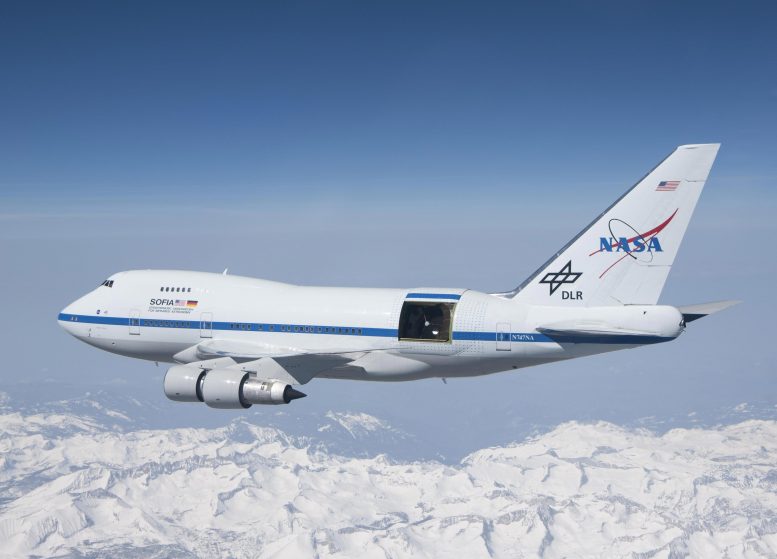
SOFIA was a joint project of NASA and the German Space Agency at DLR. DLR provided the telescope, scheduled aircraft maintenance, and other support for the mission. NASA’s Ames Research Center in California’s Silicon Valley managed the SOFIA program, science, and mission operations in cooperation with the Universities Space Research Association, headquartered in Columbia, Maryland, and the German SOFIA Institute at the University of Stuttgart. The aircraft was maintained and operated by NASA’s Armstrong Flight Research Center Building 703, in Palmdale, California. SOFIA achieved full operational capability in 2014 and concluded its final science flight on September 29, 2022.
Never miss a breakthrough: Join the SciTechDaily newsletter.
Follow us on Google and Google News.
4 Comments
Maybe these finding will help explain why galaxies can rotate faster than expected.
More proof man is isolated to earth.
Tools are going to be the only way to understand the Universe,
Even though life is everywhere man must stay on earth, the garden of eden…
Everything is more powerful than originally thought…the tools are getting better…
“Black Holes More Powerful Than Thought”. Tough to compare: how powerful is thought?