
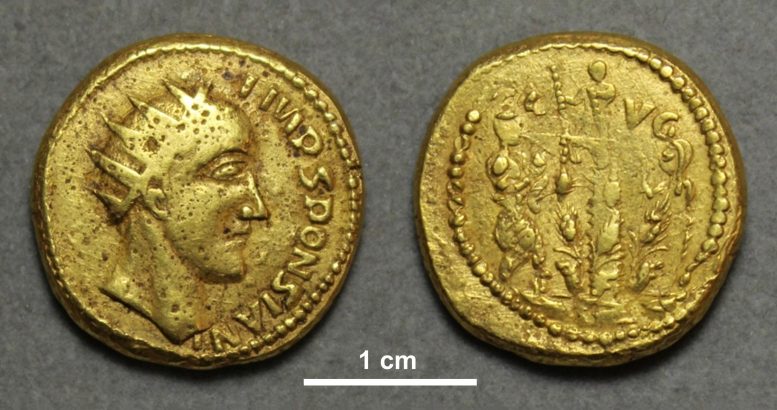
Gold Coins Are Only Clue That Roman Leader Named Sponsian Ever Existed
Several Roman coins unearthed in 1713 — long thought to be forgeries — are likely authentic, according to a new scientific analysis. This provides evidence that the leader portrayed on one of the coins was indeed in power during the 260s CE. These findings were presented on November 23, 2022, in the open-access journal PLOS ONE by Paul Pearson of University College London, U.K., and colleagues.
For much of ancient Roman history, Roman mints produced coins featuring portraits of current emperors. In 1713, a group of such coins was allegedly discovered in Transylvania, some of them featuring a portrait labeled with the name “Sponsian,” although there are no other historical records that a Roman emperor named Sponsian ever existed.
While the Transylvanian coins follow the general style of mid-third-century Roman coins, they diverge in certain stylistic characteristics and in how they were manufactured, leading many experts to dismiss them as forgeries created to sell to collectors. However, the coins are also uncharacteristic of the forgeries that would have been of interest to past collectors. Additionally, in 1713, “Sponsian” was not yet known to be a name that had ever existed in ancient Rome.
Scientific Evidence Validates Coin Authenticity
To further investigate the Transylvanian coins’ authenticity, Pearson and colleagues conducted a deeper assessment of the physical characteristics of four of the coins, including the Sponsian coin. They applied visible light microscopy, ultra-violet imaging, scanning electron microscopy, and reflection mode Fourier transform infrared spectroscopy to the four coins and, for comparison, two undoubtedly authentic Roman gold coins.
The analysis revealed deep micro-abrasion patterns typically associated with coins that were in circulation for an extensive period of time. The researchers also analyzed earthen deposits on the coins, finding evidence that after extensive circulation, the coins were buried for a prolonged period before being exhumed. Together, the new evidence strongly suggests the coins are authentic.
Considering the historical record alongside the new evidence from the coins, the researchers suggest that Sponsian was an army commander in the Roman Province of Dacia during a period of military strife in the 260s CE.
Lead author of the paper, Paul N. Pearson of University College, London, adds: “Scientific analysis of these ultra-rare coins rescues the emperor Sponsian from obscurity. Our evidence suggests he ruled Roman Dacia, an isolated gold mining outpost, at a time when the empire was beset by civil wars and the borderlands were overrun by plundering invaders.”
Curator of Numismatics at The Hunterian, Jesper Ericsson, adds: “This has been a really exciting project for The Hunterian. Not only do we hope that this encourages further debate about Sponsian as a historical figure, but also the investigation of coins relating to him held in other museums across Europe.”
Reference: “Authenticating coins of the ‘Roman emperor’ Sponsian” by Paul N. Pearson, Michela Botticelli, Jesper Ericsson, Jacek Olender and Liene Spruženiece, 23 November 2022, PLOS ONE.
DOI: 10.1371/journal.pone.0274285
Funding: PNP received a small grant of <£1K from the Royal Numismatic Society. The funders had no role in study design, data collection, and analysis, decision to publish, or preparation of the manuscript.
Never miss a breakthrough: Join the SciTechDaily newsletter.
Follow us on Google and Google News.