
Close Menu
    Facebook X (Twitter) Instagram
    SciTechDaily
    • Biology
    • Chemistry
    • Earth
    • Health
    • Physics
    • Science
    • Space
    • Technology
    Facebook X (Twitter) Pinterest YouTube RSS
    SciTechDaily
    Home»Science»Haast’s Eagle Was Big & Strong Enough to Prey on Humans
    Science

    Haast’s Eagle Was Big & Strong Enough to Prey on Humans

    By SciTechDailyDecember 21, 20125 Comments2 Mins Read
    Facebook Twitter Pinterest Telegram LinkedIn WhatsApp Email Reddit
    Share
    Facebook Twitter LinkedIn Pinterest Telegram Email Reddit
    haasts-eagle-moa
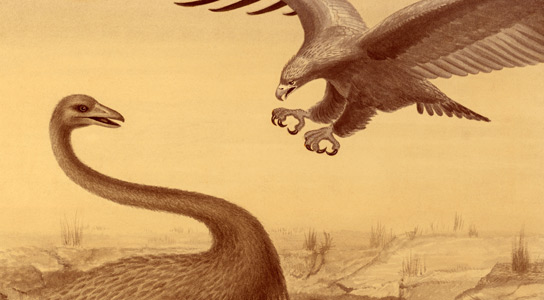
    Reconstruction of predation by Haast’s Eagle (Harpagornis moorei) on South Island giant moa (Dinornis robustus). Credit Original artwork by Ray Jacobs/Canterbury Museum.

    The strongest and biggest bird of prey that ever existed was the Haast’s Eagle (Harpagornis moorei) of New Zealand, and it became extinct around the 1400s soon after the Maori settled the South Island of New Zealand.

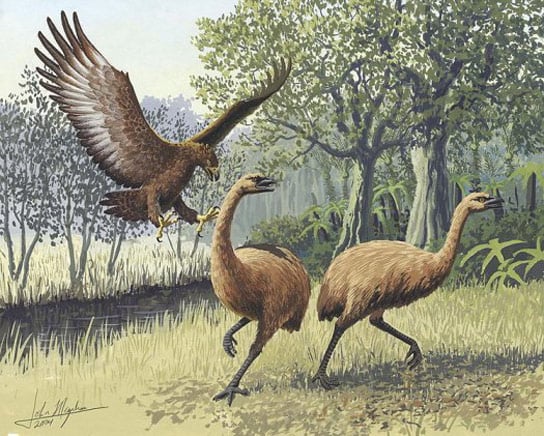
    H. moorei was powerful enough to attack and prey on giant flightless birds, the moa, weighing 10 to 15 times their own body weight. Comparatively to its body size, the Haast’s Eagle’s wingspan was short, at about 9 feet (2.7 meters). It’s believed that the raptor would swoop down at speeds of nearly 50 mph (80 kph) to attack the moa. It used its talons to kill them on the ground and didn’t carry off its prey.
    haasts-eagle-two-moa
    Haast’s Eagle hunting moa. Credit: Wikimedia Commons

    It’s believed that the Haast’s Eagle and moa evolved due to island gigantism, a phenomenon in which animals isolated from other, more diverse populations, end up much larger than they would be on the mainland. When the Maori first arrived in New Zealand, there were no land animals. Birds and reptiles evolved to fill up these empty ecological niches that would have been typically filled up by larger mammals.
    haasts-eagle-skull
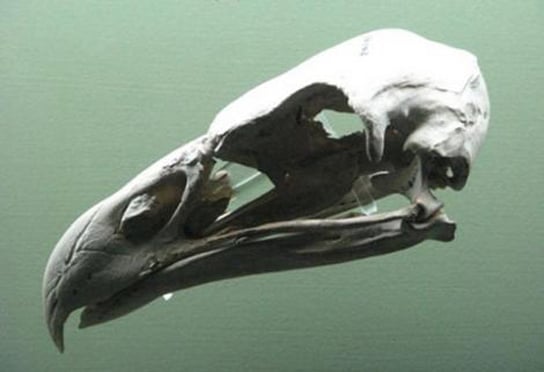
    Skull of a Haast’s Eagle specimen.

    Evolutionarily speaking, Haast’s Eagle took the place of the apex predator that hunted grazers, a space taken up by the moa species. When the Maori hunted the moa to extinction in the 1400s, barely a century after their arrival, there was no prey large enough to sustain the Haast’s Eagles, so they became extinct quickly.

    No evidence has been found that Haast’s Eagle preyed on humans, but researchers believe it was big and strong enough to do so.

    Never miss a breakthrough: Join the SciTechDaily newsletter.
    Follow us on Google and Google News.

    Evolution New Zealand Paleontology Wildlife
    Share. Facebook Twitter Pinterest LinkedIn Email Reddit

    Related Articles

    Earliest Interbreeding Between Ancient Human Populations Discovered – Evolutionary Puzzle Solved

    One-of-a-Kind Dinosaur Specimen Discovered in China Offers View Into Dinosaur-Bird Evolution

    What Came First, the Animal or the Embryo? New Research Has Answer

    It Seems There Were Too Many Meat-Eating Dinosaurs – This May Be the Explanation

    New Evidence Shows Humans Mastered Fire Earlier Than Thought

    New Species of Giant Predatory Dinosaur Discovered in Thailand Provides a New Glimpse at Dinosaur Evolution

    Fossil Discovery Shows Giant Reptiles Coexisted with Mammals

    Jawless Vertebrate Conodont Had Sharpest Yet Minuscule Teeth

    Giant Oligocene Kairuku Penguins Stood Nearly Five Feet Tall

    5 Comments

    1. Ewan Zerafa Gregory on July 2, 2018 11:46 pm

      I also think, that if the haasts eagle was very well able to attack and kill an adult giant moa, it could also attack and kill and adult human being or even a cow. But even though it might sound exaggerating a little bit to kill an adult man or cow, it perfectly isn’t, especially when you consider that these giant predatory birds were able to kill birds that weighed up to 250 kilograms and stood up to 12 feet tall.

      Reply
    2. Bo on December 11, 2020 6:32 am

      i wounder if the moa lived in open plains and i also wounder if the Haast’s eagle di prey on humans?

      Reply
    3. Bruzote on March 25, 2021 11:00 pm

      The statements of eagles capable of attacking humans is silent on the notion that the humans could fight back and kill the eagles, and destroy the eagle nests as well.

      Reply
    4. Brian Threlkeld on March 31, 2022 8:05 pm

      About this sentence: “When the Maori first arrived in New Zealand, there were no land animals.” Clearly, the writer intended to say, “there were no land •mammals•.” New Zealand had lots of land animals before humans arrived; they were just almost all non-mammals: birds, reptiles, amphibians, and invertebrates.

      But it’s not quite correct to say there were no land mammals. Prior to human settlement, three species of bat were native to New Zealand. And, in the absence of larger mammalian predators, the New Zealand bats developed highly terrestrial foraging behaviors, although they did not completely lose the ability to fly.

      Reply
    5. Rob on December 28, 2025 4:45 pm

      So the living-in-harmony Maoris ate the Moas and the Eagles. Human beings have never lived in harmony with Mother Nature, whatever that means; Mother Nature has a habit of wanting to kill us.

      Reply
    Leave A Reply Cancel Reply

    • Facebook
    • Twitter
    • Pinterest
    • YouTube

    Don't Miss a Discovery

    Subscribe for the Latest in Science & Tech!

    Trending News

    Popular Sugar-Free Sweetener Linked to Liver Disease, Study Warns

    What Is Hantavirus? The Deadly Disease Raising Alarm Worldwide

    Scientists Just Discovered How the Universe Builds Monster Black Holes

    Scientists Unveil New Treatment Strategy That Could Outsmart Cancer

    A Simple Vitamin May Hold the Key to Treating Rare Genetic Diseases

    Scientists Think the Real Fountain of Youth May Be Hiding in Your Gut

    Ravens Don’t Follow Wolves, They Predict Them

    This Common Knee Surgery May Be Doing More Harm Than Good

    Follow SciTechDaily
    • Facebook
    • Twitter
    • YouTube
    • Pinterest
    • Newsletter
    • RSS
    SciTech News
    • Biology News
    • Chemistry News
    • Earth News
    • Health News
    • Physics News
    • Science News
    • Space News
    • Technology News
    Recent Posts
    • Popular Supplement Ingredient Linked to Shorter Lifespan in Men
    • Scientists May Have Found a Way To Repair Nerve Damage in Multiple Sclerosis
    • GLP-1 Weight Loss Linked To Dramatically Lower Risk of Sleep Apnea, Kidney Disease and More
    • Scientists Uncover the Surprising Source of Strange Clouds Near the Milky Way’s Supermassive Black Hole
    • This Dazzling Green Snake Was Hiding in Plain Sight for Decades
    Copyright © 1998 - 2026 SciTechDaily. All Rights Reserved.
    • Science News
    • About
    • Contact
    • Editorial Board
    • Privacy Policy
    • Terms of Use

    Type above and press Enter to search. Press Esc to cancel.