
Close Menu
    Facebook X (Twitter) Instagram
    SciTechDaily
    • Biology
    • Chemistry
    • Earth
    • Health
    • Physics
    • Science
    • Space
    • Technology
    Facebook X (Twitter) Pinterest YouTube RSS
    SciTechDaily
    Home»Biology»Origin of Ion-Pumping Proteins Could Explain How Life Began
    Biology

    Origin of Ion-Pumping Proteins Could Explain How Life Began

    By SciTechDailyDecember 21, 2012No Comments3 Mins Read
    Facebook Twitter Pinterest Telegram LinkedIn WhatsApp Email Reddit
    Share
    Facebook Twitter LinkedIn Pinterest Telegram Email Reddit
    underwater-thermal-vent
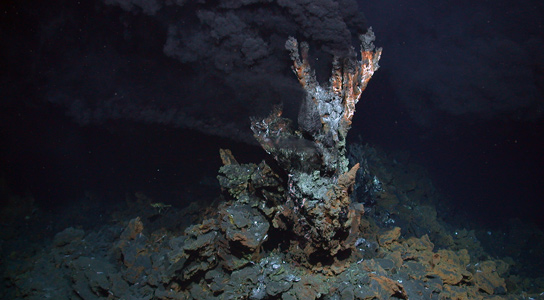
    Underwater thermal vent. Credit: MARUM Research Center, University of Bremen

    A new study indicates how the first cells might have evolved from rocks, water and hot alkaline fluid rich in hydrogen gas spewing out of deep-sea vents, and how they might have escaped their deep sea lairs.

    The scientists published their findings in the journal Cell¹. Scientists thought that the origin of life was tied to the origin of the cellular ion pumps, proteins that regulate the flow of ions across the cell’s membrane. All cells have an enzyme called ATP synthase, which uses the energy from the flow of ions across membranes to produce the energy-storage molecule ATP. This process relies on ion-pumping proteins that generate these gradients. Cells store energy by the means of proteins that make ion gradients, but it takes energy to make these proteins in the first place.

    The scientists think that hydrogen-saturated alkaline water, meeting acidic oceanic water at underwater vents, would produce a natural proton gradient across thin mineral walls in the rocks that are rich in catalytic ion-sulfur minerals. This could create the right conditions for converting carbon dioxide and hydrogen into organic carbon-containing molecules, which react with each other to form the building blocks of life, such as nucleotides and amino acids.

    The rocks of deep-sea thermal vents contain labyrinths of these thin-walled pores, which could have been the precursors of cells, producing a proton gradient and concentrating the simple organic molecules formed, enabling them to eventually generate complex proteins and the nucleic acid RNA.

    Rocky proto-cells would be initially lined with leaky organic membranes. If the cells escaped the vents and became free-living in the ocean, the membranes would have to have been sealed. But sealing membranes would cut off natural proton gradients, because while an ATP synthase would let protons into the cell, there would be nothing to pump them out.

    Proteins that pump protons out of the cells would solve this problem, but there would have been no evolutionary pressure for such proteins to evolve until after the membranes were closed. In which case, they would have had to evolve a proton pumping system in almost no time, which is impossible, states researcher Nick Lane.

    The scientists think that the proto-cells were able to escape this dilemma by evolving a sodium-proton antiporter, a simple proton that uses the influx of protons to pump sodium ions out of the cells. As the proto-cell membranes started closing up, they became impermeable to the large sodium ions before the smaller protons. This would have provided advantages to cells that evolved a sodium-pumping protein, while they could still rely on the vents’ natural proton gradients to generate energy. These antiporters created sodium gradients as well, and when the cell membrane closed up completely, the cells could run on the sodium gradient, and were free to leave the vent.

    Reference: “The Problem with Mixing Mitochondria” by Nick Lane, 12 October 2012, Cell.
    DOI: 10.1016/j.cell.2012.09.028

    Never miss a breakthrough: Join the SciTechDaily newsletter.
    Follow us on Google and Google News.

    Evolution Evolutionary Biology Life Microbiology
    Share. Facebook Twitter Pinterest LinkedIn Email Reddit

    Related Articles

    An Ancient Partnership: Unlocking the Microbial Blueprint of Earth’s Evolution

    New Insights Into Earth’s First Organisms Could Change How We Search for Extraterrestrial Life

    New Research Reveals That Complex Green Organisms Emerged a Billion Years Ago

    The Unsolved Enigma of the Origin of Life: A New Strategy

    New Study Presents “Water World” Theory for the Emergence of Life

    Rudimentary Form of Life Sidesteps Normal Replication Processes

    New Findings Challenge Assumptions about the Origins of Life

    DNA Could Predate Existence of Life As We Know It

    Evolutionary Biologists Make Multicellular Life Evolve in the Lab

    Leave A Reply Cancel Reply

    • Facebook
    • Twitter
    • Pinterest
    • YouTube

    Don't Miss a Discovery

    Subscribe for the Latest in Science & Tech!

    Trending News

    The Universe Is Expanding Too Fast and Scientists Can’t Explain Why

    “Like Liquid Metal”: Scientists Create Strange Shape-Shifting Material

    Early Warning Signals of Esophageal Cancer May Be Hiding in Plain Sight

    Common Blood Pressure Drug Shows Surprising Power Against Deadly Antibiotic-Resistant Superbug

    Scientists Uncover Dangerous Connection Between Serotonin and Heart Valve Disease

    Scientists Discover a “Protector” Protein That Could Help Reverse Hair Loss

    Bone-Strengthening Discovery Could Reverse Osteoporosis

    Scientists Uncover Hidden Trigger Behind Stem Cell Aging

    Follow SciTechDaily
    • Facebook
    • Twitter
    • YouTube
    • Pinterest
    • Newsletter
    • RSS
    SciTech News
    • Biology News
    • Chemistry News
    • Earth News
    • Health News
    • Physics News
    • Science News
    • Space News
    • Technology News
    Recent Posts
    • Scientists Overcome Major Quantum Bottleneck, Potentially Transforming Teleportation and Computing
    • Quantum Physics’ Strangest Problem May Hold the Key to Time Itself
    • Scientists Create “Liquid Gears” That Spin Without Touching
    • The Simple Habit That Could Help Prevent Cancer
    • Forgotten Medicinal Plant Shows Promise in Fighting Dangerous Superbugs
    Copyright © 1998 - 2026 SciTechDaily. All Rights Reserved.
    • Science News
    • About
    • Contact
    • Editorial Board
    • Privacy Policy
    • Terms of Use

    Type above and press Enter to search. Press Esc to cancel.