
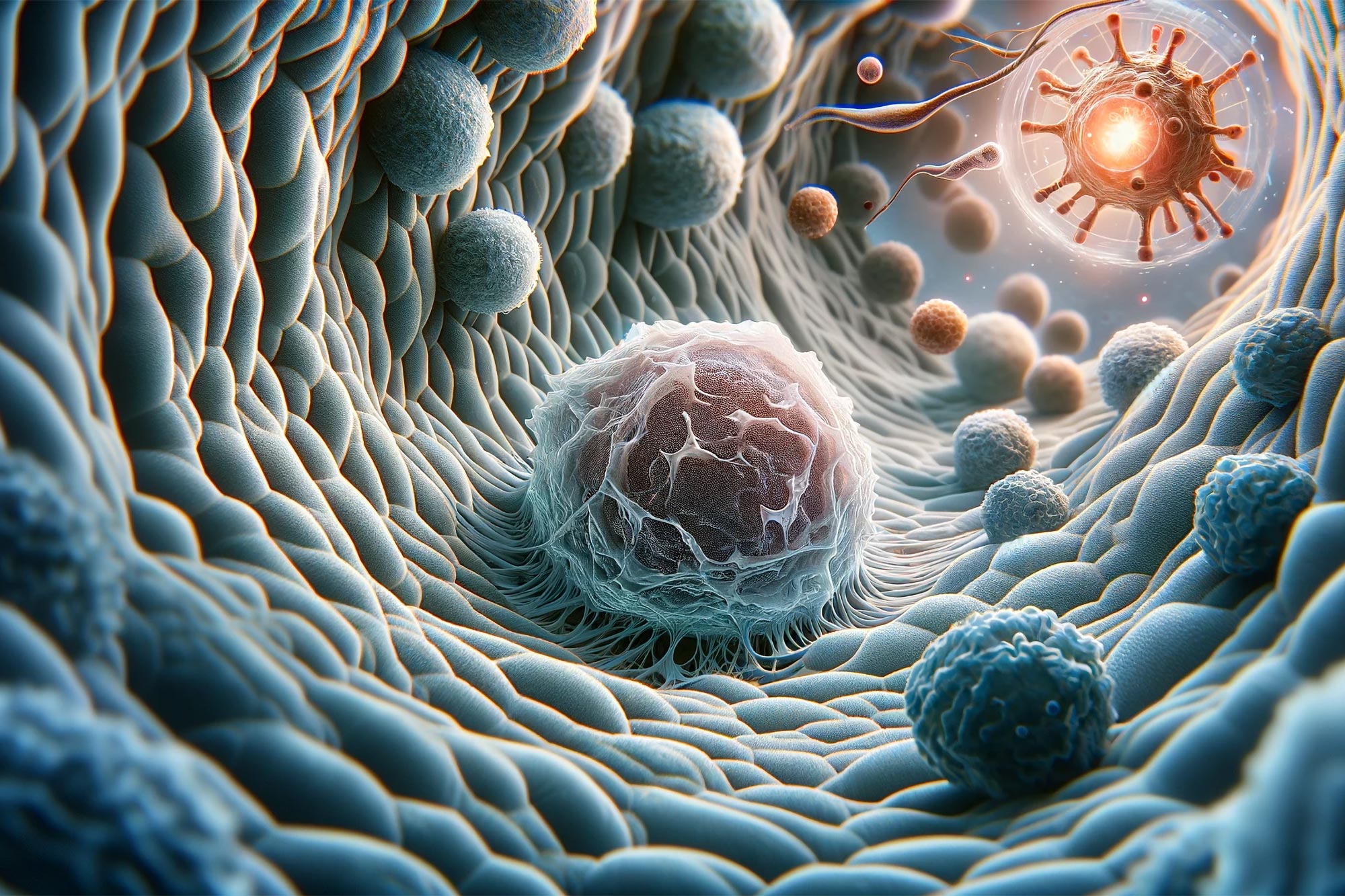
A new study finds precancerous colon cells turn on a gene called SOX17, which helps them evade detection and develop into more advanced tumors.
One of the immune system’s primary roles is to detect and kill cells that have acquired cancerous mutations. However, some early-stage cancer cells manage to evade this surveillance and develop into more advanced tumors.
A new study from MIT and Dana-Farber Cancer Institute has identified one strategy that helps these precancerous cells avoid immune detection. The researchers found that early in colon cancer development, cells that turn on a gene called SOX17 can become essentially invisible to the immune system.
If scientists could find a way to block SOX17 function or the pathway that it activates, this may offer a new way to treat early-stage cancers before they grow into larger tumors, the researchers say.
Discovery of SOX17’s Role in Colon Cancer
“Activation of the SOX17 program in the earliest innings of colorectal cancer formation is a critical step that shields precancerous cells from the immune system. If we can inhibit the SOX17 program, we might be better able to prevent colon cancer, particularly in patients that are prone to developing colon polyps,” says Omer Yilmaz, an MIT associate professor of biology, a member of MIT’s Koch Institute for Integrative Cancer Research, and one of the senior authors of the study.
Judith Agudo, a principal investigator at Dana-Farber Cancer Institute and an assistant professor at Harvard Medical School, is also a senior author of the study, which was published recently in Nature. The paper’s lead author is MIT Research Scientist Norihiro Goto. Other collaborators include Tyler Jacks, a professor of biology and a member of MIT’s Koch Institute; Peter Westcott, a former Jacks lab postdoc who is now an assistant professor at Cold Spring Harbor Laboratory; and Saori Goto, an MIT postdoc in the Yilmaz lab.
How Precancerous Growths Evade Immune Detection
Colon cancer usually arises in long-lived cells called intestinal stem cells, whose job is to continually regenerate the lining of the intestines. Over their long lifetime, these cells can accumulate cancerous mutations that lead to the formation of polyps, a type of premalignant growth that can eventually become metastatic colon cancer.
To learn more about how these precancerous growths evade the immune system, the researchers used a technique they had previously developed for growing mini colon tumors in a lab dish and then implanting them into mice. In this case, the researchers engineered the tumors to express mutated versions of cancer-linked genes Kras, p53, and APC, which are often found in human colon cancers.
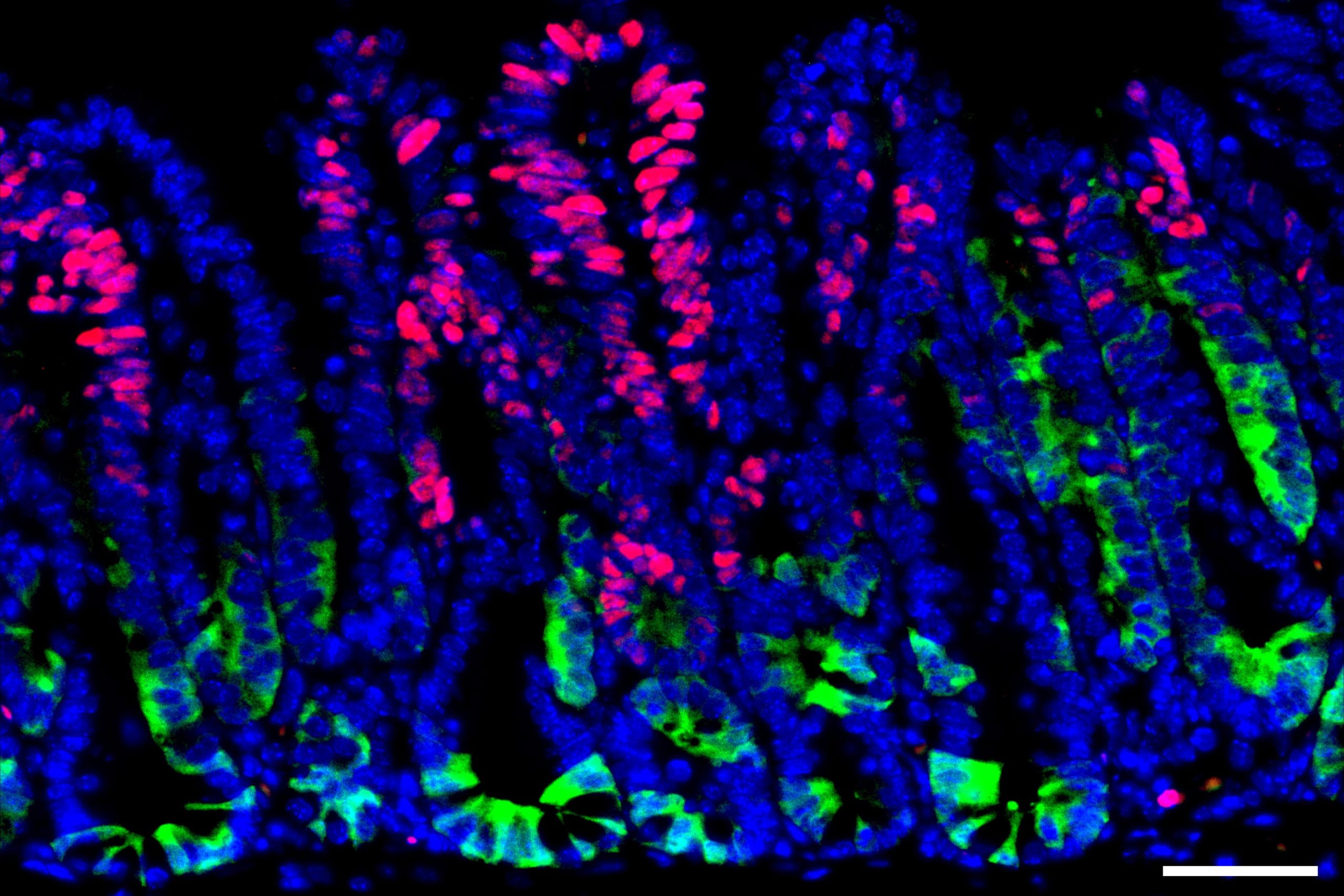
Once these tumors were implanted in mice, the researchers observed a dramatic increase in the tumors’ expression of SOX17. This gene encodes a transcription factor that is normally active only during embryonic development, when it helps to control development of the intestines and the formation of blood vessels.
The researchers’ experiments revealed that when SOX17 is turned on in cancer cells, it helps the cells to create an immunosuppressive environment. Among its effects, SOX17 prevents cells from synthesizing the receptor that normally detects interferon gamma, a molecule that is one of the immune system’s primary weapons against cancer cells.
Without those interferon gamma receptors, cancerous and precancerous cells can simply ignore messages from the immune system, which would normally direct them to undergo programmed cell death.
“One of SOX17’s main roles is to turn off the interferon gamma signaling pathway in colorectal cancer cells and in precancerous adenoma cells. By turning off interferon gamma receptor signaling in the tumor cells, the tumor cells become hidden from T cells and can grow in the presence of an immune system,” Yilmaz says.
Without interferon gamma signaling, cancer cells also minimize their production of molecules called MHC proteins, which are responsible for displaying cancerous antigens to the immune system. The cells’ insensitivity to interferon gamma also prevents them from producing immune molecules called chemokines, which normally recruit T cells that would help destroy the cancerous cells.
SOX17 as a Target for Early-Stage Cancer Treatment
When the researchers generated colon tumor organoids with SOX17 knocked out, and implanted those into mice, the immune system was able to attack those tumors much more effectively. This suggests that preventing cancer cells from turning off SOX17 could offer a way to treat colon cancer in its earliest stages.
“Just by turning off SOX17 in fairly complex tumors, we were able to essentially obliterate the ability of these tumor cells to persist,” Goto says.
As part of their study, the researchers also analyzed gene expression data from patients with colon cancer and found that SOX17 tended to be highly expressed in early-stage colon cancers but dropped off as the tumors became more invasive and metastatic.
“We think this makes a lot of sense because as colorectal cancers become more invasive and metastatic, there are other mechanisms that create an immunosuppressive environment,” Yilmaz says. “As the colon cancer becomes more aggressive and activates these other mechanisms, then there’s less importance for SOX17.”
Transcription factors such as SOX17 are considered difficult to target using drugs, in part because of their disorganized structure, so the researchers now plan to identify other proteins that SOX17 interacts with, in hopes that it might be easier to block some of those interactions.
The researchers also plan to investigate what triggers SOX17 to turn on in precancerous cells.
Reference: “SOX17 enables immune evasion of early colorectal adenomas and cancers” by Norihiro Goto, Peter M. K. Westcott, Saori Goto, Shinya Imada, Martin S. Taylor, George Eng, Jonathan Braverman, Vikram Deshpande, Tyler Jacks, Judith Agudo and Ömer H. Yilmaz, 28 February 2024, Nature.
DOI: 10.1038/s41586-024-07135-3
The research was funded by the MIT Stem Cell Initiative via Fondation MIT, the National Institutes of Health/National Cancer Institute, and a Koch Institute-Dana Farber Harvard Cancer Center Bridge Project grant.
Never miss a breakthrough: Join the SciTechDaily newsletter.
Follow us on Google and Google News.