
University of Chicago researchers awarded $80,000 grant to develop test for current and former infections.
Accurate and widespread testing is crucial to managing the coronavirus pandemic, but many people in the U.S. still can’t get tested for COVID-19 without visiting designated sites. A new research project could lead to a solution: an affordable, at-home test that offers rapid detection.
University of Chicago researchers were awarded a Big Ideas Generator grant to develop a handheld COVID-19 testing device that provides results in five minutes. They hope to be able to detect both current infections as well as previous ones, all for about $10 per test.
With this funding, Pritzker Molecular Engineering researchers Jun Huang and Junhong Chen, their lab groups, and Kathleen Beavis of the Department of Pathology will come together to create a detection device that uses field-effect transistor technology to enable rapid diagnosis of COVID-19—at home or at the doctor.
Affordable, at-home testing
Haihui Pu, a staff scientist in the Junhong Chen research group, said a home testing kit could provide peace of mind to individuals who might be concerned about the risk of exposure to the coronavirus at a testing site, as well as rapid results to those who might face a long wait or may not qualify based on their symptoms.
“Home testing offers the opportunity to carry out the self-diagnosis even with very mild symptoms or in the asymptomatic condition,” Pu said. “In addition, it is affordable at about $10 per test.” An affordable price point is critical for under-resourced and under-served populations to access the technology, he added.
To meet the high demand for testing, the researchers plan to use cost-effective technology that is sensitive, precise, reliable and able to process a lot of information quickly.
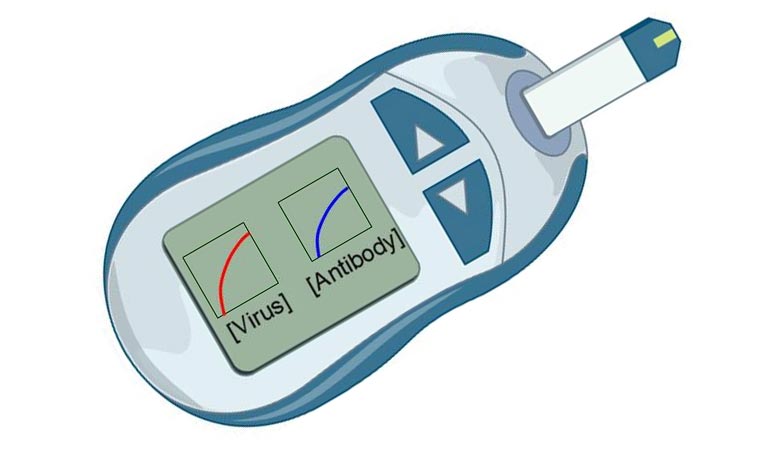
The researchers plan to create a handheld device programmed with step-by-step prompts on the LCD screen, allowing for easy use without any prior training. The device would use various specimens from patients (e.g., nasal and saliva samples) to test for both infection and antibodies.
Detecting both the virus and antibodies
“The existing technologies only allow for diagnosis against COVID-19 by separately detecting the presence of virus and antibodies, which also require professional training for operation and take hours to deliver the results,” said Pu.
The research team’s device, however, will detect viral particles and antibodies simultaneously.
“In order to do this,” explained Nicholas Ankenbruck, a postdoctoral researcher in the Huang lab, “we immobilize probes specific to the virus or antibodies on the surface of the device, and then monitor changes in electrical measurements in the presence of a sample.”
This combined detection is important, Ankenbruck said, because it can hint at the stage of viral infection or indicate whether the individual is unable to produce antibodies to fight the infection. In other words, people could use the testing device to track the progression of the disease from home.
For example, if a user takes the test when they first have symptoms, it may detect the virus but no antibodies. A week later, that user may detect both the virus and antibodies, suggesting their body is starting to fight off the infection. And if a user is not getting better within a reasonable time frame, they will know it’s time to call the doctor for intervention.
A collaborative approach
Each member of the research team brings specific expertise to the project. Chen, also lead water strategist at Argonne National Laboratory, has extensive experience in nanomaterials and nanodevices. His group will provide the central sensing platform for the device. Huang and his lab group focus on immunology. They will develop a pseudovirus, or synthetic virus, to enable optimization of the device.
Beavis will contribute clinical expertise in current testing practices to evaluate the performance of the device.
BIG, which awarded the research team $80,000 in direct cost funding, funds early-stage research projects at UChicago that have the potential to grow into novel and robust areas of research.
Ankenbruck said creating an accurate test will require the use of purified biological materials for extensive evaluation before moving on to actual patient samples.
“This new funding enables us to purchase all the necessary resources in order to fine-tune and calibrate the device to ensure it is ready for patient use,” he said.
He said the team expects to have a calibrated device within six months and to finish evaluations of the prototype within a year.
“My biggest hope is that we are able to deliver an accurate sensing device for diagnosis and monitoring of COVID-19 that can be transitioned to commercial use and help facilitate a safe transition back to normal life,” he said.
Never miss a breakthrough: Join the SciTechDaily newsletter.
Follow us on Google and Google News.