

Groundbreaking study demonstrates control over quantum fluctuations, unlocking potential for probabilistic computing and ultra-precise field sensing.
A team of researchers from the Massachusetts Institute of Technology (MIT) has achieved a milestone in quantum technologies, demonstrating for the first time the control of quantum randomness.
The team of researchers focused on a unique feature of quantum physics known as “vacuum fluctuations.” You might think of a vacuum as a completely empty space without matter or light. However, in the quantum world, even this “empty” space experiences fluctuations or changes. Imagine a calm sea that suddenly gets waves — that’s similar to what happens in a vacuum at the quantum level. Previously, these fluctuations have allowed scientists to generate random numbers. They’re also responsible for many fascinating phenomena that quantum scientists have discovered over the past hundred years.
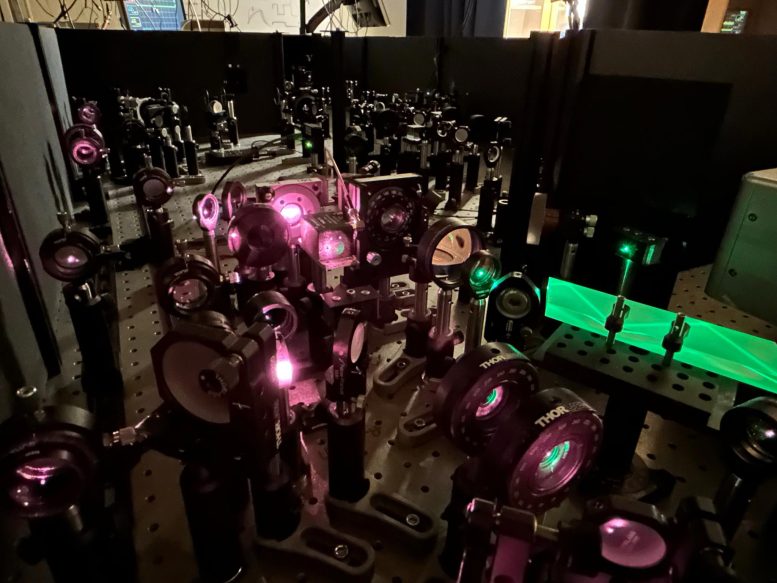
The findings were described recently in the journal Science, in a paper led by MIT postdoctoral associates Charles Roques-Carmes and Yannick Salamin; MIT professors Marin Soljačić and John Joannopoulos; and colleagues.
Computing in a New Light
Conventionally, computers function in a deterministic manner, executing step-by-step instructions that follow a set of predefined rules and algorithms. In this paradigm, if you run the same operation multiple times, you always get the exact same outcome. This deterministic approach has powered our digital age, but it has its limitations, especially when it comes to simulating the physical world or optimizing complex systems, tasks that often involve vast amounts of uncertainty and randomness.

This is where the concept of probabilistic computing comes into play. Probabilistic computing systems leverage the intrinsic randomness of certain processes to perform computations. They don’t just provide a single “right” answer, but rather a range of possible outcomes each with its associated probability. This inherently makes them well-suited to simulate physical phenomena and tackle optimization problems where multiple solutions could exist and where exploration of various possibilities can lead to a better solution.
Overcoming Quantum Challenges
However, the practical implementation of probabilistic computing has been hampered historically by a significant obstacle: the lack of control over the probability distributions associated with quantum randomness. However, the research conducted by the MIT team has shed light on a possible solution.
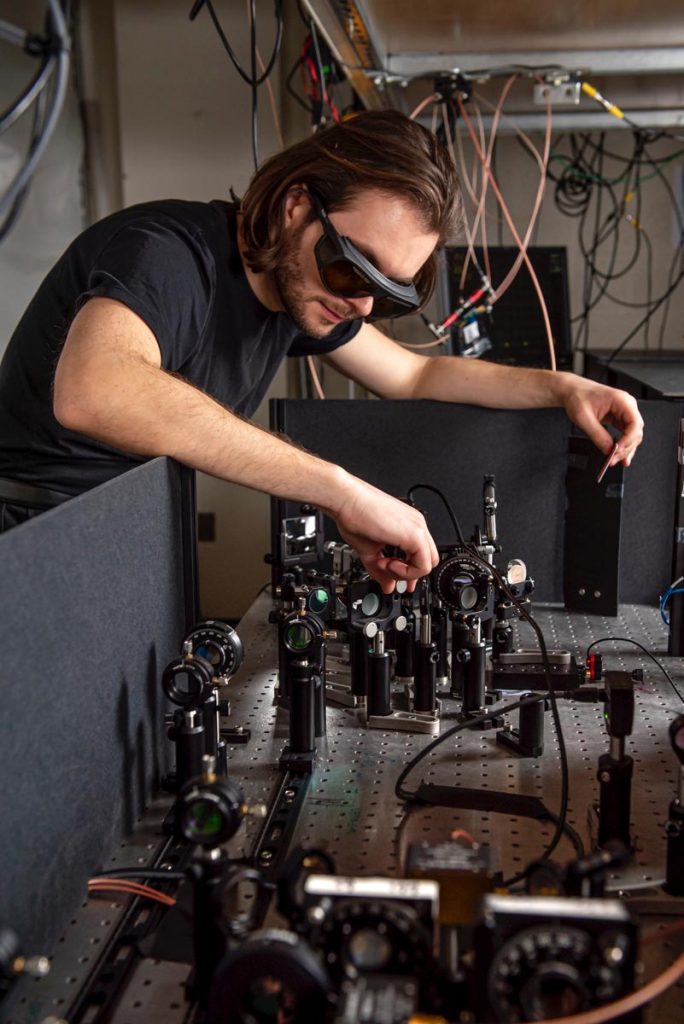
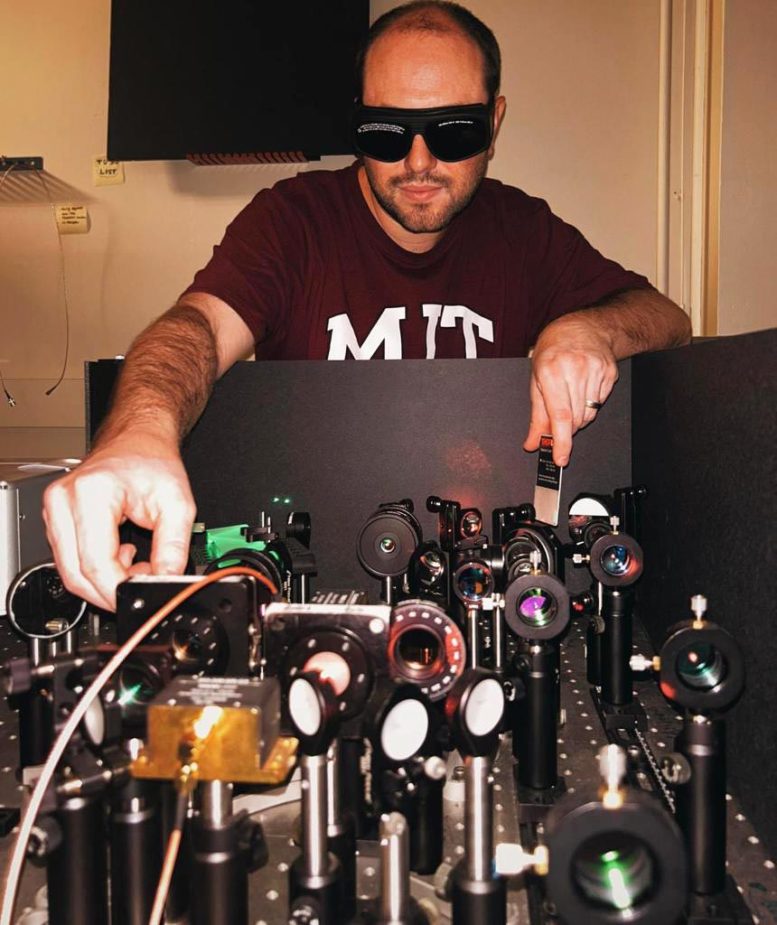
Specifically, the researchers have shown that injecting a weak laser “bias” into an optical parametric oscillator, an optical system that naturally generates random numbers, can serve as a controllable source of “biased” quantum randomness.
“Despite extensive study of these quantum systems, the influence of a very weak bias field was unexplored,” remarks Charles Roques-Carmes, a researcher in the study. “Our discovery of controllable quantum randomness not only allows us to revisit decades-old concepts in quantum optics but also opens up potential in probabilistic computing and ultra-precise field sensing.”
The team has successfully exhibited the ability to manipulate the probabilities associated with the output states of an optical parametric oscillator, thereby creating the first-ever controllable photonic probabilistic bit (p-bit). Additionally, the system has shown sensitivity to the temporal oscillations of bias field pulses, even far below the single photon level.
Future Implications and Prospects
Yannick Salamin, another team member, remarks, “Our photonic p-bit generation system currently allows for the production of 10,000 bits per second, each of which can follow an arbitrary binomial distribution. We expect that this technology will evolve in the next few years, leading to higher-rate photonic p-bits and a broader range of applications.”
Professor Marin Soljačić from MIT emphasizes the broader implications of the work: “By making the vacuum fluctuations a controllable element, we are pushing the boundaries of what’s possible in quantum-enhanced probabilistic computing. The prospect of simulating complex dynamics in areas such as combinatorial optimization and lattice quantum chromodynamics simulations is very exciting.”
Reference: “Biasing the quantum vacuum to control macroscopic probability distributions” by Charles Roques-Carmes, Yannick Salamin, Jamison Sloan, Seou Choi, Gustavo Velez, Ethan Koskas, Nicholas Rivera, Steven E. Kooi, John D. Joannopoulos and Marin Soljačić, 13 July 2023, Science.
DOI: 10.1126/science.adh4920
Never miss a breakthrough: Join the SciTechDaily newsletter.
Follow us on Google and Google News.
2 Comments
That’s great for probabilistic computing, but it’s use as a means of energy management could be even more profound, because not all vacuums are created equal; for example, the frequency of those random fluctuations would less somewhere far deep in space where things such as gravitational fields, etcetera, would not be so intense, than if that vacuum was, let’s say, just out an imaginary event horizon, or the surface of a magnatar; those vacuums would have much higher frequencies, and has already been shown, their associated masses are already entangled, ready for harvest remotely.
This is a whole new world now, to everything, I hope man is ready and doesn’t destroy !!!