
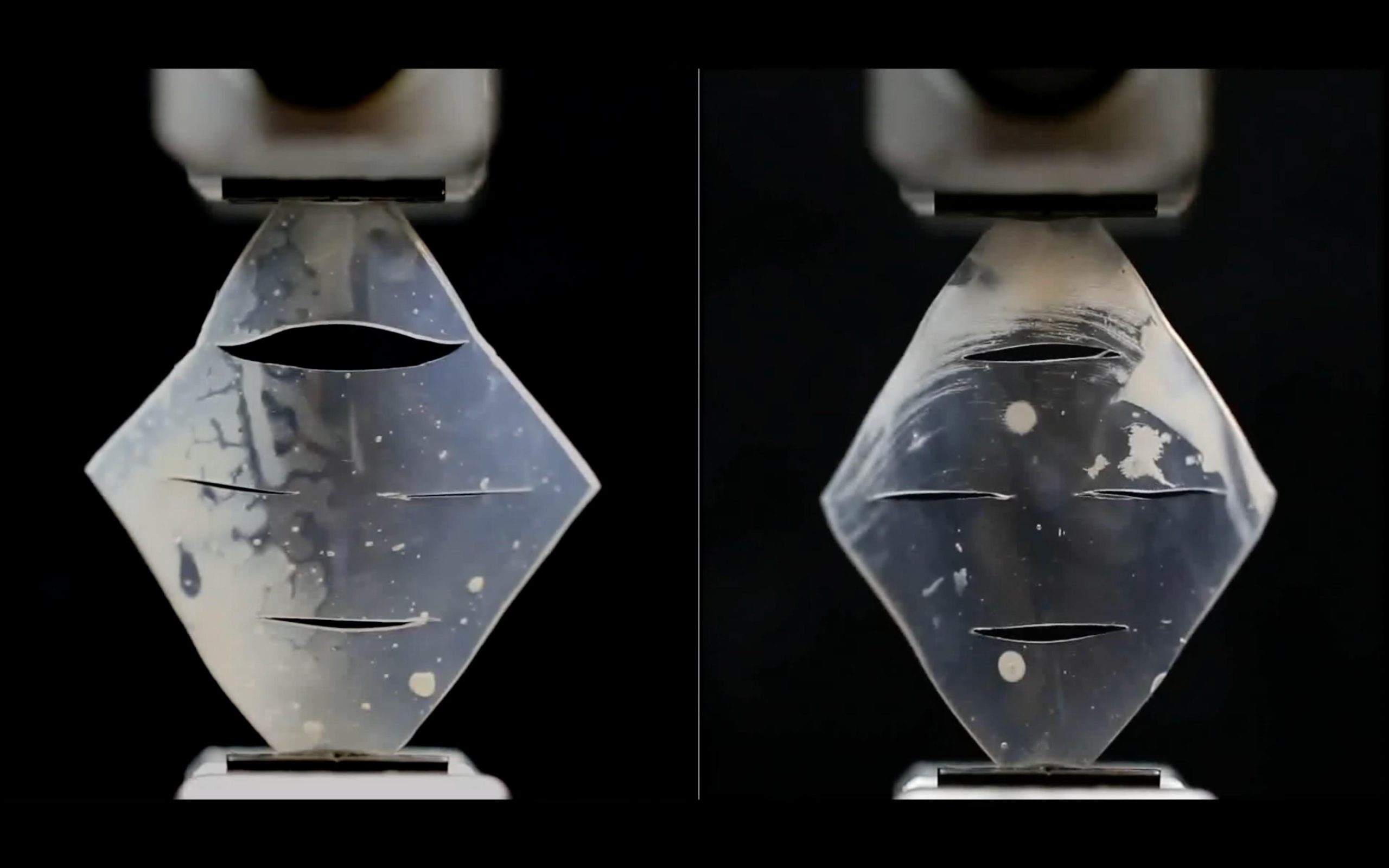
Using a multi-scale approach enhances the fatigue threshold of particle-reinforced rubber.
Scientists at the Harvard John A. Paulson School of Engineering and Applied Sciences (SEAS) have improved the fatigue threshold of particle-reinforced rubber, developing a new, multiscale approach that allows the material to bear high loads and resist crack growth over repeated use. This approach could not only increase the longevity of rubber products such as tires but also reduce the amount of pollution from rubber particles shed during use.
The research is published in Nature.
Improving Particle-Reinforced Rubbers
Naturally occurring rubber latex is soft and stretchy. For a range of applications, including tires, hoses, and dampeners, rubbers are reinforced by rigid particles, such as carbon black and silica. Since their introduction, these particles greatly improve the stiffness of rubbers but not their resistance to crack growth when the material is cyclically stretched, a measurement known as the fatigue threshold.
In fact, the fatigue threshold of particle-reinforced rubbers hasn’t improved much since it was first measured in the 1950s. This means that even with the improvements to tires that increase wear resistance and reduce fuel consumption, small cracks can shed large amounts of rubber particles into the environment, which cause air pollution for humans and accumulate in streams and rivers.
A New Discovery in Rubber Engineering
In previous research, a team led by Zhigang Suo, the Allen E. and Marilyn M. Puckett Professor of Mechanics and Materials at SEAS, markedly increased the fatigue threshold of rubbers by lengthening polymer chains and densifying entanglements. But how about particle-reinforced rubbers?
The team added silica particles to their highly entangled rubber, thinking the particles would increase stiffness but not affect fatigue threshold, as commonly reported in the literature. They were wrong.
“It was quite a surprise,” said Jason Steck, a former graduate student at SEAS and co-first author of the paper. “We did not expect adding particles would increase the fatigue threshold but we discovered that it increased by a factor of ten.” Steck is now a Research Engineer at GE Aerospace.
In the Harvard team’s material, the polymer chains are long and highly entangled, while the particles are clustered and covalently bonded to the polymer chains.
“As it turns out,” said Junsoo Kim, a former graduate student at SEAS and co-first author of the paper, “this material deconcentrates stress around a crack over two length scales: the scale of polymer chains, and the scale of particles. This combination stops the growth of a crack in the material.”
Kim is now an Assistant Professor of Mechanical Engineering at Northwestern University.
Implications and Future Applications
The team demonstrated their approach by cutting a crack in a piece of their material and then stretching it tens of thousands of times. In their experiments, the crack never grew.
“Our approach of multiscale stress deconcentration expands the space of material properties, opening doors to curtailing polymer pollution and building high-performance soft machines,” said Suo, senior author of the study.
“Traditional approaches to design new elastomeric materials missed these critical insights of using multiscale stress deconcentration to achieve high-performance elastomeric materials for broad industrial uses,” said Yakov Kutsovsky, an Expert in Residence at the Harvard Office of Technology Development and co-author of the paper. “Design principles developed and demonstrated in this work could be applicable across a wide range of industries, including high-volume applications such as tires and industrial rubber goods, as well as emerging applications such as wearable devices.”
Reference: “Multiscale stress deconcentration amplifies fatigue resistance of rubber” by Jason Steck, Junsoo Kim, Yakov Kutsovsky and Zhigang Suo, 13 December 2023, Nature.
DOI: 10.1038/s41586-023-06782-2
Kutsovsky previously served as Chief Scientific Officer and Chief Technology Officer at Cabot Corporation for 15 years.
Harvard’s Office of Technology Development has protected the intellectual property associated with this project and is exploring commercialization opportunities.
The research was supported in part by the MRSEC grant DMR-2011754 and by the Air Force Office of Scientific Research under grant FA9550-20-1-0397.
Never miss a breakthrough: Join the SciTechDaily newsletter.
Follow us on Google and Google News.