

A study reveals that the liver acts as a bidirectional hub, exchanging gut-microbiome-derived metabolic products with the heart.
A research team supported by FAPESP and working at Harvard University in the United States has identified a collection of metabolites that move from the intestine to the liver and then reach the heart, which distributes them throughout the body.
These compounds influence key metabolic processes in the liver and affect how the body responds to insulin. According to the authors, the findings could eventually guide new strategies for treating obesity and type 2 diabetes. The study was recently published in the journal Cell Metabolism.
“The hepatic portal vein drains much of the blood from the intestine to the liver. Therefore, it’s the first place to receive products from the gut microbiome. In the liver, they can be conjugated, transformed, or eliminated, and then enter the systemic circulation,” explains Vitor Rosetto Muñoz, first author of the study and postdoctoral researcher at the Ribeirão Preto School of Physical Education and Sports at the University of São Paulo (EEFERP-USP) in Brazil.
“By analyzing the blood leaving the intestine and the peripheral blood circulating throughout the body, we were able to more accurately observe the enrichment of these metabolites derived from the gut microbiome in each location and, consequently, how they can modify hepatic metabolism and metabolic health,” adds Muñoz. He conducted this research during an internship at the Joslin Diabetes Center at Harvard Medical School in the United States with a scholarship from FAPESP under the supervision of researcher Carl Ronald Kahn.
Recent research has increasingly shown that the gut microbiome plays a central role in how genetic factors and environmental influences contribute to metabolic diseases. Studies in both animals and humans have revealed notable differences in gut microbial communities between individuals with and without obesity, type 2 diabetes, glucose intolerance, and insulin resistance.
Identifying Key Metabolites
Although scientists know that the gut microbiome influences metabolic health, it remains challenging to pinpoint which specific bacteria or microbial products drive these effects or how they interact with the intestinal environment.
To explore this question further, the newly published study examined metabolites in the blood of mice that varied in their susceptibility to obesity and diabetes. The researchers collected samples from the hepatic portal vein, which carries blood from the intestine to the liver, and from peripheral blood, which moves from the liver to the heart before circulating throughout the rest of the body.
“Normally, studies tend to look at metabolites present in fecal material or peripheral blood, but they don’t accurately reflect what’s first reaching the tissue of the liver, which is an important metabolic organ linked to different diseases,” says the researcher.
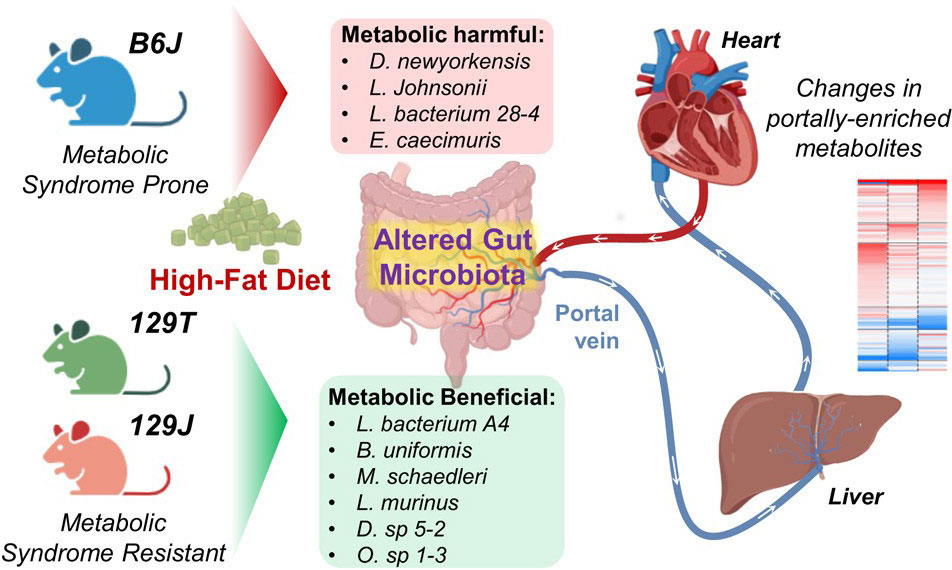
The study found 111 metabolites enriched in the hepatic portal vein and 74 in peripheral blood in healthy mice. However, when mice susceptible to obesity and type 2 diabetes were exposed to a hyperlipidemic diet (rich in fat), the number of metabolites enriched in the hepatic portal vein decreased from 111 to 48. This shows that environmental factors can be decisive in this regulation.
Many of these metabolites differ from those found in blood collected from the same site in a different type of mouse that is resistant to metabolic syndrome. This suggests that the genetic basis is also fundamental in defining the metabolite profile in the hepatic portal vein.
“This shows that both the environment and the host’s genetics can interact in complex ways with the gut microbiome. As a result of these interactions, different combinations of metabolites may be sent to the liver and subsequently to the peripheral circulation. These metabolites likely play an important role in mediating the conditions that lead to obesity, diabetes, and metabolic syndrome,” says Muñoz.
Future
To better understand which bacteria and their byproducts contribute to the production of these metabolites, the researchers treated mice susceptible to obesity and diabetes with an antibiotic that targets specific intestinal microorganisms. As expected, there was a change in the microbiome and the proportion of metabolites in the peripheral blood and hepatic portal vein.
The treatment increased metabolites such as mesaconate, which is linked to the Krebs cycle, an essential metabolic pathway for energy production in cells.
Based on this result, the researchers treated hepatocytes (liver cells) with mesaconate and its isomers – chemical compounds with the same formula but different molecular structures. This treatment improved insulin signaling and regulated genes involved in hepatic fat accumulation (lipogenesis) and fatty acid oxidation – processes that are essential for a healthy metabolism.
“The metabolites found in the blood of these two sites, therefore, play important roles in mediating the effects of the microbiome on liver metabolism and the pathogenesis of type 2 diabetes insulin resistance, which is related to eating a high-fat diet,” says Muñoz.
The researchers are now seeking to better characterize each metabolite and investigate how they are formed. This will improve our understanding of the role of the microbiome in metabolism and may lead to the discovery of molecules that could be used to treat metabolic diseases in the future.
Reference: “Portal vein-enriched metabolites as intermediate regulators of the gut microbiome in insulin resistance” by Vitor Rosetto Muñoz, Francois Moreau, Marion Soto, Yoshiyuki Watanabe, Loc-Duyen Pham, Jimmy Zhong, Sam Zimmerman, Bruna B. Brandao, Khyati Girdhar, Julian Avila, Hui Pan, Jonathan M. Dreyfuss, Michael Y. Mi, Robert E. Gerszten, Emrah Altindis, Aleksandar Kostic, Clary B. Clish and C. Ronald Kahn, 5 September 2025, Cell Metabolism.
DOI: 10.1016/j.cmet.2025.08.005
Funding: São Paulo Research Foundation
Never miss a breakthrough: Join the SciTechDaily newsletter.
Follow us on Google and Google News.
5 Comments
Great research work for humanity
Stop eating the wrong foods(if you can call that food) eat plant based, portion control, use your brain, do your research.
Why in the world would you add a drug to your system, when YOU can change until your own life.
Plant based is where you are going wrong unless you are just referring to natural fruits and vegetables.
Any processed food called “plant based” like all the vegan poison is not food. Its edible poison and should never replace the things nature made. Real meat, real cheese, real diary, and in general real food.
Great research but I don’t understand why you had to say that type 2! Diabetes is due to a high fat diet when in fact eating a low carb diet puts it in remission. That’s bias based on old beliefs with little scientific evidence that has little to do with this research. High caloric diet would have been a better and more accurate comment which would still be unnecessary here. Let the data talk by itself.
I agree. They can’t just lump all fats together by saying “high fat.” Someone who eats natural fats is going to have better health than someone who eats things fried in seed oils. It’s apples and oranges.