
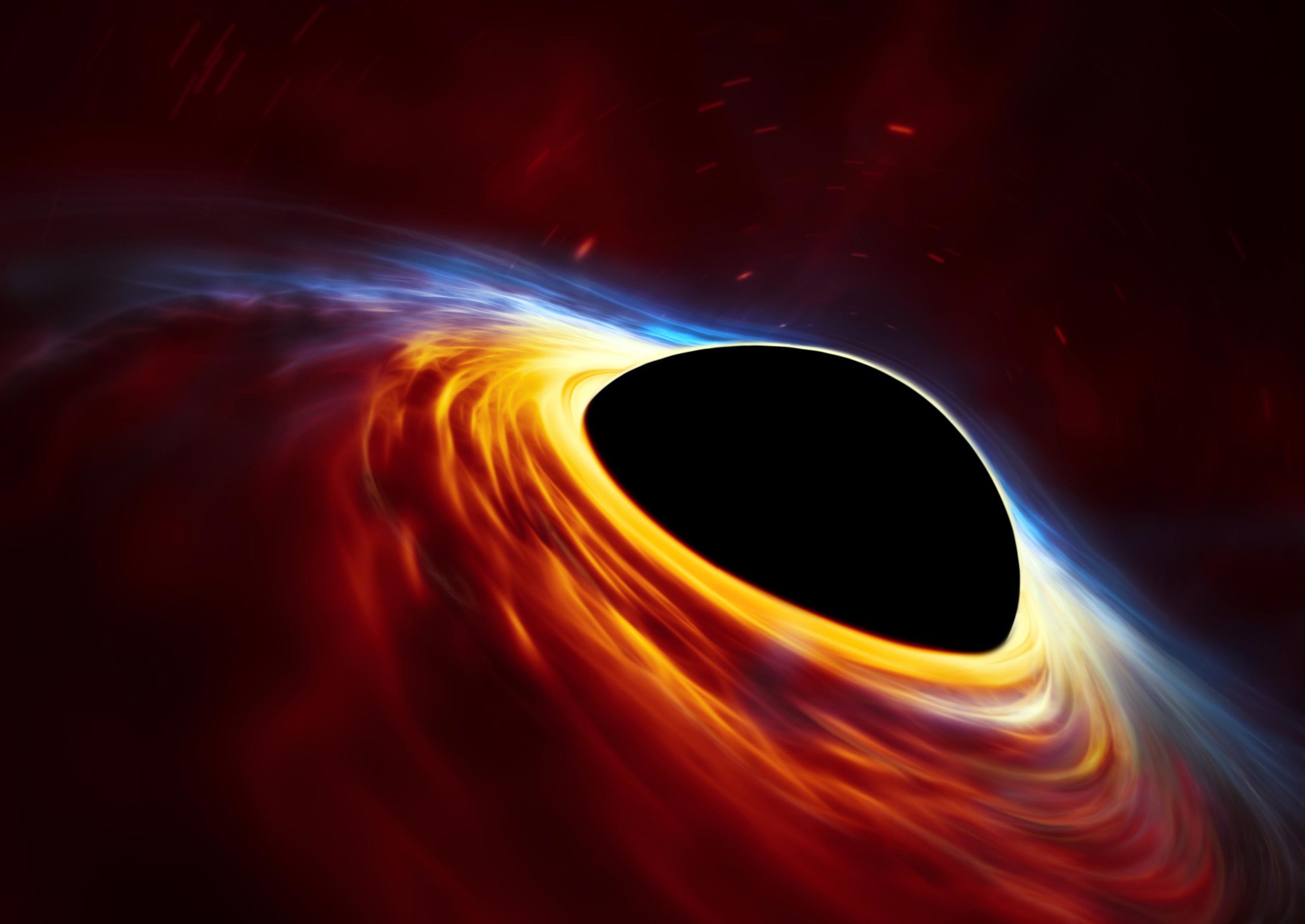
Study adds more certainty to theory involving information paradox.
Black holes really are giant fuzzballs, a new study says.
The study attempts to put to rest the debate over Stephen Hawking’s famous information paradox, the problem created by Hawking’s conclusion that any data that enters a black hole can never leave. This conclusion accorded with the laws of thermodynamics, but opposed the fundamental laws of quantum mechanics.
“What we found from string theory is that all the mass of a black hole is not getting sucked into the center,” said Samir Mathur, lead author of the study and professor of physics at The Ohio State University. “The black hole tries to squeeze things to a point, but then the particles get stretched into these strings, and the strings start to stretch and expand and it becomes this fuzzball that expands to fill up the entirety of the black hole.”
Fuzzball Solution to Hawking’s Paradox
The study, published in the Turkish Journal of Physics, found that string theory almost certainly holds the answer to Hawking’s paradox, as the paper’s authors had originally believed. The physicists proved theorems to show that the fuzzball theory remains the most likely solution for Hawking’s information paradox. The researchers have also published an essay showing how this work may resolve longstanding puzzles in cosmology; the essay appeared in the International Journal of Modern Physics.
Mathur published a study in 2004 that theorized black holes were similar to very large, very messy balls of yarn – “fuzzballs” that become larger and messier as new objects get sucked in.
“The bigger the black hole, the more energy that goes in, and the bigger the fuzzball becomes,” Mathur said. The 2004 study found that string theory, the physics theory that holds that all particles in the universe are made of tiny vibrating strings, could be the solution to Hawking’s paradox. With this fuzzball structure, the hole radiates like any normal body, and there is no puzzle.
After Mathur’s 2004 study and other, similar works, “many people thought the problem was solved,” he said. “But in fact, a section of people in the string theory community itself thought they would look for a different solution to Hawking’s information paradox. They were bothered that, in physical terms, the whole structure of the black hole had changed.”
Revisiting the Wormhole Paradigm
Studies in recent years attempted to reconcile Hawking’s conclusions with the old picture of the hole, where one can think of the black hole as being “empty space with all its mass in the center.” One theory, the wormhole paradigm, suggested that black holes might be one end of a bridge in the space-time continuum, meaning anything that entered a black hole might appear on the other end of the bridge – the other end of the wormhole – in a different place in space and time.
In order for the wormhole picture to work, though, some low-energy radiation would have to escape from the black hole at its edges.
This recent study proved a theorem – the “effective small corrections theorem” – to show that if that were to happen, black holes would not appear to radiate in the way that they do.
The researchers also examined the physical properties from black holes, including topology change in quantum gravity, to determine whether the wormhole paradigm would work.
“In each of the versions that have been proposed for the wormhole approach, we found that the physics was not consistent,” Mathur said. “The wormhole paradigm tries to argue that, in some way, you could still think of the black hole as being effectively empty with all the mass in the center. And the theorems we prove show that such a picture of the hole is not a possibility.”
References:
“Contrasting the fuzzball and wormhole paradigms for black holes” by Bin Guo, Marcel Hughes, Samir Mathur and Madhur Mehta, 28 December 2021, Turkish Journal of Physics.
DOI: 10.55730/1300-0101.1000
“The elastic vacuum” by Samir D. Mathur, 1 July 2021, International Journal of Modern Physics D.
DOI: 10.1142/S0218271821410017
Other Ohio State researchers who worked on this study include Madhur Mehta, Marcel R. R. Hughes and Bin Guo.
Never miss a breakthrough: Join the SciTechDaily newsletter.
Follow us on Google and Google News.
2 Comments
Setting all physical / mathematical models aside, it makes perfect sense that black holes can also give up energy and information. After all, they are not completely isolated from our universe though they are beyond the light speed barrier. They cannot be not truly “black” in every sense as they interact with mass around them thru gravitation. How this works exactly is simply dependent on the mathematical model one devises / picks to model them.
Black holes are just stars. That’s all. Just plain, old stars that haven’t cooled enough to create optical light yet. They are the most powerful stars in the universe which only release gamma rays. That is where the unexplained cosmic and gamma rays come from in our universe. They aren’t optically visible because gamma rays are optically invisible. The only reason they are so confusing is because of the big bang theory which uses gravity to create all the energy we see when, in reality, the energy we see actually came from the pressure and friction from our universe turning itself into a particle collider. That is what the Big Bang was. Nothing more, nothing less. The galaxies are expanding because they are shrapnel and each one was created as one black hole initially. Black holes are made of quark plasma which is invisible and can make shapes. Our galaxy was spinning and used centrifugal force to create a massive disk with a bulbous center. The center separated from the disk and our black hole was formed. The remaining quark plasma disk was left to create all the solar systems exactly the way our galaxy was formed if they were spinning. Black holes are so much simpler than the Big Bang theory has made them out to be. Quark plasma creates all the naturally occurring elements all by itself using the extremely pressurized electron neutrinos of space which is known as dark matter. Quark plasma follows the conservation of energy by turning itself into a rock no different than our moon. That is how minimum entropy matter turns into maximum entropy matter in our universe.