
Close Menu
    Facebook X (Twitter) Instagram
    SciTechDaily
    • Biology
    • Chemistry
    • Earth
    • Health
    • Physics
    • Science
    • Space
    • Technology
    Facebook X (Twitter) Pinterest YouTube RSS
    SciTechDaily
    Home»Space»HD 97300 Lights Up The Surrounding Cosmic Clouds
    Space

    HD 97300 Lights Up The Surrounding Cosmic Clouds

    By European Southern ObservatoryFebruary 10, 20162 Comments3 Mins Read
    Facebook Twitter Pinterest Telegram LinkedIn WhatsApp Email Reddit
    Share
    Facebook Twitter LinkedIn Pinterest Telegram Email Reddit
    ESO Close-up of the Reflection Nebula IC 2631
    Star HD 97300 provides a reflection for Nebula IC 2631. Credit: NASA, ESA, and K. Stapelfeldt (Jet Propulsion Laboratory); Processing; Gladys Kober (NASA/Catholic University of America)

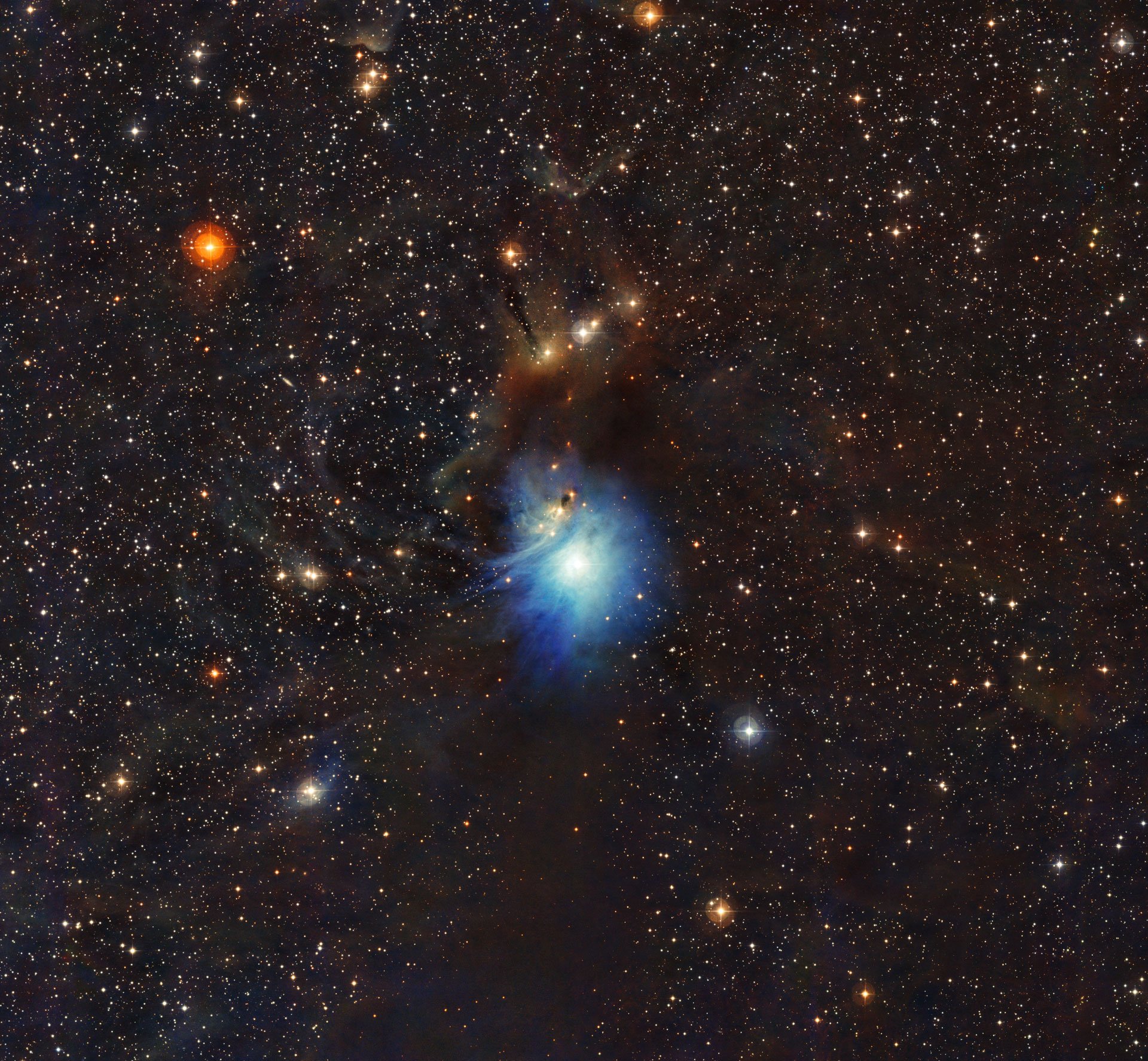
    A newly released image from the La Silla Observatory shows the reflection nebula IC 2631 from the light of star HD 97300.

    A newly formed star lights up the surrounding cosmic clouds in this new image from ESO’s La Silla Observatory in Chile. Dust particles in the vast clouds that surround the star HD 97300 diffuse its light, like a car headlight in enveloping fog, and create the reflection nebula IC 2631. Although HD 97300 is in the spotlight for now, the very dust that makes it so hard to miss heralds the birth of additional, potentially scene-stealing, future stars.

    The glowing region in this new image from the MPG/ESO 2.2-meter (7.2-foot) telescope is a reflection nebula known as IC 2631. These objects are clouds of cosmic dust that reflect light from a nearby star into space, creating a stunning light show like the one captured here. IC 2631 is the brightest nebula in the Chamaeleon Complex, a large region of gas and dust clouds that harbors numerous newborn and still-forming stars. The complex lies about 500 light-years away in the southern constellation of Chamaeleon.

    IC 2631 is illuminated by the star HD 97300, one of the youngest — as well as most massive and brightest — stars in its neighborhood. This region is full of star-making material, which is made evident by the presence of dark nebulae noticeable above and below IC 2631 in this picture. Dark nebulae are so dense with gas and dust that they prevent the passage of background starlight.

    Despite its dominating presence, the heft of HD 97300 should be kept in perspective. It is a T Tauri star, the youngest visible stage for relatively small stars. As these stars mature and reach adulthood they will lose mass and shrink. But during the T Tauri phase, these stars have not yet contracted to the more modest size that they will maintain for billions of years as main sequence stars.


    Close-up of the reflection nebula IC 2631

    These fledging stars already have surface temperatures similar to their main sequence phase and accordingly, because T Tauri-phase objects are essentially jumbo versions of their later selves, they look brighter in their oversized youth than in maturity. They have not yet started to fuse hydrogen into helium in their cores, like normal main sequence stars, but are just starting to flex their thermal muscles by generating heat from contraction.

    Reflection nebula, like the one spawned by HD 97300, merely scatter starlight back out into space. Starlight that is more energetic, such as the ultraviolet radiation pouring forth from very hot new stars, can ionize nearby gas, making it emit light of its own. These emission nebulae indicate the presence of hotter and more powerful stars, which in their maturity can be observed across thousands of light-years. HD 97300 is not so powerful, and its moment in the spotlight is destined not to last.

    Never miss a breakthrough: Join the SciTechDaily newsletter.
    Follow us on Google and Google News.

    Astronomy Cosmology European Southern Observatory Popular
    Share. Facebook Twitter Pinterest LinkedIn Email Reddit

    Related Articles

    Astronomers Discover Unexpectedly Cold Grains in a Planet-Forming Disc

    Detailed Images of the Hypergiant Star VY Canis Majoris

    VISTA Survey Telescope Discovers Massive Galaxies in the Early Universe

    VISTA Telescope Discovers a New Component of Milky Way

    Astronomers Discover VFTS 352 – The Hottest and Most Massive Touching Double Star System to Date

    ESO Image of the Week: A Microlensing Mystery

    GAMA Survey Reveals the Slow Death of the Universe

    VLT/SPHERE Reveal a Star Giving Birth to a Butterfly-Like Planetary Nebula

    ESO Views Star Forming Cloud RCW 34

    2 Comments

    1. Nyanzi Herbert on February 11, 2016 8:42 am

      I Believe in destination

      Reply
    2. Madanagopal.V.C. on February 12, 2016 10:52 pm

      If you consider the galaxies in the LOCAL GROUP where we have Andromeda Nebula, Large Magellanic cloud, Small Magellanic cloud etc., we may also come across several local groups in the neighborhood of other galaxies. Some are in the beginning stage nebulous form like the one shown here , and some are fully formed with stars. But everything will coelesce into one in the future by what is called cannibalization of other nearby galaxies by monster galaxies. Thank You.

      Reply
    Leave A Reply Cancel Reply

    • Facebook
    • Twitter
    • Pinterest
    • YouTube

    Don't Miss a Discovery

    Subscribe for the Latest in Science & Tech!

    Trending News

    Mezcal “Worm” in a Bottle Mystery: DNA Testing Reveals a Surprise

    New Research Reveals That Your Morning Coffee Activates an Ancient Longevity Switch

    This Is What Makes You Irresistible to Mosquitoes

    Shockingly Powerful Giant Octopuses Ruled the Seas 100 Million Years Ago

    Scientists Stunned by New Organic Molecules Found on Mars

    Rewriting Dinosaur Evolution: Scientists Unearth Remarkable 150-Million-Year-Old Stegosaur Skull

    Omega-3 Supplements Linked to Cognitive Decline in Surprising New Study

    First-of-Its-Kind Discovery: Homer’s Iliad Found Embedded in a 1,600-Year-Old Egyptian Mummy

    Follow SciTechDaily
    • Facebook
    • Twitter
    • YouTube
    • Pinterest
    • Newsletter
    • RSS
    SciTech News
    • Biology News
    • Chemistry News
    • Earth News
    • Health News
    • Physics News
    • Science News
    • Space News
    • Technology News
    Recent Posts
    • This New Chip Could Make GPUs Far More Efficient
    • This Tiny World in the Outer Solar System Should Be Airless, but It Has an Atmosphere
    • NASA’s Webb Space Telescope Reveals a Dark Airless Super-Earth That Looks Like Mercury
    • These Simple Daily Habits Can Quickly Improve Blood Pressure and Heart Risk Factors
    • A Common Nutrient May Play a Surprising Role in Anxiety
    Copyright © 1998 - 2026 SciTechDaily. All Rights Reserved.
    • Science News
    • About
    • Contact
    • Editorial Board
    • Privacy Policy
    • Terms of Use

    Type above and press Enter to search. Press Esc to cancel.