
New Tracks Combine Science and Art, Improving Experiences for Blind and Low-Vision Communities
A team of experts, including scientists and musicians, has created a new way to explore the images and data of NASA’s James Webb Space Telescope. The first two tracks map the prismatic landscapes of the Cosmic Cliffs in the Carina Nebula as well as two views of the Southern Ring Nebula. A third track plays the notes of a transmission spectrum, which graphs the atmospheric characteristics of hot gas giant exoplanet WASP-96 b. All of them allow listeners to pick out key features and experience the data in a new way.
NASA Webb’s First Full-Color Images, Data Are Set to Sound
NASA offers a unique, immersive way to explore some of the first full-color infrared images and data from the James Webb Space Telescope – through sound. Listeners can enter the intricate soundscape of the Cosmic Cliffs in the Carina Nebula, explore the contrasting tones of two images that depict the Southern Ring Nebula, and identify the individual data points in a transmission spectrum of WASP-96 b, a hot gas giant exoplanet.
“Music taps into our emotional centers,” said Matt Russo, a musician and physics professor at the University of Toronto. “Our goal is to make Webb’s images and data understandable through sound – helping listeners create their own mental images.”
A team of scientists, musicians, and a member of the blind and visually impaired community worked to adapt Webb’s data, with support from the Webb mission and NASA’s Universe of Learning.
Webb’s Cosmic Cliffs Sonification
Credit: Image: NASA, ESA, CSA, and STScI; Accessibility Production: NASA, ESA, CSA, STScI, and Kimberly Arcand (CXC/SAO), Matt Russo and Andrew Santaguida (SYSTEM Sounds), Quyen Hart (STScI), Claire Blome (STScI), and Christine Malec (consultant).
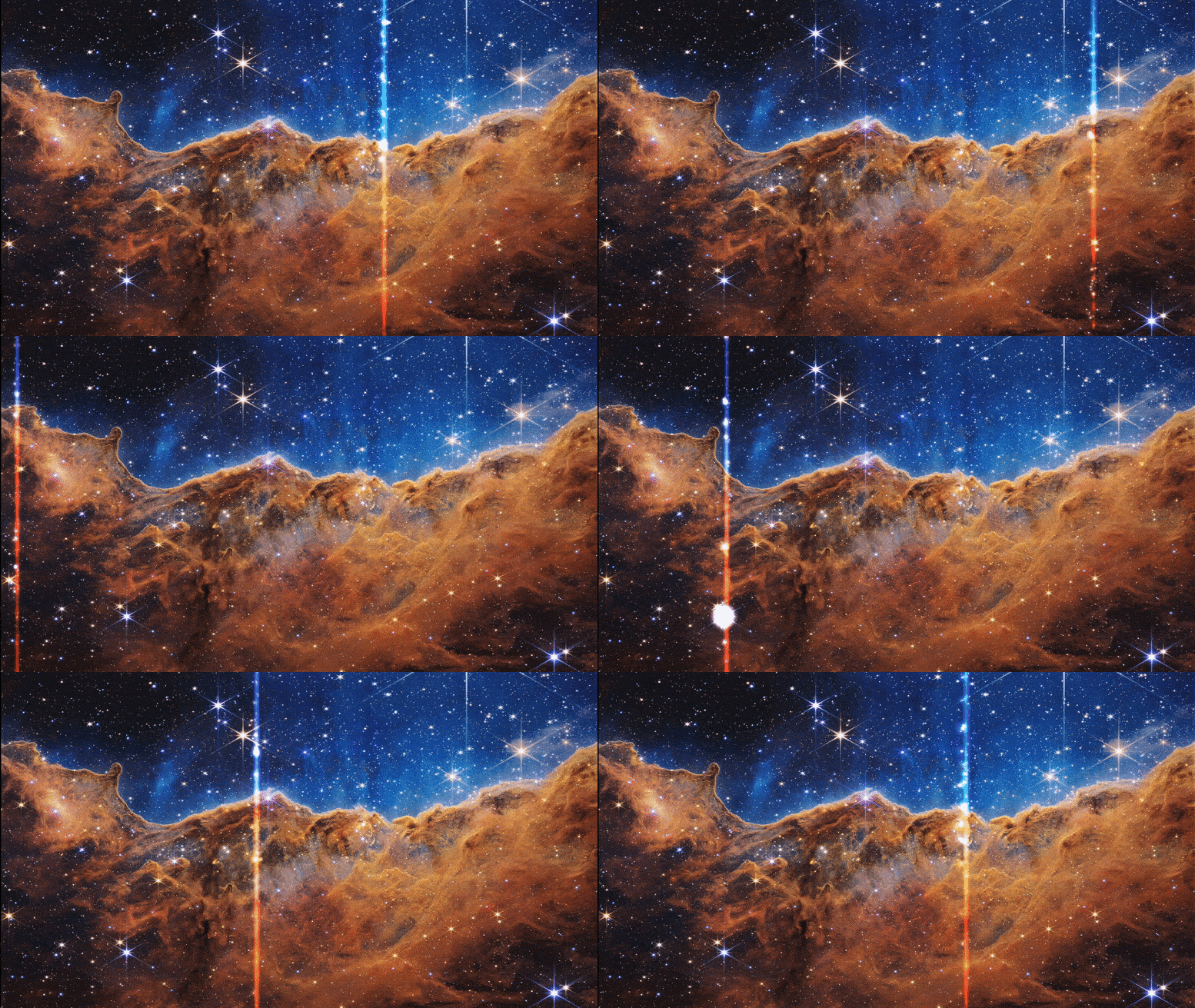
Experts have mapped a near-infrared image of the Cosmic Cliffs in the Carina Nebula, captured by NASA’s Webb Telescope, to a symphony of sounds. Musicians assigned unique notes to the semi-transparent, gauzy regions and very dense areas of gas and dust in the nebula, resulting in a buzzing soundscape.
The sonification scans the image from left to right. Vibrant and full, the soundtrack represents the detail in this gigantic, gaseous cavity that has the appearance of a mountain range. The gas and dust in the top half of the image are represented in blue hues and windy, drone-like sounds. The bottom half of the image, represented in ruddy shades of orange and red, has a clearer, more melodic composition.
Brighter light in the image translates to louder sound. The vertical position of light also dictates the frequency of sound. For example, bright light near the top of the image sounds loud and high, but bright light near the middle is loud and lower pitched. Dimmer, dust-obscured areas that appear lower in the image are represented by lower frequencies and clearer, undistorted notes.
Webb’s Southern Ring Nebula Sonification
Credit: NASA, ESA, CSA, and STScI; Accessibility Production: NASA, ESA, CSA, STScI, and Kimberly Arcand (CXC/SAO), Matt Russo and Andrew Santaguida (SYSTEM Sounds), Quyen Hart (STScI), Claire Blome (STScI), and Christine Malec (consultant).
NASA’s Webb Telescope uncovered two views of the Southern Ring Nebula and each has been adapted to sound. The one on the left (NIRCam) is in near-infrared light and the view on the right (MIRI) is in mid-infrared light.
In this sonification, the colors in the images were mapped to pitches of sound – frequencies of light translated directly to frequencies of sound. Near-infrared light is represented by a higher range of frequencies at the beginning of the track. Mid-way through, the notes change, becoming lower overall to reflect that mid-infrared includes longer wavelengths of light.
Listen carefully at 15 seconds and 44 seconds. These notes align with the centers of the near- and mid-infrared images, where the stars at the center of the “action” appear. In the near-infrared image that begins the track, only one star is heard clearly, with a louder clang. In the second half of the track, listeners will hear a low note just before a higher note, which denotes that two stars were detected in mid-infrared light. The lower note represents the redder star that created this nebula, and the second is the star that appears brighter and larger.
Webb’s Exoplanet WASP-96 b Sonification
Credit: Image: NASA, ESA, CSA, and STScI; Accessibility Production: NASA, ESA, CSA, STScI, and Kimberly Arcand (CXC/SAO), Matt Russo and Andrew Santaguida (SYSTEM Sounds), Quyen Hart (STScI), Claire Blome (STScI), and Christine Malec (consultant).
NASA’s Webb Telescope observed the atmospheric characteristics of the hot gas giant exoplanet WASP-96 b – which contains clear signatures of water. The resulting transmission spectrum’s individual data points were translated into sound.
The sonification scans the spectrum from left to right. From bottom to top, the y-axis ranges from less to more light blocked. The x-axis ranges from 0.6 microns on the left to 2.8 microns on the right. The pitches of each data point correspond to the frequencies of light each point represents. Longer wavelengths of light have lower frequencies and are heard as lower pitches. The volume indicates the amount of light detected in each data point.
The sound of water droplets falling are used to represent the four water signatures. These sounds simplify the data – water is detected as a signature that has multiple data points. The sounds align only to the highest points in the data.
Mapping Data to Sound
Although these audio tracks support blind and low-vision listeners first, they are designed to be captivating to anyone who tunes in. “These compositions provide a different way to experience the detailed information in Webb’s first data. Similar to how written descriptions are unique translations of visual images, sonifications also translate the visual images by encoding information, like color, brightness, star locations, or water absorption signatures, as sounds,” said Quyen Hart, a senior education and outreach scientist at the Space Telescope Science Institute in Baltimore, Maryland. “Our teams are committed to ensuring astronomy is accessible to all.”
“One significant finding was from people who are sighted. They reported that the experience helped them understand how people who are blind or low vision access information differently.”
This project has parallels to the “curb-cut effect,” an accessibility requirement that supports a wide range of pedestrians. “When curbs are cut, they benefit people who use wheelchairs first, but also people who walk with a cane and parents pushing strollers,” explained Kimberly Arcand, a visualization scientist at the Chandra X-ray Center in Cambridge, Massachusetts, who led the initial data sonification project for NASA and now works on it on behalf of NASA’s Universe of Learning. “We hope these sonifications reach an equally broad audience.”
Preliminary results from a survey Arcand led showed that people who are blind or have low vision, and people who are sighted, all reported that they learned something about astronomical images by listening. Participants also shared that auditory experiences deeply resonated with them. “Respondents’ reactions varied – from experiencing awe to feeling a bit jumpy,” Arcand continued. “One significant finding was from people who are sighted. They reported that the experience helped them understand how people who are blind or low vision access information differently.”
It should be noted that these tracks are not actual sounds recorded in space. Rather, Russo and his collaborator, musician Andrew Santaguida, mapped Webb’s data to sound, carefully composing music to accurately represent details the team would like listeners to focus on. In a way, these sonifications can be viewed like modern dance or abstract painting – they convert Webb’s images and data to a new medium to engage and inspire listeners.
Christine Malec, a member of the blind and low vision community who also supports this project, said she experiences the audio tracks with multiple senses. “When I first heard a sonification, it struck me in a visceral, emotional way that I imagine sighted people experience when they look up at the night sky.”
There are other profound benefits to these adaptations. “I want to understand every nuance of sound and every instrument choice, because this is primarily how I’m experiencing the image or data,” Malec continued. Overall, the team hopes that sonifications of Webb’s data help more listeners feel a stronger connection to the universe – and inspire everyone to follow the observatory’s upcoming astronomical discoveries.
As the world’s premier space science observatory, the James Webb Space Telescope will solve mysteries in our solar system, look beyond to distant worlds around other stars, and probe the mysterious structures and origins of our universe and our place in it. Webb is an international program led by NASA with its partners, ESA (European Space Agency) and CSA (Canadian Space Agency).
These sonifications are a result of a collaboration between the James Webb Space Telescope and NASA’s Universe of Learning program. The Chandra X-ray Center (CXC) leads data sonification as NASA’s Universe of Learning partner. Science experts affiliated with the Webb mission provide their expertise on Webb observations, data, and targets.
NASA’s Universe of Learning is part of the NASA Science Activation program, from the Science Mission Directorate at NASA Headquarters. The Science Activation program connects NASA science experts, real content and experiences, and community leaders in a way that activates minds and promotes deeper understanding of our world and beyond. Using its direct connection to the science and the experts behind the science, NASA’s Universe of Learning provides resources and experiences that enable youth, families, and lifelong learners to explore fundamental questions in science, experience how science is done, and discover the universe for themselves.
NASA’s Universe of Learning materials are based upon work supported by NASA under cooperative agreement award number NNX16AC65A to the Space Telescope Science Institute, working in partnership with Caltech/IPAC, Center for Astrophysics | Harvard & Smithsonian, and Jet Propulsion Laboratory.
Never miss a breakthrough: Join the SciTechDaily newsletter.
Follow us on Google and Google News.
1 Comment
Who would have believed, The Cosmos sounds just like Elevator Music.