
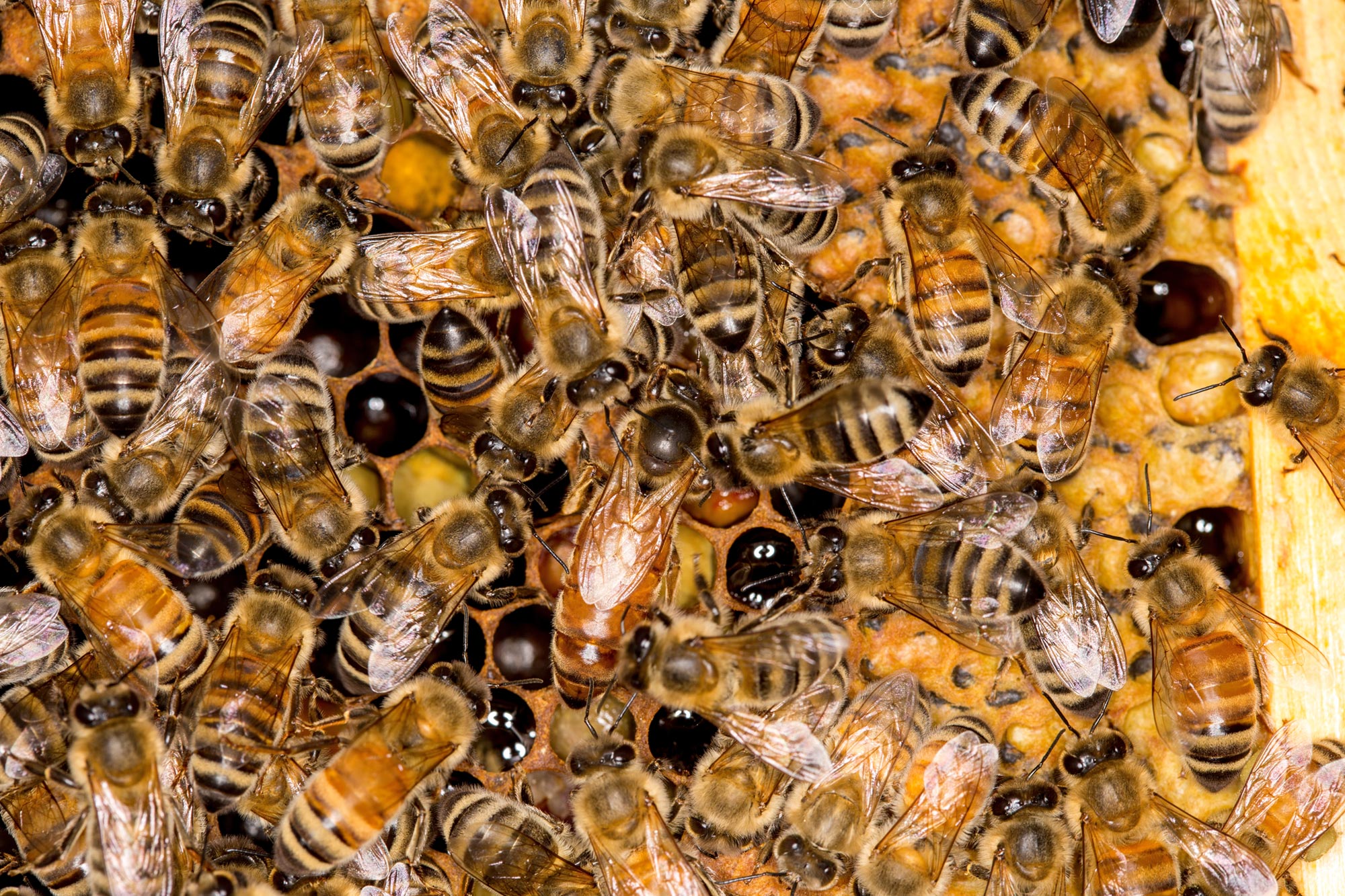
Extreme heat is overwhelming honey bees’ ability to keep their hives cool, leading to population declines.
Honey bees are able to carefully manage the temperature inside their hives, but new research shows that extreme summer heat can overwhelm this ability. A study published in Ecological and Evolutionary Physiology found that prolonged high temperatures can disrupt hive cooling and cause sharp declines in colony populations.
Studying Bees During an Arizona Heat Wave
The research, titled “Negative Effects of Excessive Heat on Colony Thermoregulation and Population Dynamics in Honey Bees,” examined nine honey bee colonies during an unusually hot summer in Arizona. Over a three-month period, outdoor temperatures often rose above 40°C (104°F). The findings suggest that stronger and more frequent heat waves pose a growing danger to honey bees and the pollination services they support around the world.
“Honey bee colonies have well-documented mechanisms to cope with heat exposure,” write authors Jun Chen, Adrian Fisher II, Gloria DeGrandi-Hoffman, Cahit Ozturk, Brian H. Smith, Jennifer H. Fewell, Yun Kang, Kylie Maxwell, Kynadi Overcash, Keerut Chahal, and Jon F. Harrison. “However, there have been no studies to date that have assessed the limits of such thermoregulation or how natural heat waves affect the capacity of honey bees colonies to thermoregulate and grow.”
Large Temperature Swings Inside the Hive
Although the colonies were able to keep average brood temperatures within the ideal 34-36°C range needed for proper development, conditions inside the hives still fluctuated widely each day. Bees developing in the center of the brood experienced about 1.7 hours per day below the optimal range and about 1.6 hours above it.
The situation was much worse near the edges of the brood. In these outer areas, developing bees spent nearly eight hours each day outside the safe temperature range, exposing them to prolonged thermal stress.
Heat Stress Drives Population Declines
These repeated temperature changes had clear impacts on colony health. Colonies exposed to higher peak air temperatures and larger internal temperature swings experienced noticeable drops in population size. The researchers concluded that “excessive heat, with maximal temperatures exceeding 40°C, can reduce colony populations by impairing the thermoregulation of brood or by exposing adults to temperatures that shorten their lifespans.”
Why Colony Size Matters
The study also showed that larger colonies were better protected from heat stress. Bigger hives maintained more stable internal temperatures, while smaller colonies experienced much greater fluctuations. At the outer brood edges, the smallest colonies saw daily temperature swings of up to 11°C, compared with about 6°C in the largest colonies.
Because of this stability, both developing bees and adult workers in larger colonies spent far less time exposed to dangerous temperature extremes.
Climate Change Raises Global Concerns
The researchers warn that the conditions observed in Arizona may become increasingly common. “Climate projections indicate that global average temperatures could rise by approximately 2.7°C by the end of the century, with potential increases up to 4°C under higher emission scenarios,” the authors note. Rising temperatures are expected to increase the frequency and intensity of heat waves worldwide.
Humidity could further worsen the problem. The authors explain that “high humidity significantly reduces the effectiveness of evaporative cooling—the primary mechanism honey bees use to regulate hive temperatures—potentially making thermoregulation even more difficult.”
What This Means for Beekeepers and Agriculture
The findings carry important implications for beekeepers and for agricultural systems that depend on honey bee pollination. The researchers suggest that strategies such as providing supplemental water, placing hives in shaded areas, improving hive design and insulation, and ensuring access to high-quality forage may become increasingly necessary. These steps could help protect colonies from rising temperatures and support long-term stability in a warming climate.
Reference: “Negative Effects of Excessive Heat on Colony Thermoregulation and Population Dynamics in Honeybees” by Jun Chen, Adrian Fisher II, Gloria DeGrandi-Hoffman, Cahit Ozturk, Brian H. Smith, Jennifer H. Fewell, Yun Kang, Kylie Maxwell, Kynadi Overcash, Keerut Chahal and Jon F. Harrison, 8 January 2026, Ecological and Evolutionary Physiology.
DOI: 10.1086/739493
Never miss a breakthrough: Join the SciTechDaily newsletter.
Follow us on Google and Google News.
3 Comments
“Honey bees likely originated in eastern tropical Africa and spread to Europe and Asia.”
Might it be that introducing honey bees to the Sonora Desert is pushing the limits of their adaptation? That is, it is a situation not so much of rapid climate change as it is pushing the limits of what bees can tolerate when introduced to areas that have temperature extremes untypical of what they have experienced for the last 5,000 years. In any event, the article does not provide evidence for the temperatures increasing significantly in recent years, only an assertion.
I understand Florida and Georgia may get snow this weekend. I suggest shipping the bees there.
Wait, I thought colony collapse was the end. Many great articles on this site but many also are just grants that got spent on bar tabs and they have to publish something. I know, here in NYC, we’re overwhelmed with honey bees. City Island, in the bushes and the meadows, they’re all over.
Just not buying many predictions anymore.