

Visceral fat has been linked to early Alzheimer’s disease pathology, according to a study of midlife individuals.
Researchers found this fat significantly increases amyloid and tau protein accumulation, which are precursors to Alzheimer’s symptoms. The study also highlighted insulin resistance and low HDL as contributing factors.
Early Connections Between Body Fat and Alzheimer’s Disease
Scientists have discovered a connection between a specific type of body fat and the buildup of abnormal brain proteins associated with Alzheimer’s disease—up to 20 years before any symptoms of dementia appear. This finding, presented at the annual meeting of the Radiological Society of North America (RSNA), highlights the potential for lifestyle changes aimed at reducing this fat to influence Alzheimer’s risk.
“This crucial result was discovered because we investigated Alzheimer’s disease pathology as early as midlife—in the 40s and 50s—when the disease pathology is at its earliest stages, and potential modifications like weight loss and reducing visceral fat are more effective as a means of preventing or delaying the onset of the disease,” explained Mahsa Dolatshahi, M.D., M.P.H., a post-doctoral research associate at the Mallinckrodt Institute of Radiology at Washington University School of Medicine and lead author of the study.
Alarming Alzheimer’s Projections
An estimated 6.9 million Americans, aged 65 and older, are living with Alzheimer’s disease, according to the Alzheimer’s Association. The association estimates this number could grow to 13 million by 2050, barring the development of medical breakthroughs to prevent or cure the disease.
For the study, the researchers focused on the link between modifiable lifestyle-related factors, such as obesity, body fat distribution and metabolic aspects, and Alzheimer’s disease pathology.
A total of 80 cognitively normal midlife individuals (average age: 49.4 years, female: 62.5%,) were included in the study. Approximately 57.5% of participants were obese, and the average body mass index (BMI) of the participants was 32.31. The participants underwent brain positron emission tomography (PET), body MRI and metabolic assessment (glucose and insulin measurements), as well as a lipid (cholesterol) panel. MRI scans of the abdomen were performed to measure the volume of the subcutaneous fat (the fat under skin) and visceral fat (deep hidden fat surrounding the organs).
Visceral Fat and Alzheimer’s Pathology
“We investigated the association of BMI, visceral fat, subcutaneous fat, liver fat fraction, thigh fat and muscle, as well as insulin resistance and HDL (good cholesterol), with amyloid and tau deposition in Alzheimer’s disease,” said Dr. Dolatshahi, a member of the Raji Lab at MIR’s Neuroimaging Labs Research Center.
Thigh muscle scans were used to measure the volume of muscle and fat. Alzheimer’s disease pathology was measured using PET scans with tracers that bind to amyloid plaques and tau tangles that accumulate in the brains of people with Alzheimer’s disease.
Distinctive Role of Visceral Fat
The findings revealed that higher levels of visceral fat were related to increased amyloid, accounting for 77% of the effect of high BMI on amyloid accumulation. Other types of fat did not explain obesity-related increased Alzheimer’s pathology.
“Our study showed that higher visceral fat was associated with higher PET levels of the two hallmark pathologic proteins of Alzheimer’s disease—amyloid and tau,” Dr. Dolatshahi said. “To our knowledge, our study is the only one to demonstrate these findings at midlife where our participants are decades out from developing the earliest symptoms of the dementia that results from Alzheimer’s disease.”
Insights on Metabolism and Lipid Profiles
The study also showed that higher insulin resistance and lower HDL were associated with high amyloid in the brain. The effects of visceral fat on amyloid pathology were partially reduced in people with higher HDL.
“A key implication of our work is that managing Alzheimer’s risk in obesity will need to involve targeting the related metabolic and lipid issues that often arise with higher body fat,” said senior study author Cyrus A. Raji, M.D., Ph.D., associate professor of radiology at MIR.
Novel Focus on Fat Types
Although previous studies have shown the role of high BMI in damaging the cells of the brain, no similar study has investigated the differential role of visceral and subcutaneous fat or metabolic profile, especially in terms of Alzheimer’s amyloid pathology as early as midlife, Dr. Dolatshahi pointed out.
“This study goes beyond using BMI to characterize body fat more accurately with MRI and, in so doing, reveals key insights about why obesity can increase risk for Alzheimer’s disease,” Dr. Dolatshahi said.
Blood Flow and Obesity Impacts
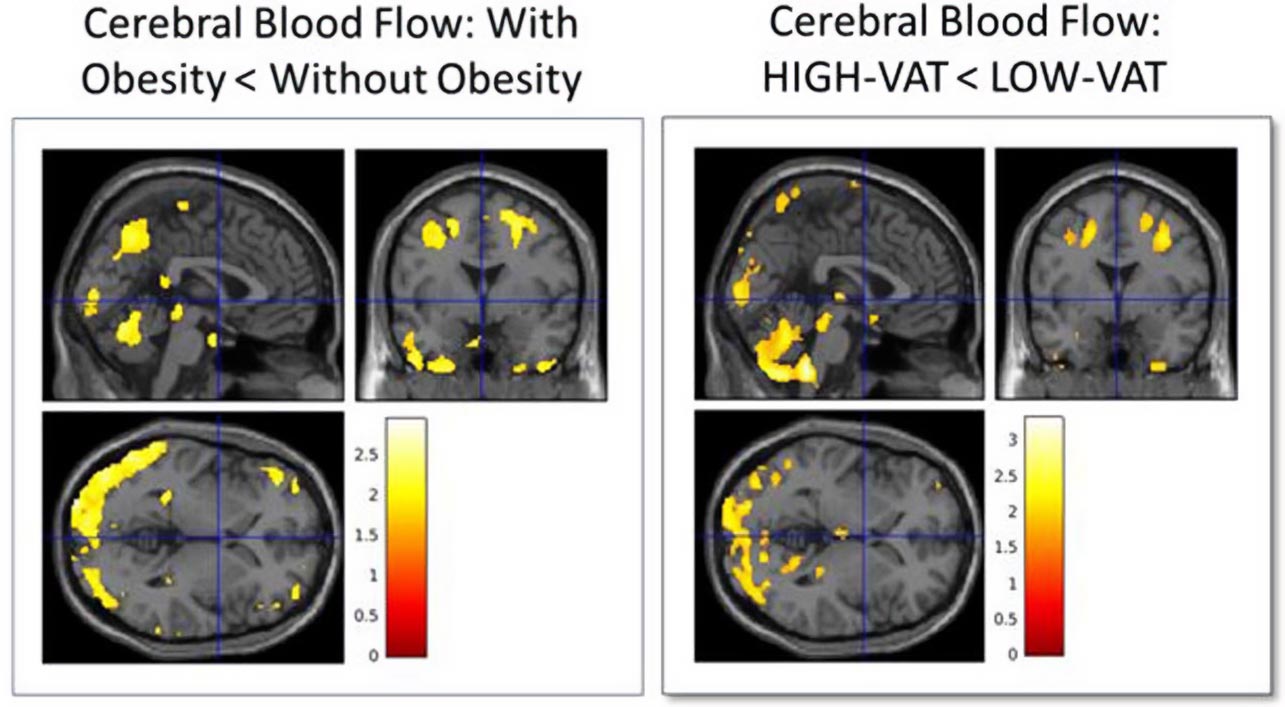
Drs. Raji, Dolatshahi, and colleagues are also presenting a study at RSNA 2024 that shows how obesity and visceral fat reduce blood flow in the brain.
In that study, the researchers performed brain and abdominal MRI on cognitively normal midlife individuals with a wide range of BMI and compared whole-brain and regional cerebral blood flow on brain MRI in individuals with high vs. low visceral and subcutaneous fat. The high visceral fat group showed lower whole-brain blood flow. No significant difference was observed in cerebral blood flow in the groups with high vs. low subcutaneous fat.
Public Health Implications
“This work will have a considerable impact on public health because nearly three out of four Americans are overweight or obese,” Dr. Raji said. “Knowing that visceral obesity negatively affects the brain opens up the possibility that treatment with lifestyle modifications or appropriate weight-loss drugs could improve cerebral blood flow and potentially lower the burden of and reduce the risk for Alzheimer’s disease.”
Meeting: 110th Scientific Assembly and Annual Meeting of the Radiological Society of North America
Other co-authors are Paul K. Commean, B.E.E., Mahshid Naghashzadeh, M.S., Sara Hosseinzadeh Kassani, Ph.D., Jake Weeks, B.S., Caitlyn Nguyen, B.S., Abby McBee-Kemper, B.S., Nancy Hantler, B.S., LaKisha Lloyd, M.Sc., Shaney Flores, M.S., Yifei Xu, M.S., Jingxia Liu, Ph.D., Claude B. Sirlin, M.D., Bettina Mittendorfer, Ph.D., Joseph E. Ippolito, M.D., Ph.D., John C. Morris, M.D., and Tammie L.S. Benzinger, M.D., Ph.D. This study was awarded the RSNA Trainee Research Prize.
Never miss a breakthrough: Join the SciTechDaily newsletter.
Follow us on Google and Google News.
1 Comment
Let’s stop pretending that statistical studies like this are useful for anything more than finding interesting questions that need to be studied much further. Visceral fat may just be statistical noise here – it was an underpowered study of 80 people.
What were the actual cellular mechanisms of the supposed connection? How could losing visceral fat change those cellular mechanisms? How does this explain the many thin people who have Alzheimers? Why do thin people develop Alzheimers if it is caused by obesity? They couldn’t say, they didn’t study that. They were hunting for a statistical correlation between body weight and Alzheimers and (what a surprise) they found one – but until you can describe the actual cellular-level mechanisms involved, studies like this can’t support the conclusions the researchers came to, since something else entirely may be powering both the Alzheimers increase and the differences in visceral fat, if those turn out to be real.