
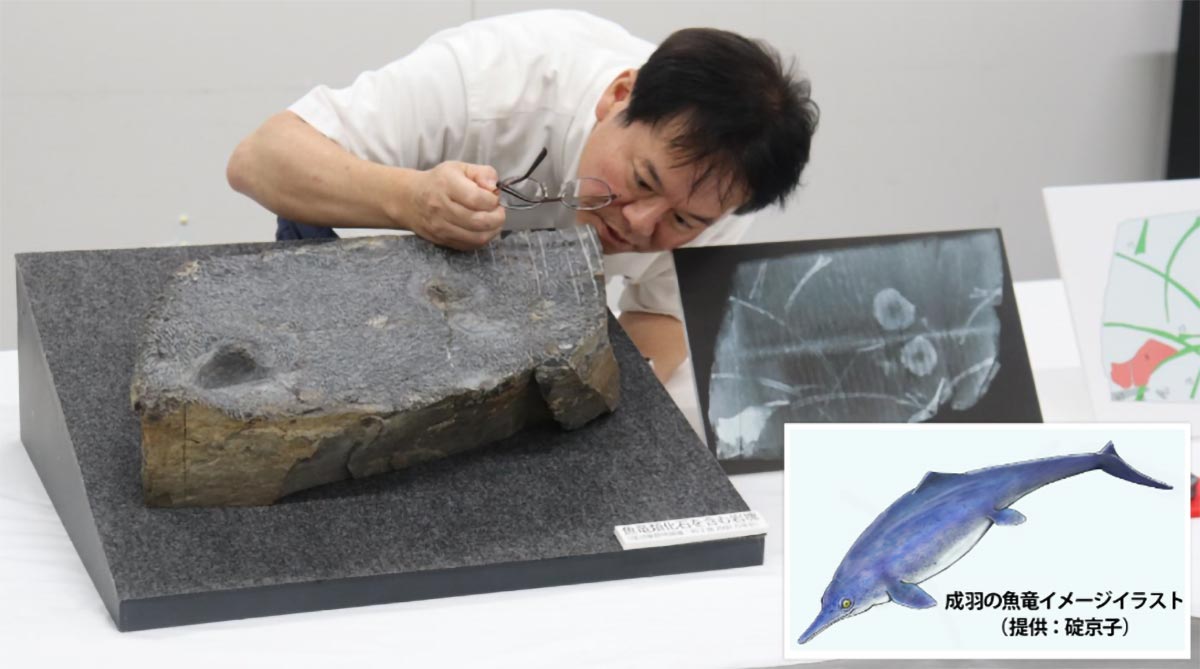
Ichthyosaur fossil confirmed for the first time in western Japan — also marks Japan’s first discovery of a Late Triassic ichthyosaur.
Researchers have confirmed that a fossil discovered in Takahashi City, Okayama Prefecture, is the first ichthyosaur ever found in western Japan. The fossil, embedded in rock from the Late Triassic period (about 220 million years ago), was verified through collaborative research by Okayama University of Science and other institutions.
The finding was formally announced by Professor Takafumi Kato of the Department of Dinosaur Paleontology during the Paleontological Society of Japan’s annual meeting at Hokkaido University on June 29. This is the first time an ichthyosaur has been identified in Japanese geological layers from this particular era. Paleontologists specializing in ichthyosaurs have highlighted the rarity of such fossils, describing specimens from this time period as “exceptionally rare worldwide.”
The fossil was encased in a block of muddy sandstone that measures 59 centimeters wide, 34.5 centimeters deep, and 26 centimeters high. For years, the rock had been displayed at the Nariwa Museum of Art in Takahashi City, where it was believed to be a fossil of Monotis, a bivalve commonly used as a marker fossil for the Late Triassic. Museum records indicate that the rock was part of the collection even before the museum’s renovation in 1994 and had originated from Takahashi.
The turning point came on July 26, 2023, when Professor Kato was leading a hands-on educational program for middle and high school students. While giving a lecture in the museum’s fossil gallery, he and his longtime colleague Dr. Hirokazu Yukawa from the Fukui Prefectural Dinosaur Museum took a closer look at the rock. It was then that they spotted a large bone fragment embedded in the stone. “Wait—that’s a bone!” Kato exclaimed. A more detailed examination revealed a porous, spongy interior surrounded by a thin layer of compact bone—anatomical features typical of reptiles adapted to life in the sea. Drawing on his background in paleontology, Kato immediately recognized the fossil’s potential significance.
Advanced Analysis Confirms Identity
Wondering how much fossil material was inside, the team cut a 14 cm-thick slab from the rock and examined it using a CT scanner at the University of Fukui’s School of Medical Sciences. They confirmed 21 bone fragments, including ribs, vertebrae, and a scapula. Their analysis revealed four distinct characteristics:
- The vertebrae were thin and had a distinctive hourglass shape.
- Each vertebra featured two rib articulation surfaces.
- The ribs were grooved and had a gourd-shaped cross-section.
- The scapula was slender and constricted in the middle.
These features led the team to conclude that the fossil belonged to an ichthyosaur.
Until now, all ichthyosaur fossils discovered in Japan—including Utatsu Gyoryu (Utatsusaurus) from the Early Triassic, Kudanohama Gyoryu (Mixosaurus) from the Middle Triassic, and Hosoura Gyoru (Leptopterygius) from the Early Jurassic—had been found in Minamisanriku, Miyagi Prefecture.

Commenting on the discovery, Dr. Ryosuke Motani, a leading authority on ichthyosaurs from the University of California, Davis, stated: “The Norian age represents a critical transition in ichthyosaur evolution, when open-ocean species were nearly fully developed from their coastal ancestors. However, ichthyosaur fossils from this era are extremely rare globally, with well-preserved examples only known from British Columbia, Canada. The fact that one has now been found in Japan suggests that these advanced ichthyosaurs may have been capable of crossing the Panthalassic Ocean, which was even larger than today’s Pacific. This is a highly significant finding.”
The Norian is a stage of the Late Triassic spanning approximately 227 to 206 million years ago. The Panthalassic Ocean was the massive global ocean that surrounded the supercontinent Pangaea during that time.
Local Impact and Scientific Significance
Before the academic presentation, a press conference was held at Takahashi City Hall. Among those present were Mayor Yoshio Ishida, Professor Kato, Dr. Yukawa, and Nariwa Museum of Art curator Kyoko Ikari. Mayor Ishida expressed his enthusiasm for the discovery, stating, “We’re hopeful that continued research will lead to even more findings. We see this discovery as an opportunity to stimulate regional revitalization and public interest.”
Professor Kato emphasized the importance of the museum’s role in preserving local specimens and serving as an educational resource. “This discovery was made possible because the Nariwa Museum of Art has continuously maintained and managed regional materials, and because it functioned as an educational platform,” he noted. Speaking about the fossil itself, he added, “The shape of the scapula is particularly telling. It may indicate a high swimming ability, though further detailed analysis is needed. In any case, this fossil will serve as a valuable clue in understanding ichthyosaur evolution.”
Reflecting on the moment of discovery, he shared: “I’ve made it a habit to look at rocks and fossils from different angles, always thinking, ‘Is there something more here?’ After doing this for over 40 years, this is the first time I’ve stumbled upon something like this. It was truly an unforgettable moment.”
The ichthyosaur fossil is scheduled to be on display for about a month at the Nariwa Museum of Art during the summer break. It is expected to be a valuable educational tool, helping children learn about both Earth’s profound history and their local heritage.
Never miss a breakthrough: Join the SciTechDaily newsletter.
Follow us on Google and Google News.