
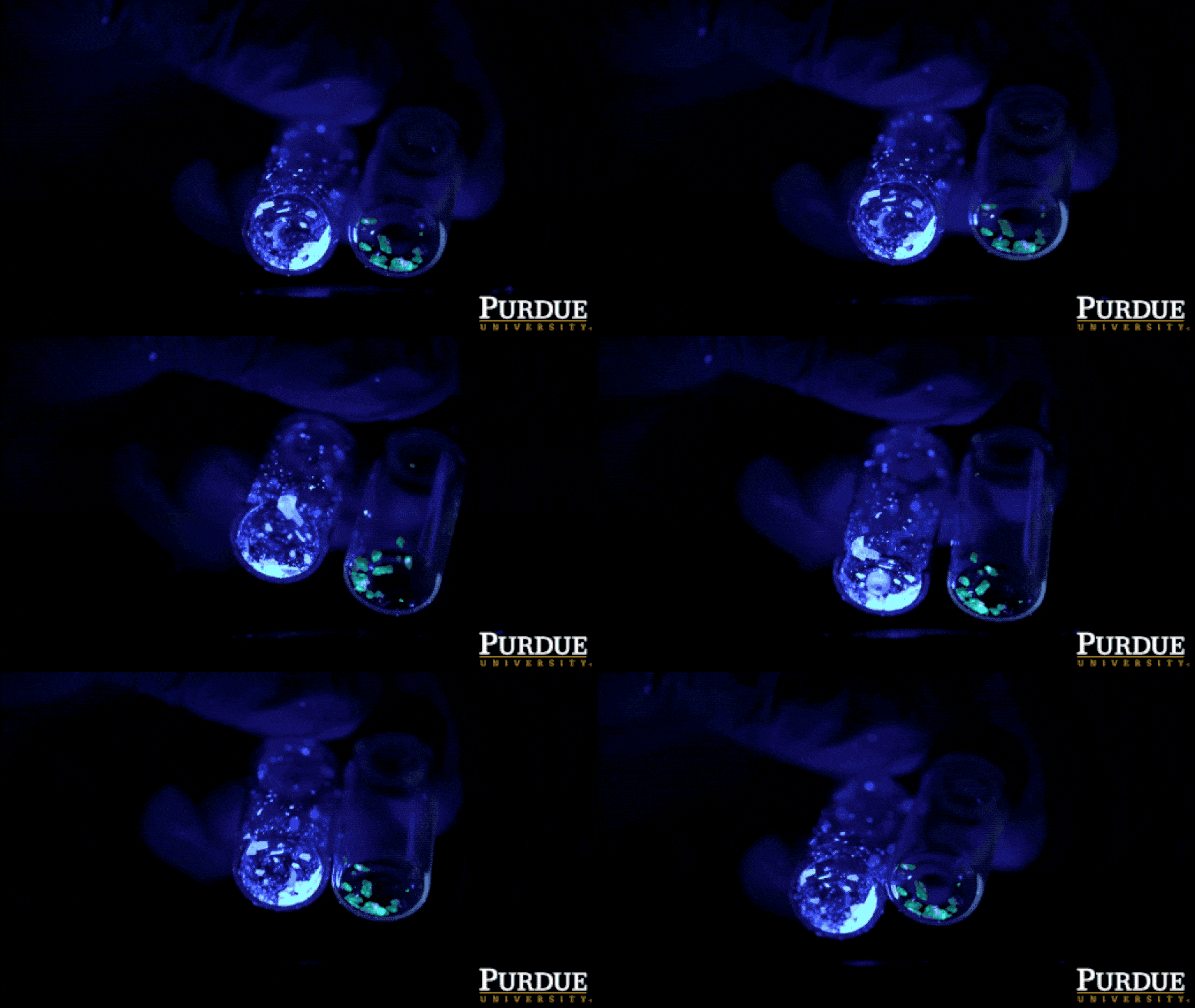
A new type of material for next-generation solar cells eliminates the need to use lead, which has been a major roadblock for this technology.
Solar cells, incorporating the mineral perovskite, have been the focus of attention since the material was first shown to work in 2009. Solar cells that are built using this material are more efficient than current solar panels. Current solar panels capture 15% to 18% of the solar energy on average, while perovskite solar cells have been found to be as much as 28% efficient.
But there are major obstacles to using these materials commercially: The materials are not stable, and they contain water-soluble lead, which is a health hazard.
Now a team of scientists and engineers led by Letian Dou, assistant professor of chemical engineering at Purdue University, have developed a sandwich-like material incorporating organic and inorganic materials to form a hybrid structure that doesn’t use lead and has much improved stability.
“These structures are very exciting,” Dou said. “The sandwich structures are like semiconductor quantum wells that are widely used today in many electronic and optoelectronic devices, but they are much easier to produce and more tolerant to defects,”
The research was published Monday (November 11, 2019) in the journal Nature Chemistry.
In a paper published in the Journal of the American Chemical Society in September, the scientists had incorporated the material into an essential component of many electronic devices, a field effect transistor.
Yao Gao, the lead author of both research papers and a postdoctoral fellow in Dou’s research group, said the new organic-inorganic hybrid perovskite materials are cheaper and perform better than a traditional inorganic semiconductor. Also, Gao said, the new material’s design strategy could serve as a blueprint for many other functional hybrid materials.
“Solar cells, as many people have demonstrated, can be highly efficient,” he said. “With our new technology, we can make the hybrid perovskite materials intrinsically more stable. By replacing the toxic lead, these new materials are better for the environment and can also be safely used for bioelectronics sensors on the body.”
###
Reference: “Molecular engineering of organic–inorganic hybrid perovskites quantum wells” by Yao Gao, Enzheng Shi, Shibin Deng, Stephen B. Shiring, Jordan M. Snaider, Chao Liang, Biao Yuan, Ruyi Song, Svenja M. Janke, Alexander Liebman-Peláez, Pilsun Yoo, Matthias Zeller, Bryan W. Boudouris, Peilin Liao, Chenhui Zhu, Volker Blum, Yi Yu, Brett M. Savoie, Libai Huang and Letian Dou, 11 November 2019, Nature Chemistry.
DOI: 10.1038/s41557-019-0354-2
A patent for this technology has been filed through the Purdue Research Foundation Office of Technology Commercialization. This work is supported by the U.S. Office of Naval Research (award N00014-19-1- 2296) and Purdue’s Davidson School of Chemical Engineering and Purdue’s Discovery Park Birck Nanotechnology Center.
ABSTRACT
Molecular Engineering of Organic-Inorganic Hybrid Perovskites Quantum Wells
Yao Gao, Enzheng Shi, Shibin Deng, Stephen B. Shiring, Jordan M. Snaider, Chao Liang, Biao Yuan, Ruyi Song, Svenja M. Janke, Alexander Liebman-Peláez, Pilsun Yoo, Matthias Zeller, Bryan W. Boudouris, Peilin Liao, Chenhui Zhu, Volker Blum, Yi Yu, Brett M. Savoie, Libai Huang, Letian Dou
Purdue University, ShanghaiTech University, Duke University, Lawrence Berkeley National Laboratory
Semiconductor quantum well and superlattices are key building blocks in modern optoelectronics, but it is difficult to simultaneously realize defect-free epitaxial growth and fine-tuning of the chemical composition, layer thickness, and band structure of each layer to achieve the desired performance. Here, we demonstrate the modulation of the electronic structure, and consequently the optical properties, of organic semiconducting building blocks incorporated between the layers of perovskites through a facile solution-processing step. The strong self-aggregation of the conjugated organic molecules can be suppressed by functionalization with sterically demanding groups, and single-crystalline organic-perovskite hybrid quantum wells (down to one-unit-cell thick) are obtained. The energy and charge transfers between adjacent organic and inorganic layers were shown to be fast and efficient, owing to the atomically flat interface and ultra-small interlayer distance of the perovskite materials. The resulting 2D hybrid perovskites are very stable, owing to the protection of the bulky hydrophobic organic groups.
Never miss a breakthrough: Join the SciTechDaily newsletter.
Follow us on Google and Google News.